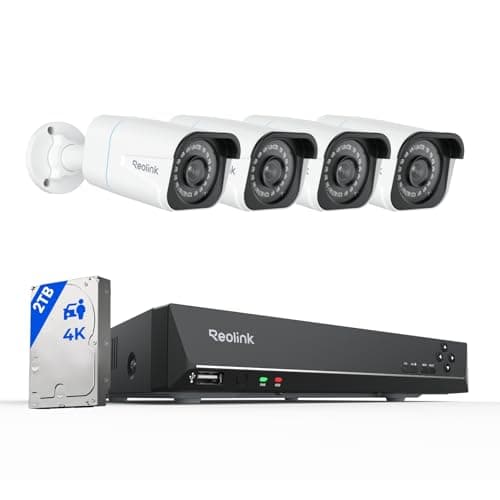
“Security camera without Wi-Fi” is really three different questions wearing one phrase, and the right camera depends on which one you are asking. Some people have no broadband at the property at all. Some have broadband and do not want a camera on it, usually because they do not want footage leaving the house. And some have a building the router cannot reach. The first two want what is on this page. The third wants a different page, and we link it below.
What “works without Wi-Fi” has to mean
A camera does three things: it captures, it stores, and it lets you look at what it stored. Most consumer cameras only do the first one locally. Storage and review both route through the maker's cloud, which is why pulling the plug on the internet turns a $200 camera into a status light. A camera genuinely independent of the internet has to do all three inside the building, and that means a recorder or a card, plus a way to look at the recording that does not involve a phone app phoning home.
This is why the page is almost entirely wired cameras. A battery camera with a microSD card does keep capturing and storing with the internet down — but to review the footage you pair with it over Bluetooth or local Wi-Fi, or you climb up and take the card out. That is a camera that survives an outage, not a camera designed for a property with no connection. A PoE camera into a recorder is designed for exactly that: the recorder has a monitor output, you plug in a screen and a mouse, and you scrub through the timeline with no network of any kind.
No internet does not mean no network.PoE cameras still speak Ethernet, and the switch or the recorder is still a network — a closed one, with nothing routed out of it. That distinction is the whole trick: you get the reliability and the searchable timeline of a networked system with none of the exposure. The explainer, with the mechanism in full, is do security cameras work without Wi-Fi.
How we ranked them
Independence from the internet first: can you record, retain and review with nothing online. Then whether the camera also keeps a copy locally on its own card, because a camera with onboard storage keeps recording when the recorder or the switch goes down. Then openness — published RTSP and ONVIF support, which is what lets a camera be pointed at recording software you chose rather than only at the vendor's box. Image quality after that. The rubric is at our methodology and is compiled from manufacturer documentation rather than from testing.
Compiled from manufacturer specifications and published RTSP/ONVIF documentation, October 2026. “Review with no internet” is how you actually watch back footage with nothing online.| Camera | Power and data | Records to | Review with no internet | Open stream |
|---|
| Reolink 8CH 4K PoE system + NVR | PoE from the NVR | Included 2TB drive | Monitor on the recorder | Yes (Reolink RTSP/ONVIF) |
|---|
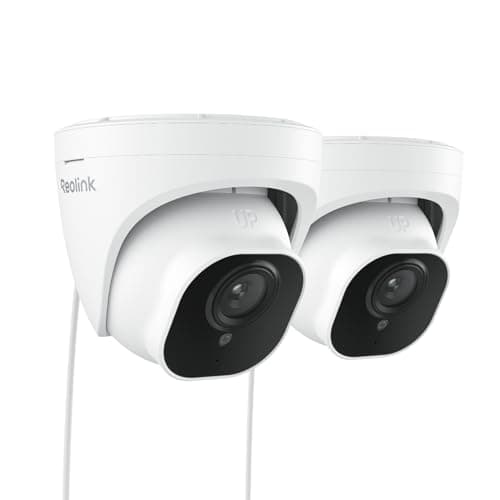
| Reolink RLC-520A (2-pack) | PoE | Your recorder | Your recorder or a PC on the LAN | Yes, documented |
|---|
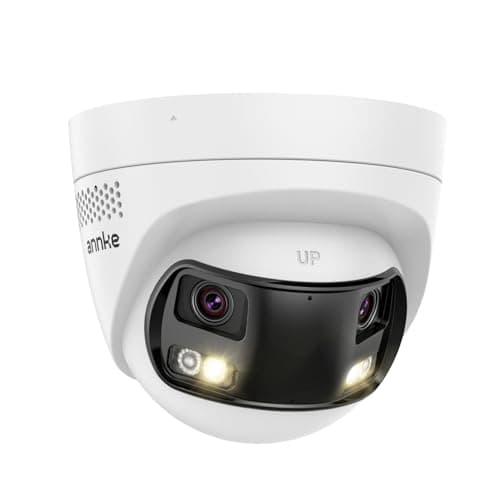
| ANNKE FCD800 dual-lens | PoE | Onboard SD + your recorder | Recorder, or the card | ONVIF |
|---|
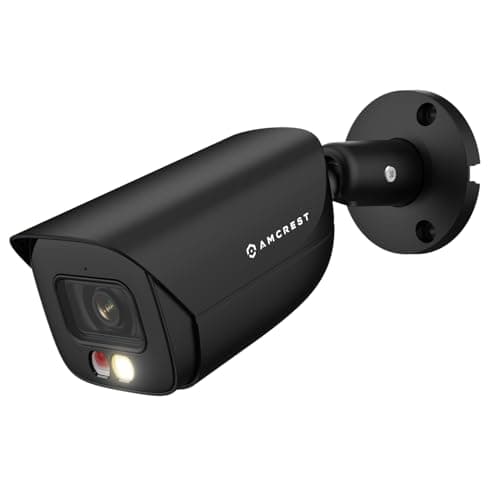
| Amcrest 5MP PoE bullet | PoE | Onboard microSD to 256GB | Recorder, or the card | Yes, RTSP path published |
|---|
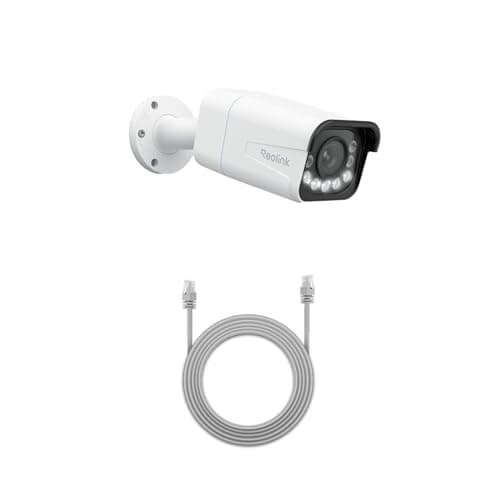
| Reolink RLC-811A | PoE | Card or NVR, continuous | Recorder or a PC on the LAN | Yes, documented |
|---|
Reolink 8CH 4K PoE system — the whole answer in one box
Four 4K cameras, an eight-channel recorder and a 2TB drive, and the reason it tops this page is that nothing is missing. The NVR is the storage, the search interface and the monitor output: plug a screen into it, and the system is complete with no router, no app, no account and no connection to anything. It records continuously rather than in event clips, which no battery camera can do, and the included drive holds weeks of footage across four channels. It expands to eight cameras on the same recorder.
You are running four Ethernet cables, which for most houses is a weekend or a contractor, and the NVR is a box that has to live somewhere with mains and airflow. Everything good about this system comes from the wire; a PoE system you cannot cable for is money spent on a box in a cupboard. The retention arithmetic — how many days a drive actually holds — is in our guide to continuous recording, and the recorder-ranked field is in our camera system roundup.
Reolink RLC-520A (2-pack) — adding cameras to a recorder you own
The sensible way to buy your second and third camera. A pair of wired PoE domes with the same published RTSP and ONVIF support as the flagship, at roughly the per-camera cost of one consumer battery cam, and the dome housing is discreet and hard to knock out of alignment. If there is already an NVR or a machine running Blue Iris or Frigate in the house, this is where the money should go.
It is 5MP with a fixed lens, so there is no optical zoom and distant detail is limited — this is a coverage camera, not a detail camera. And a dome under an eave collects spider webs directly in front of the infrared, which is a real and recurring maintenance nuisance rather than a spec-sheet quibble.
ANNKE FCD800 — one camera where two would normally go
Two lenses stitched into a 180-degree field, over PoE, with a card slot in the camera as well as whatever recorder you point it at. On a property with no internet the onboard card matters more than usual: if the recorder or the switch fails, the camera keeps writing. Color night vision and person and vehicle filtering are included without a subscription tier.
The honest warning is about your recorder, not the camera. Stitched dual-lens streams are handled less gracefully by some NVR software than a single sensor, so check your recorder before committing — some setups will show you two images where you expected one. ANNKE's documentation is also thinner than Reolink's or Amcrest's, which matters on a system you are configuring yourself.
Amcrest 5MP PoE bullet — the cheapest properly open camera
Amcrest publishes its RTSP URL format and ONVIF conformance openly, which is the entire reason this camera exists in a self-hosted build rather than a nicer-looking one. It takes a microSD card up to 256GB, so it keeps recording even if the network or the recorder goes down, and the human and vehicle detection plus tripwire zones run on the camera — so the recorder is filtering real events rather than every moving leaf.
It is 5MP where the rest of this group has moved to 8MP and 4K, and night vision reaches about 49 feet — enough for a porch or a driveway apron, short for a long garden. It is also a component rather than an appliance: it expects you to have somewhere to send the stream, and on its own it is considerably less pleasant to live with than a consumer camera. The integration-ranked field is in our Home Assistant camera roundup.
Reolink RLC-811A — when you need to read something at distance
Last on this page not because it is worse but because it is the specialist. 4K with a real 5x optical zoom rather than a digital crop, one cable for power and data, continuous recording to a card or an NVR, and published RTSP and ONVIF. If one of your no-internet cameras has to cover a long approach where a face or a plate needs to stay legible, this is the one that does it.
It needs Ethernet run to it and a PoE switch or injector, which is another purchase, and there is no battery option at all. If drilling through an exterior wall and pulling Cat6 into a loft is not happening, the answer is not this camera. The optical-reach argument in full is in our driveway camera roundup.
What about a camera with a SIM card?
Cellular cameras exist and they solve a real problem — a site with no broadband where you still want remote alerts. They are not on this page for one reason: a 4G camera is not a camera without a connection, it is a camera with a different connection, and it comes with a data plan, which is precisely the recurring cost this site exists to help people avoid. If remote access to a disconnected property is the requirement, that is the trade-off to weigh, and the five-year arithmetic on recurring fees is in our subscription cost comparison.