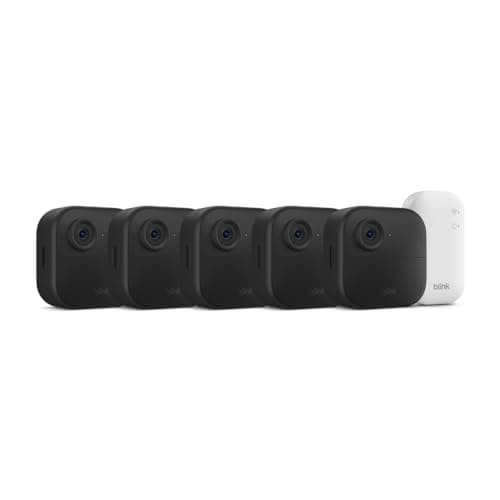
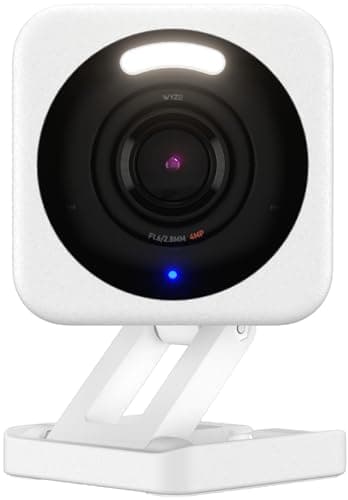
These are the two cameras people reach for when the budget is the brief. The Wyze Cam v4 is the cheapest competent camera sold: mains-powered, 2.5K, recording to a microSD card with no plan — with a documented brand-security history you should read before you point it anywhere private. The Blink Outdoor 4 answers a different question entirely: it is wireless, 1080p, and runs a published two years on a pair of AA cells, storing clips locally through a Sync Module 2 or in Amazon's cloud on a plan. The split here is not really price. It is power.
Decide first whether there is a socket or a wire where the camera needs to go. If there is, the Wyze is hard to beat on cost-per-pixel and can record continuously. If there is not — a fence post, a shed, a spot no cable reaches — the Blink's multi-year battery is the entire reason it exists, and 1080p is the price it pays for that battery. Everything below follows from that one fork.
Wyze Cam v4 vs Blink Outdoor 4, compared
The columns below are the ones that actually separate two cheap cameras. There is no price row — both are budget picks and the live layer renders the number — but there is a row for what you have to buy on top before the “no subscription” claim is true, because that is where the real cost hides.
Compiled from manufacturer specifications, August 2026.| Model | Resolution | Power | Where recordings live | Free local storage out of the box? | Plan gates what? |
|---|
| Wyze Cam v4 | 2.5K | Mains (wired) | microSD card in the camera | Yes — add a microSD card | Cam Plus for the smarter detection |
|---|
| Blink Outdoor 4 | 1080p | Battery — ~2 years on 2x AA lithium | Cloud, or local USB via the Sync Module 2 | No — needs a Sync Module 2 plus a USB drive | Blink plan for cloud clip storage |
|---|
The decision rule. Buy the Wyze Cam v4if there is mains power at the spot, you want 2.5K and the option of continuous recording to a card for the lowest outlay in the category, and you have read Wyze's published security-incident history and decided where you are willing to point it. Buy the Blink Outdoor 4if no power reaches the spot and a multi-year battery matters more than resolution — and budget for a Sync Module 2 and a USB drive if you want clips stored locally rather than on a Blink plan. Power at the mounting point usually decides this before anything else does. The wider shortlist is at best budget security cameras.
Power is the real dividing line
A mains-wired camera and a battery camera are different tools that happen to look alike. The Wyze Cam v4 takes a permanent power feed, which is what lets it stay awake and record continuously to its card — a rolling 24/7 timeline you can scrub, not just event clips. That is a genuine capability the Blink cannot match at any price, and it is the reason the Wyze is the cheapest continuous-recording option worth naming. The catch is equally plain: it only works where a cable or socket already is. Run it to a fence post and you are into extension leads and weatherproofing, which is exactly the job the Blink exists to avoid.
The Blink Outdoor 4 trades that timeline for freedom of placement. Blink publishes a two-year battery life on two AA lithium cells, which is a real engineering achievement and nothing else in this bracket is close — but it is achieved by keeping the camera asleep until motion wakes it, so you get event clips, never a continuous record. The two-year figure is also quoted at some unstated number of events per day; a camera facing a busy pavement triggers far more and drains faster. Same honesty applies as with any battery unit: trim the motion zones and the published life holds up, leave them wide and it will not.
Storage: a card versus a Sync Module
Both can avoid a subscription, but they get there differently, and one needs a purchase the box does not advertise. The Wyze records to a microSD card that slots into the camera — add a card and local recording is free, full stop. The Blink's local path runs through the Sync Module 2: plug a USB drive into the module and your clips save locally, dodging the plan. The catch has got worse rather than better. Current Blink kits ship the Sync Module Core, which Blink's support documentation says does not support local storage or clip backup at all — there is no USB port on it. So the “no subscription” version of the Blink is camera plus a separately bought Sync Module 2 plus a USB stick, and the module that came in the box does not count toward it. That is the single most overlooked line when people compare these two on shelf price alone. The general case for keeping footage local is laid out in local storage versus cloud security cameras.
Neither brand traps you completely. Wyze puts free local recording in reach and gates only its smarter person, package and vehicle detection behind Cam Plus; Blink gives you a real local path through the Sync Module, or a plan if you prefer the convenience of cloud clips. The difference is that the Wyze is subscription-free with just a card, while the Blink is subscription-free only after you have bought the extra hardware.
Resolution, and the Wyze security question stated plainly
On resolution the Wyze is ahead: 2.5K against the Blink's 1080p, in a field that has largely moved past 1080p. If sharpness per dollar is your metric, the Wyze wins it outright. But there is a fact that has to sit next to that recommendation rather than in a footnote: Wyze has had publicly disclosed security incidents.That is documented, not a rumor, and it is a reason to think carefully about where a Wyze camera points. For a garage, a driveway or a shed, where the stakes are low, it remains an easy recommendation. For anywhere private — a room inside the house, a nursery — read Wyze's published incident history first and decide with that in front of you. We would rather name that plainly than sell you a camera and bury it. Blink, as an Amazon brand, keeps its footage inside the Amazon and Alexa ecosystem, which is its own consideration depending on how you feel about that ecosystem.
How we compiled this
Products we claim to have tested: zero. We have not lived with either of these; we read each manufacturer's published specification, support pages and plan terms — and, in Wyze's case, its published service and security notices — work out the running cost, and cite it. Both cameras appear on their own hubs; this page exists only to put the budget trade-off side by side. The rest of the head-to-heads are on the comparisons hub, and the scoring rubric is at methodology.
How to choose between them
Answer the power question first
Stand at the exact spot the camera will go and ask whether power is already there. A socket, an outdoor outlet, a wire you can reach — if yes, the Wyze Cam v4 gives you more resolution, a card you can record to continuously, and the lowest cost, and there is little reason to look further for that spot. If the honest answer is no, do not fight it with extension leads: the Blink Outdoor 4 is engineered precisely for the no-power spot, and its battery is the whole point.
Add up the real no-subscription cost
If avoiding a monthly plan is the goal, price the complete kit, not the camera. For the Wyze that is the camera plus a microSD card, and you are done. For the Blink that is the camera plus a Sync Module 2 plus a USB drive, because out of the box its saved clips go to a plan. Both can end up subscription-free; they just start from different places, and the Blink's starting line is a little further back than the box implies.
The mistake buyers make
Two of them. The first is buying the Blink on its low headline price and assuming local storage is included — then finding that saved clips wanted a plan until you added the Sync Module. The second is putting a Wyze camera somewhere genuinely private without first reading the brand's published security history. Neither camera is a bad buy for the right job; both are bad buys when bought for the wrong one. Match the camera to the spot and to how much you care about where the footage sits.