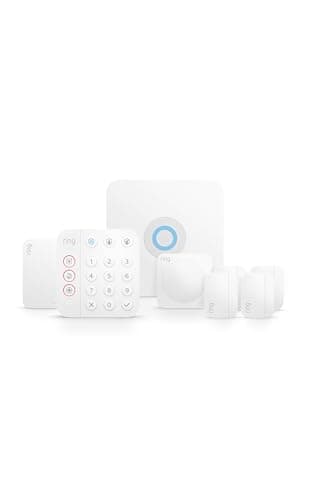
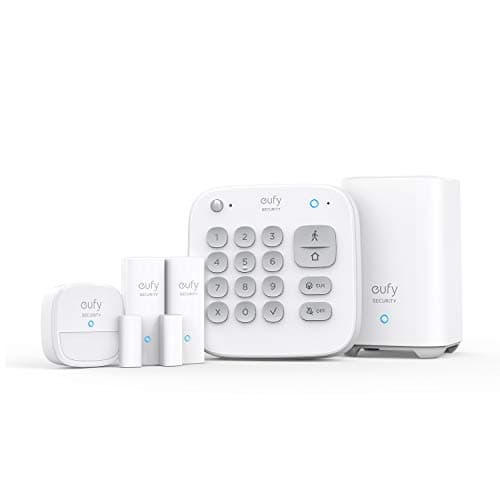
Both of these are do-it-yourself alarm systems that arm, disarm and sound a siren without anyone else's server involved. The one decision between them is the monitoring model: the eufy Alarm Kit is self-monitored with genuinely no monthly fee and none available, built around a HomeBase; the Ring Alarm 8-Piece works unmonitored too, but keeps an optional professional-monitoring plan on the table and ships more sensors, using Z-Wave with a wide accessory range.
Neither of these charges you to arm the house, and that is worth saying up front because the alarm category is full of systems that do. The eufy is the pick for the buyer who wants a one-time purchase and zero recurring cost forever; the Ring is the pick for the buyer who wants that same free core but also wants the option, one day, of a monitoring center that can call for a response. This page sets those two positions side by side; the wider slate of subscription-free systems is on best home security systems without a subscription.
eufy Alarm Kit vs Ring Alarm 8-Piece, side by side
Compiled from manufacturer specifications, August 2026.| System | Monitoring | Works with no plan? | Sensor tech | In the box | Expandability |
|---|
| eufy 5-Piece Home Alarm Kit | Self-monitored only | Yes — arming, disarming, alerts and the siren | eufy sensors on a HomeBase | Keypad, motion sensor, two entry sensors | Adds eufy cameras and sensors to the same base |
|---|
| Ring Alarm 8-Piece Kit | Unmonitored, or optional professional (paid plan) | Yes for the alarm core; a response and some features need a plan | Z-Wave sensors on the Ring base | Base, keypad, four contact sensors, motion, range extender | Wide Ring accessory range, locked to the Ring base |
|---|
The decision rule. Buy the eufy Alarm Kit if you want a flat, one-time purchase with genuinely zero recurring cost and you are content to be the only person the alarm calls. Buy the Ring Alarm 8-Pieceif you want the option to switch on a professional monitored response later without changing hardware, more coverage in the box, and a wider accessory catalog — accepting that the response is a recurring plan and the sensors are locked to Ring. If never paying a subscription is a hard rule and self-monitoring is acceptable, it is the eufy. If you might one day want someone to call for help on your behalf, the Ring keeps that door open.
What works with no subscription
This is where people expect the two to diverge, and mostly they do not. On the eufy, arming, disarming, the app alerts and the siren all work forever with no account tier — there is no plan to buy and nothing is held back. On the Ring, the surprising part for a brand with a subscription reputation is that the alarm's core is the same: app alerts and the siren genuinely work with no plan. Both systems will notify your phone and make noise on their own.
There is one asterisk on the Ring, and it is a fair one to raise. Ring's cameras, on the same app, do require a plan to record — so a household that runs Ring cameras alongside the alarm can come away with the impression that the alarm needs a subscription too. It does not. Keep the two products separate in your head: the alarm core is free, the cameras are the part with the plan. If a fully subscription-free build is the goal, both of these belong on best home security systems without a subscription, which filters the field to systems whose core is free.
Self-monitored versus professionally monitored
Here is the actual fork. The eufy is self-monitored, and self-monitored means exactly what it says: the alert reaches your phone and stops there. Nobody else is watching, and there is no plan to switch on that would change that — a professional response is simply not part of this product. That is a clean, honest design for the buyer who wants to be their own alarm desk, and a dead end for the buyer who wants a call placed on their behalf while they are asleep or abroad.
The Ring offers what the eufy does not: optional professional monitoring. Left alone, it behaves like the eufy — you are the responder. Turn the plan on, and a monitoring center watches the alarm and can escalate to a response, at a price well under the traditional alarm companies. That plan is a recurring cost, billed on an ongoing basis for as long as you want the monitored response, so it is a different shape of spending from the eufy's one-time hardware outlay. We do not print plan prices here because they move; the current shape of the cost, and how it stacks up over years, lives in subscription costs compared. The rule of thumb: if you will never want a monitored response, the eufy removes a temptation the Ring keeps in front of you; if you might, the Ring lets you add it without buying a new system.
Two closed sensor estates: HomeBase and Z-Wave
Both systems are built on a base station, and both bind their sensors to it. The eufy sensors talk to a HomeBase, and you extend the system with eufy cameras and eufy sensors onto that same base. The Ring uses Z-Wave sensors on the Ring base, with a broad accessory catalog that reaches well beyond the pieces in the starter kit. The important thing to understand is that both are closed: eufy sensors are locked to eufy, Ring sensors are locked to Ring, and neither set will join the other system — or any third one — later.
That closure matters most to one specific buyer: anyone building toward Home Assistant or a Matter house. Neither of these kits is the on-ramp to a vendor-neutral, locally controlled estate. The Ring in particular is a closed estate by design; the sensors you buy today cannot be repurposed tomorrow. If open, local control is your long game, this comparison is the wrong aisle, and the answer is a hub-and-sensor build rather than either sealed kit. If you simply want a working alarm from one brand with a clear upgrade path inside that brand, both qualify.
Coverage and expandability out of the box
The kits are sized differently, and it shows. The Ring 8-Piece — base, keypad, four contact sensors, a motion sensor and a range extender — covers a real ground floor as shipped, with enough door and window points to protect the usual entries without a second order. The eufy is a five-piece starter set: a keypad, a motion sensor and two entry sensors, which most houses will add to. Neither is a ceiling — both expand on their own base — but if you want the most coverage in the first box, the Ring is the larger kit, and its accessory range gives it more room to grow.
Weigh that against what the eufy is for. Its whole pitch is that the alarm you buy today keeps working, in full, with no fee ever, and that it grows into a eufy camera and sensor system on the same base. It wins our best-no-fee-alarm nod for exactly that reason: it is the system with nothing held back and nothing to cancel. The Ring wins on kit size and the monitoring option, and loses on the fact that the sensors are one-way locked and the camera side of the brand does carry a plan. The two philosophies are drawn out at greater length in Ring vs eufy, which covers the camera side as well as the alarm.
How we compiled this
Products we claim to have tested: zero. We have not installed either of these kits, and we are not going to pretend a lab we do not run. This comparison is built from each manufacturer's published specifications and support documentation — the kit contents, the sensor technology, the monitoring options and what each function costs — read against how DIY alarms work in general, and cited below. Where these two are ranked against the rest of the field it is on best home security systems without a subscription, and the full set of head-to-head calls is on the comparisons index.
How to choose between them
Decide whether you will ever want a monitored response
This is the one question that settles it. If you are certain you only ever want the alarm to reach your own phone, the eufy is the cleaner choice, because there is no plan sitting there to upsell and no monthly line item to ever appear. If there is any chance you will one day want a monitoring center that can call for a response — a second home, frequent travel, a household member who cannot self-monitor — the Ring lets you add that later by turning on a plan, with no new hardware to buy.
What a plan actually buys on the Ring
Not the basics. The alarm, the app alerts and the siren all work on the Ring with no plan at all — the paid tier buys a professional monitored response, not the ability to arm your own house. That plan is a recurring monthly cost, ongoing for as long as you keep the monitoring, which is a different commitment from a one-time hardware purchase. We keep the current shape of that cost, and how it compounds over the years you own the system, in subscription costs compared rather than printing a figure here that would be stale in a quarter. Keep the alarm plan mentally separate from the Ring camera plan — they are different products.
The mistake buyers make
Two mistakes, opposite in shape. The first is assuming the Ring alarm needs a subscription to function at all — it does not; its core is free, and only the monitored response and a few features sit behind a plan. The second is assuming the eufy can be upgraded to a professional monitored response later — it cannot; self-monitored is the whole design, and if you want a call placed for you, you needed the Ring from the start. Buy for the monitoring model you actually want, not the one you assume the brand implies.
The five-year number
Compare the hardware plus five years of whatever keeps it doing what you want. The eufy is the purchase price and then nothing — no fee exists to add. The Ring is the purchase price and then nothing too, unless you choose the monitored response, at which point it becomes the hardware plus five years of monthly payments. That optionality is the whole difference: with the eufy the recurring number is fixed at zero, and with the Ring it is a choice you make and can change. The maintained comparison of those numbers lives at subscription costs compared.