HUB 06 · Guides
Where to Place Security Cameras for Coverage That Identifies People
The high-value positions, the mounting height and angle that captures a face instead of the top of a head, and the sun and coverage mistakes that make footage useless.
We earn a commission if you buy through our links. It does not change the price you pay, and it does not decide our picks — our selection criteria are published in full. How this works.
Where should you place security cameras?
Cover the routes people actually use: the front door and porch, the driveway, the back or side door, ground-floor windows and the garage. Mount around eight to ten feet high, angled down enough to frame a face rather than the top of a head, with the sun behind the camera. Those five positions and that one angle rule decide most of the value.
The goal is identification, not just presence.A camera that shows “someone was here” is far less useful than one that shows who. Most of the placement rules below exist to capture a recognizable face at a usable size, which is a different problem from simply pointing a lens at the yard.
The five positions worth covering first
Front door and porch
The front entrance is where the most people approach and where package and porch activity happens, so it is the first camera to place. In practice this position is often best served by a video doorbell, which sits at the door at exactly the right spot to capture the face of anyone standing at it — the case for one is laid out in our video doorbells roundup. A doorbell covers the doorstep close-up; a second camera higher on the wall or under the eave covers the wider approach the doorbell's narrow view misses. The two overlap deliberately.
Driveway and the approach to it
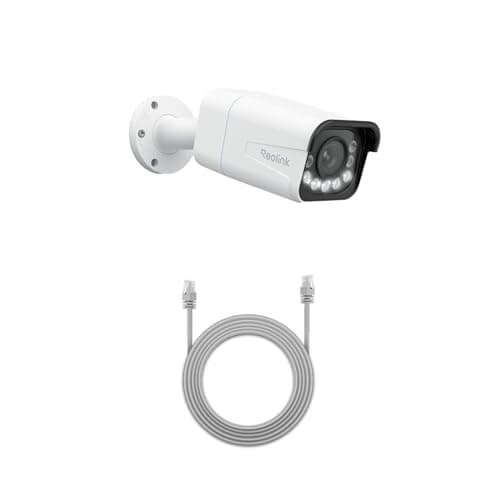
The driveway is where vehicles, deliveries and anyone walking up to the house pass through a single choke point, which makes it high value. This is the position where optical zoom earns its place: a camera like the Reolink RLC-811A with a real 5x optical zoom can keep a license plate readable at the far end of a drive, where a fixed wide-angle lens turns it to mush. Point the camera along the length of the driveway rather than across it, so anyone moving up it stays in frame for several seconds instead of crossing it in one.
Back and side doors
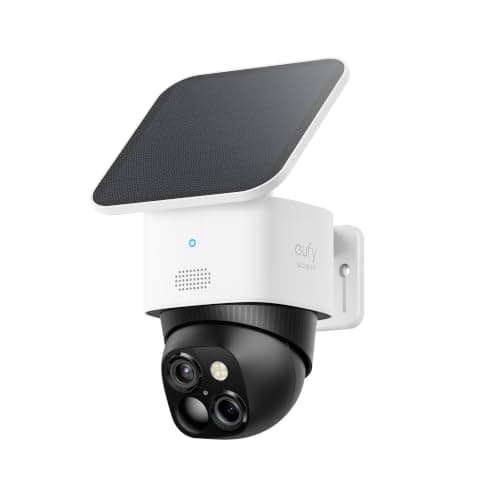
Secondary doors matter precisely because they are out of sight from the street, which is what makes them attractive to approach unseen — and unseen by you too, if you do not cover them. A back or side door usually needs a camera that can run without a convenient power outlet nearby, which is where a solar camera such as the eufy SoloCam S340 fits: it installs once and charges itself, so a remote corner of the property is not off-limits for lack of a socket.
Ground-floor windows and the garage
Large ground-floor windows and the garage round out the exterior. You do not need a camera per window; one camera covering the run of windows along a wall, or the corner where two walls meet, is usually enough to see anyone lingering at them. The garage — especially a detached one — is a common weak point because it often has no coverage at all, and a single camera on its approach closes that gap cheaply.
Mounting height and angle: faces, not scalps
The most common placement mistake is mounting too high and aiming too steeply down. A camera bolted under a second-floor eave and pointed at the doormat records the tops of heads and the shoulders of everyone who visits, which is close to useless for recognizing anyone. The fix is a compromise: mount high enough to be out of easy reach — around eight to ten feet is the usual sweet spot — but angle the camera so its view reaches out from the wall rather than straight down, so an approaching person walks into a frame that shows their face at eye level for a few strides before they reach the door.
Think about where in the frame a face will be at the distance that matters. A wide-angle lens covers more ground but makes each face smaller; a longer or zoomed lens frames a face larger but sees less width. For an entrance you want faces; for a broad yard you want coverage. Placing the camera so the useful action happens in the middle third of its field, not at the far edge where lens distortion and low pixel density ruin detail, is worth more than any resolution number on the box.
Avoid shooting into the sun
A camera pointed east or west will, at some point every day, stare into a low sun or a bright sky behind whatever you are trying to see, and the automatic exposure will darken the subject to a silhouette. Wherever you can, put the sun behind the camera or overhead, not in front of it. The same applies to a bright light source at night: a porch light or a street lamp directly in the frame makes the camera stop down and lose everything around it. If a position forces you to shoot toward a bright background, a camera with strong wide-dynamic-range handling helps, but geometry beats electronics — move the camera if you can.
Night performance is a placement variable too, not just a spec on the box. Most cameras light a scene after dark with built-in infrared, and that illumination has a limited range — push a camera to cover a distance beyond its reach and the far half of the frame goes black at night, which is often exactly when detail matters most. Place the camera so the zone you care about falls inside its night-vision range, and keep bright, reflective surfaces such as a white wall or a glass storm door out of the near field, because they bounce the camera's own infrared straight back and wash the image to a glare. If a spot needs long night range, a camera with a spotlight or a wired feed to a brighter illuminator is the honest fix.
Overlap and coverage: do the simple math
Cameras have a stated horizontal field of view, and a little planning stops you buying more cameras than you need or leaving a blind spot you find out about later. Sketch the house from above, draw each camera's rough cone of view, and make adjacent cameras overlap slightly at the edges so there is no seam a person can walk through unseen. The most important overlap is that every camera's own mounting point should be visible in another camera's frame where practical, so no single camera can be approached and covered without a second one seeing it. A handful of well-placed, overlapping cameras beats a scattering of isolated ones pointed at nothing in particular; the fuller field is ranked in our outdoor cameras roundup.
Indoor cameras: coverage with privacy in mind
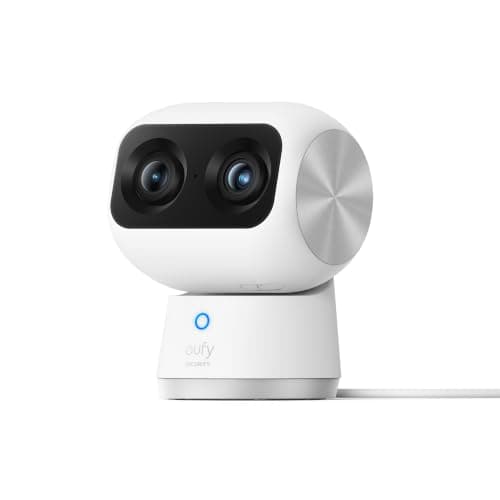
Inside, the useful positions are entry points and main circulation — the inside of the front and back doors, the foot of the stairs, a hallway — rather than living spaces. An indoor camera like the eufy Indoor Cam S350 covers a room with a wide lens and a zoomed detail view, but indoors the placement question is as much about privacy as coverage. Point cameras at doors and thoroughfares, not at seating areas or bedrooms; keep them off in rooms where household members would reasonably expect not to be filmed; and prefer a camera you can physically reposition or that stores locally so the footage stays in the house. The indoor-specific options and their privacy features are in our indoor cameras roundup.
Power and network reach: the constraint that decides the rest
The best position on paper is worthless if you cannot power the camera or get its data home. Every placement is a negotiation with two utilities. A wired PoE camera needs an Ethernet run to the spot, which is the most reliable option and the most work. A Wi-Fi camera needs a usable signal at the mounting point, which thick exterior walls, distance and foil-backed insulation all degrade — test the signal where the camera will go before you drill, not after. A battery or solar camera frees you from cabling but adds its own rule: a solar panel needs genuine direct sun to stay charged, so the shaded north corner that seems ideal for coverage may be the one spot the camera cannot sustain itself. Choose the camera type to fit the position, or the position to fit the camera, but settle power and signal before you commit to a spot. The full field across wired, wireless and solar is in our home security cameras roundup.
A placement plan you can execute in an afternoon
Work outside-in and prioritize, rather than trying to cover everything at once.
- Start at the front door. A doorbell for the close-up plus one wall camera for the wider approach covers the position most people approach first.
- Add the driveway. Aim along its length, use optical zoom if plates matter, and keep the sun behind the camera.
- Cover the back or side door.This is the out-of-sight approach; a solar or battery camera solves the “no outlet out there” problem.
- Fill the gaps. One camera along the run of ground-floor windows, one on the garage approach, overlapping at the edges so there is no seam.
- Only then look inside. Entry points and hallways, never living or sleeping areas, with a local-storage camera you can reposition.
The mistake buyers make
They buy cameras first and think about position second, then mount each one wherever a bracket happens to fit — too high, aimed too steeply, staring into the afternoon sun. The result is a set of clips that prove someone was present and identify nobody. Plan the positions first, choose the camera type to suit each one's power and light, and angle every camera to catch a face at the distance that matters. Then pick the hardware from the home security cameras roundup or, for a specific spot, the outdoor cameras roundup, and check how those picks are graded in our methodology. The related placement and camera-choice questions are covered across the rest of our guides.
The question that comes immediately before this one is how many positions you should be planning for at all, and the honest answer is usually fewer than the number of walls: count entry routes, not elevations. How many security cameras do I need sets out the counting method, why the value of each additional camera falls away quickly, and what the fourth one costs on a brand that prices cloud recording per camera. Once the positions are chosen, each one has to be powered — which is how to power an outdoor security camera.
The hardware
The hardware this guide is about
The products this guide refers to, with prices pulled live from Amazon and dated on every card. Full rankings live in the roundups linked above.
Best subscription-free outdoor camera
eufy SoloCam S340 (solar, dual camera)
Solar panel, pan and tilt, dual lenses and onboard storage — no wire, no monthly fee, and no recording leaving the device unless you choose to send it.
Best wired camera
Reolink RLC-811A (4K PoE, 5x zoom)
One cable for power and data, 4K with a real 5x optical zoom, and continuous recording to a card or an NVR. This is the camera for someone who wants a serious install rather than a convenient one.
Best indoor camera
eufy Indoor Cam S350 (4K, dual camera)
4K with a second telephoto lens and 8x zoom, 360-degree coverage, and card storage with no plan — the indoor camera that does not charge you to watch your own recordings.
#ad · As an Amazon Associate we earn from qualifying purchases.
Questions
Frequently asked
How high should I mount a security camera?
Where are the most important places to put cameras?
Why is my camera footage always a dark silhouette?
Should I put security cameras inside the house?
Do I need Wi-Fi or power at every camera location?
Keep reading
Related
- Best outdoor security camerasThe field for the exterior positions above.
- Best indoor security camerasFor entry points and hallways, with privacy features.
- Best home security camerasWired, wireless and solar picks to fit each spot.
- Best video doorbellsThe right tool for the front-step close-up.
- How to choose a security cameraDecide power, storage and field of view before you decide where it goes.
Receipts
Sources
- eufy — SoloCam and Indoor Cam placement and specification documentation
- Reolink — camera field-of-view and installation documentation
- Ring — support documentation on doorbell and camera positioning
- Arlo — camera mounting and placement guidance
- ONVIF — open standard for IP camera interoperability
- Amcrest — camera installation and field-of-view reference
We do not run a testing lab and we do not pretend to. Specifications come from the manufacturer's own published documents and from published standards; prices come from the live Amazon API. Where a figure is not published, the page says “not published” rather than guessing. Read the full method.