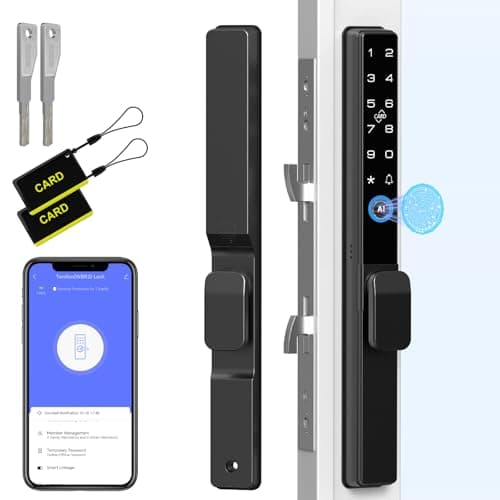
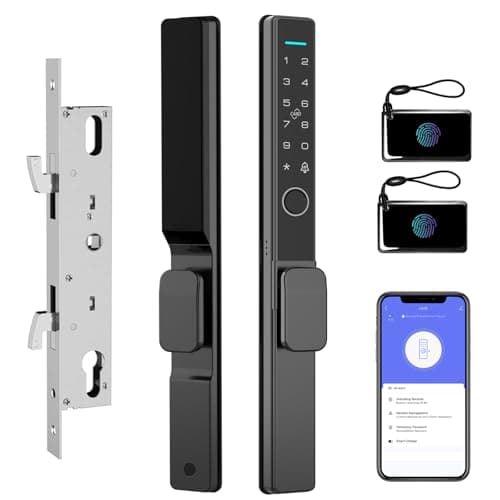
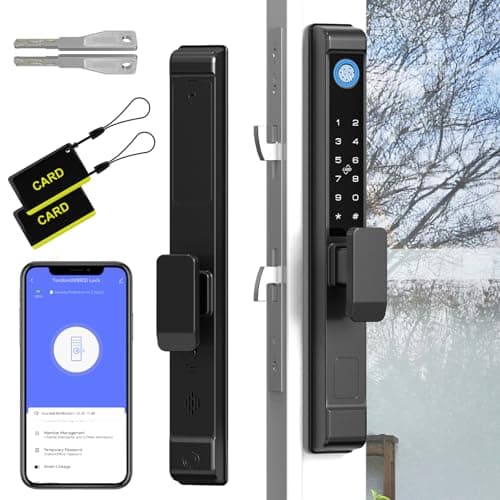
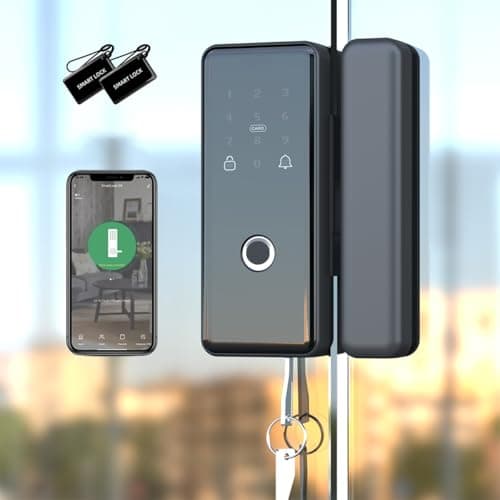
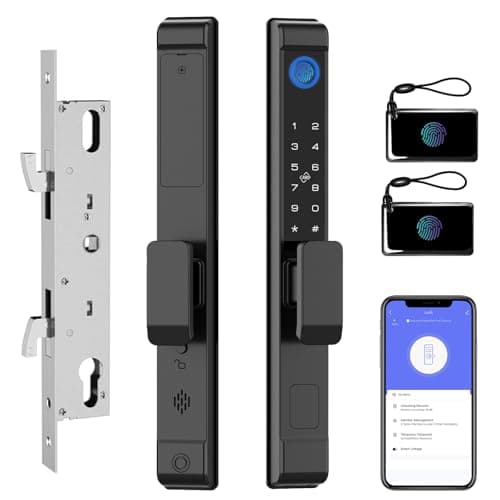
The five patio door locks, side by side
Fitment first, features second. The mortise case column is the one that decides whether a lock can go on your door at all; everything to the right of it only matters once the case matches.
Specifications compiled from the manufacturer listings and product documentation cited in Sources, September 2026. Prices are live and dated below the table.| Model | Best for | Mortise case | Mechanism | Ways in | Published door grade | Price |
|---|
| eLinkSmart 2885 Slim | Best sliding glass door lock | 2885, stated | Hook mortise, 22-110mm thickness | Fingerprint, code, RFID, app | None published | $131.96·on Amazon |
|---|
| Foxlock Double-Hook | Most ways in | Not stated | Double hook, 22-110mm thickness | Fingerprint, RFID, code, app | None published | Check price on Amazon → |
|---|
| eLinkSmart 2085 Ultra-Slim | Best for a 2085 mortise | 2085, stated | Hook mortise, 22-110mm thickness | Fingerprint, code, RFID, app | None published | $143.99·on Amazon |
|---|
| Dhiedas Double-Hook | Best value | Not stated | Double hook mortise | Fingerprint, RFID, code, remote | None published | $129.19·on Amazon |
|---|
| Sophies Frameless | Best for frameless glass | None — clamps to glass | Frameless glass mount, no drilling | Code, app | None published | $139.99·on Amazon |
|---|
#ad· Prices pulled live from the Amazon Product API, last checked October 18, 2026. Where we have no verified live price the button reads “check price” rather than showing a number that has gone stale. We may earn a commission if you buy through these links.
Why a normal smart lock cannot go on a sliding door
Every deadbolt on this site — every Schlage, Yale, Kwikset, eufy and Aqara — assumes the same door: a swinging slab between about 1-3/8 in and 1-3/4 in thick, with a 2-1/8 in cross-bore through the face and a 1 in edge-bore for the bolt. A sliding patio door has none of those things. The panel is a narrow aluminum or vinyl stile wrapped around a sheet of tempered glass. There is nothing to bore, no thickness to speak of, and no jamb in front of the panel for a bolt to throw into.
What a slider has instead is a mortise pocket milled into the stile at the factory, with a lock case sitting in it that throws a hook rather than a bolt. The hook rotates out and catches a keeper on the fixed panel or the jamb. Replacing the handle lock on a slider means pulling that case out and putting a different case in the same pocket — which is why these locks all advertise “no drilling.” It is not a convenience claim, it is a description of the only installation that is physically possible.
And that is where the whole category turns. Mortise cases are not standardized the way deadbolt bores are, but two dimensions dominate the North American residential market and both are named by number: 2085 and 2885. They differ in the case dimensions and the screw spacing, they are not interchangeable, and there is no adapter. Two of the five picks here are the same lock in both cases, from the same brand, which is the clearest possible demonstration of why this page ranks on fitment first.
Measure before you shop, not after
Three numbers decide this purchase, and all three come off the door rather than out of a catalog. Take the old handle set off first — two screws through the interior plate in almost every case — and pull the mortise case out of the pocket.
- The case number. It is usually stamped or cast into the body. 2085 and 2885 are the two you are most likely to find. Write it down.
- The screw spacing. Center to center between the two mounting screws on the face of the case. If a listing gives this figure, match it; if it does not, the case number is your proxy.
- The stile width and the panel thickness. The eLinkSmart bodies are about 36mm wide and want a stile of roughly 40mm or more, and they shim across a 22-110mm panel thickness. A very slim aluminum slider can fail the stile test even though the thickness is fine.
Do not drill a sliding door panel. The glass in a patio slider is tempered, and tempered glass cannot be cut or drilled after manufacture — it shatters. Everything on this page installs in the existing mortise pocket or clamps to the panel, and that is not a limitation to work around. The same measure-first logic that governs deadbolts is in will a smart lock fit my door, which covers the swinging-door version of this problem.
Getting the old mortise case out
This is a fifteen-minute job with a Phillips screwdriver, and doing it before you order is the difference between a clean swap and a return. It is also the only way to read the case number, so there is no shortcut.
- Open the door and work on the leading stile. That is the vertical edge the handle is mounted to. Do not remove the panel from the track; you do not need to and a patio panel is heavier and more awkward than it looks.
- Take off the interior handle plate. Two screws through the face in nearly every design. The exterior plate usually comes away with it or with one more screw from the edge.
- Remove the edge screws. The mortise case is held by two screws through the narrow edge of the stile, in line with the hook. Those are what actually retain the body.
- Slide the case out. It lifts straight out of the pocket. If it resists, the hook is still partly thrown — turn the thumbturn to fully retract it first.
- Photograph it against a tape measure. Both faces, the edge, and the screw centers. The case number is normally stamped or cast into the body; if paint or corrosion has hidden it, the overall case length and the screw spacing are your fallback identifiers.
While the case is out, look at the keeper— the plate on the fixed panel or jamb that the hook catches. It is the other half of the mechanism and it is the half people forget. If the keeper is loose, worn oval by years of use, or set so the hook only just reaches it, a new lock will inherit that slop and feel exactly as vague as the old one did. Most keepers have some adjustment in a slotted screw hole; use it while the lock is out and you can see what you are doing.
The rollers deserve the same two minutes. A slider that has dropped on worn rollers throws its hook at the wrong height, which is the most common reason a correctly-sized mortise lock still does not engage properly after fitting. Most patio doors have an adjustment screw at each bottom corner, usually behind a small plug.
What a handle lock on a slider does not do
This is the part the listings never say. Replacing the mortise lock upgrades how the panel is latched. It does nothing about the two ways a sliding door assembly actually fails: the panel being lifted out of its track, and the panel being levered along the track against a single hook.
There is a published standard for exactly this. ASTM F842 is the test method for the forced-entry resistance of sliding door assemblies, and it deliberately excludes glazing impact — it measures the assembly, the lock and the track, against the kind of attack an opportunist makes. It classifies sliding assemblies by what the operable panel locks to: the jamb, an intermediate jamb, or another panel. None of the locks on this page publishes an F842 result, and none of them claims one.
So the honest sequence for a patio door is: fit an anti-lift device or adjust the rollers so the panel cannot be raised out of the track, add a secondary foot bolt or a track block for when you are in the house, and then put a keyless lock on the handle so the family can get in from the yard without a key. The keyless lock is the convenience layer. It is a good thing to own and it is not the thing holding the door. That first step has its own page: how to secure a sliding glass door works through the latch, the lift gap and the sensing layer in order, and costs almost nothing to act on.
The cheapest genuine improvement is knowing when the panel moves at all. A contact sensor on a slider costs a fraction of any lock here and reports the one fact none of these locks can — that the door is open right now. The options are ranked in the best door and window sensors, and a patio slider is the single most common place they get fitted. It is also the place they most often fail to fit at all, because the stile is an inch of aluminum and the closed gap can exceed the magnet's rated range — which is why the sensors chosen for this specific door are ranked separately in the best sliding glass door sensors.
Be clear-eyed about the brands
Every mortise lock on this page is Tuya-platform hardware from a small brand. There is no Schlage here, no Yale, no Kwikset, and that is not an oversight — the major lock manufacturers do not make a smart mortise case for residential patio sliders. If you want a name you recognize on this door, the answer today is that you cannot have one.
What follows from that is worth stating plainly rather than burying in a con. None of these publishes an ANSI/BHMA grade. None publishes an ASTM F842 result. Documentation beyond the Amazon listing ranges from thin to nonexistent. They run on Tuya, which means no Matter, no Apple Home and no local API — if you were hoping to put the patio door in the same place as the rest of your house, that is not available here, and the Matter lock rankings cover what the standards-based end of the market looks like on doors that can take one.
None of that makes them a bad purchase. A keypad on the patio door so nobody carries a key into the yard is a genuinely good upgrade, and these are the products that do it. It makes them a purchase to go into with accurate expectations, which is what how we pick exists to keep honest. The rest of the lock field is at the smart locks hub.
How to choose a sliding glass door lock
1. Pull the old case first
Everything else is guessing. The case number, the screw spacing and the hook geometry are on the part already in your door, and the ten minutes it takes to remove it saves a return. Photograph it next to a tape measure before you order anything.
2. Match the case, then look at features
A 2885 lock will not go into a 2085 pocket. This is the entire reason two of these picks are the same product from the same brand. Get the case right and every remaining difference — fingerprint, RFID, app — is a preference. Get it wrong and the feature list is irrelevant.
3. Check the stile, not just the thickness
Thickness ranges in this category are generous, because the bodies ship with shims. Stile width is not adjustable. The eLinkSmart bodies are around 36mm wide and want roughly 40mm of stile; a narrow aluminum slider from the 1980s may not have it.
4. Decide what the lock is for
If the answer is “so the kids can get in from the pool without a key,” any of these does that and you should buy on price and case fit. If the answer is “because the patio door is the weak point,” the lock is not the fix — anti-lift hardware and a secondary bolt are, and a keyless handle lock on top of those is the convenience you were going to want anyway.
What decides the price
Very little, which is unusual and worth knowing. The spread across the four mortise locks here is narrow, and the differences that move it are the reader (a fingerprint sensor costs more than a bare keypad), a stated weather rating, and whether Wi-Fi is built into the lock rather than reached through a phone at the door. What does not move the price is brand strength or independent certification, because there is none of either in this category. Paying more here buys features, not verification.
The mistake buyers make
They order on the photo. These locks look nearly identical, and the photograph tells you nothing about the case dimensions. Two of the five picks on this page are visually the same lock and will not fit the same door.
They expect a slider lock to behave like a deadbolt. A hook in a keeper on an aluminum stile is not a 1 in steel bolt in a strike box screwed to framing. It is the right hardware for the door, and the door is inherently a lighter assembly. Treat the upgrade as convenience plus a modest deterrent, and put the security budget into the track and the anti-lift.
They forget the door is outdoors. A patio slider takes sun on one face and conditioned air on the other, and a keypad on the exterior side lives in the weather permanently. A stated weather rating and an aluminum keypad rather than a plastic membrane are worth real money on this door in a way they are not on a hallway.