HUB 06 · Guides
Will a Smart Lock Fit My Door? The Five Measurements That Decide
Backset and bore diameter cause more smart-lock returns than any other spec, and almost nobody publishes how to measure them. Here is the whole procedure.
We earn a commission if you buy through our links. It does not change the price you pay, and it does not decide our picks — our selection criteria are published in full. How this works.
Will a smart lock fit my door?
Probably, but five numbers decide it: backset, cross-bore diameter, edge-bore diameter, door thickness and strike depth. Measure all five with a tape in about ten minutes. A retrofit lock that clamps over your existing thumbturn lets you ignore four of the five entirely, which is why it is the safe answer when you are unsure.
The five numbers, and their standard residential values. Backset: 2-3/8 in or 2-3/4 in. Cross-bore: 2-1/8 in. Edge bore: 1 in. Door thickness: 1-3/8 in to 1-3/4 in. Bolt throw into the frame: 1 in on a full-size deadbolt. If all five of yours match, essentially every deadbolt on this site fits your door without modification.
Door hardware in the United States is standardized to a degree that surprises people. A builder-grade exterior door hung in the last forty years almost certainly has a 2-1/8 in bore drilled at a 2-3/8 in or 2-3/4 in backset, because that is what the hole-saw kits sold in every hardware store cut. The problem is not that non-standard doors are common. The problem is that when yours is non-standard, no product listing tells you, and you find out with the old lock already off the door and the new one in pieces on the floor.
So measure first. It takes a tape measure, five minutes and no disassembly for four of the five numbers. Then read the manufacturer's install manual for the specific model before ordering, because the published fit range is the only number that actually binds. Our methodology page explains how we compile specs from those manuals rather than from our own bench, and this page is the clearest example of why that matters: every figure below is either a dimensional standard or something you are measuring yourself.
The five measurements, in the order they cause returns
1. Backset: the one nobody mentions
Backset is the horizontal distance from the edge of the door to the center of the big round hole the lock sits in. In US residential hardware it is one of two values: 2-3/8 in (about 60 mm) or 2-3/4 in (about 70 mm). It is set by whoever drilled the door and it cannot be changed without plugging and re-drilling.
Nearly every deadbolt sold in the US ships with an adjustable bolt assembly that covers both backsets: you either slide a collar or rotate a cam to switch between them, and the instruction sheet shows which position is which. This is why backset rarely stops an install outright. What it does instead is cause a subtler failure. If the bolt is left in the wrong backset position, it still screws into the door, the escutcheons still bolt up, and the lock still powers on. The bolt then either does not reach the strike or binds against the faceplate, the motor stalls, and the owner concludes the lock is defective.
Measure it before you order anyway, because a minority of locks (particularly fixed-backset commercial-style bodies and some imported keypad deadbolts) come in one backset only. Hook the tape on the door edge, run it across the face of the door, and read the number at the center of the bore. If you land between the two values, you are measuring to the edge of the hole rather than the center — add half the bore diameter, which on a 2-1/8 in bore is about 1-1/16 in.
2. Cross-bore diameter: the 2-1/8 in standard
The cross-bore is that large hole through the face of the door. The residential standard is 2-1/8 in (54 mm). Older doors — pre-1970s, and a lot of imported or custom slabs — sometimes carry a 1-1/2 in bore, which was the older convention for tubular latches.
A 1-1/2 in bore is the single most common hard stop. Nothing adjusts around it. The fix is to enlarge the hole to 2-1/8 in with a hole saw and a drill guide jig, which is a fifteen-minute job on a wood door with a $25 jig and is not a job at all on a metal or fiberglass door with a foam core, where the hole saw wants to wander and the skin tears. If your bore is undersized and your door is not solid wood, a retrofit is the honest answer.
Measure across the widest point of the hole with the old lock removed, or measure the diameter of the round trim ring the old lock sat against — on a standard install that ring covers a 2-1/8 in bore with a small margin. If you have a keypad deadbolt already fitted and do not want to take it off, note that a 2-1/8 in bore is very close to the diameter of a US 50-cent piece plus a little; a tape is better.
3. Edge bore: the 1 in hole in the door edge
The edge bore is the smaller hole drilled into the edge of the door that the bolt assembly slides into. The standard is 1 in. Some older doors use 7/8 in, and some heavy-duty bolts want a full 1 in with no paint buildup narrowing it.
This one is easy to check and easy to fix: if a 1 in bolt assembly will not slide home, the cause is usually decades of paint rather than a genuinely undersized hole. Take the faceplate mortise back to clean wood with a chisel and try again before you reach for a drill. If it really is 7/8 in, a spade bit opens it up in under a minute, but drill from the edge and go slowly — this hole intersects the cross-bore, and a bit that grabs will blow out the far side.
4. Door thickness: 1-3/8 in to 1-3/4 in, and what happens outside it
Interior doors in the US are typically 1-3/8 in thick. Exterior doors are typically 1-3/4 in. Almost every smart deadbolt published fit range covers that span, because the through-bolts and the tailpiece that connect the two halves are cut for it.
Outside that range, two different things go wrong depending on direction. On a thicker door — a 2 in or 2-1/4 in solid slab, common on period properties and on some fire-rated doors — the standard through-bolts are too short to reach and the tailpiece does not fully engage the interior mechanism. Several manufacturers sell a thick-door extension kit that supplies longer bolts and a longer tailpiece; Yale, Schlage and Kwikset all publish one for parts of their lines, and the install manual states the maximum supported thickness. On a thinner door the opposite happens: the tailpiece bottoms out, the escutcheons clamp before they are square, and the lock binds. That is rarer, and there is no kit for it.
Measure at the edge of the door, not through the weatherstripping, and measure near the existing bore rather than at the top rail. Doors are not always uniform.
5. Strike plate depth and bolt throw
The last number lives in the door frame, not the door, and it is the one that decides whether the lock is reliable a year from now rather than whether it fits today.
A full-size residential deadbolt throws a bolt 1 in beyond the face of the door. For that to happen the frame needs a pocket at least 1 in deep behind the strike plate, drilled cleanly, aligned with the bolt, and ideally reinforced by a strike box rather than a bare hole in soft jamb pine. Builders routinely drill this pocket shallow, or drill it deep and let the plate sit proud, or fill it with paint.
Check it with the door open: throw the bolt by hand and confirm it extends fully and smoothly with the door out of the way. Then close the door and throw it again. If the second attempt is harder than the first, the strike is misaligned and a motorized lock will be fighting that misalignment on every single cycle until the batteries die. That is not a fit problem, it is a preparation problem, and it is covered step by step in our smart lock install guide.
The fit-check table
| Measurement | Standard value | Where to measure | If yours is different | Does a retrofit care? |
|---|---|---|---|---|
| Backset | 2-3/8 in or 2-3/4 in | Door edge to center of the large bore | Most bolts adjust between the two. A fixed-backset lock in the wrong size will not reach the strike. | No |
| Cross-bore diameter | 2-1/8 in | Across the large hole in the door face | A 1-1/2 in bore is a hard stop. Enlarging it needs a hole saw and a drill guide, and is risky on a hollow or foam-core door. | No |
| Edge bore | 1 in | The hole in the door edge the bolt slides into | 7/8 in is common on older doors and opens up with a spade bit. Paint buildup is the more likely cause of a tight fit. | No |
| Door thickness | 1-3/8 in to 1-3/4 in | Door edge, near the existing bore | Thicker doors need the manufacturer's extension kit for longer bolts and tailpiece. Thinner doors bind and have no kit. | No |
| Strike pocket depth | At least 1 in | Behind the strike plate, in the jamb | A shallow or misaligned pocket makes the motor fight the bolt on every cycle. Deepen and realign before blaming the lock. | Yes |
| Bolt-to-knob center spacing | 5-1/2 in typical | Center of deadbolt bore to center of knob bore | Only matters for combined handle-and-deadbolt sets. Independent deadbolts do not care. | No |
| Interior clearance | Varies | Around the inside of the deadbolt, to trim and storm door | Large interior escutcheons can foul architrave, a narrow stile, or a storm door frame. Check with a ruler before ordering. | Yes |
What a retrofit lets you ignore entirely
A retrofit smart lock does not replace your deadbolt. It clamps to the interior side of the door over the existing thumbturn and turns it with a motor. The no-drilling retrofit locks we cover for renters all work this way, and it changes the fit question completely.
Backset, cross-bore, edge bore and door thickness stop mattering, because none of the hardware in the door is being removed. The exterior of the door does not change at all, which is why the August Wi-Fi Smart Lock and the SwitchBot Lock Ultra are the standard answers for a rented door and for anyone whose measurements came back non-standard.
Two things still matter, and they matter more than they would on a full replacement. The first is strike alignment. A retrofit motor drives your existing bolt, so it inherits every mechanical problem that bolt already has. The SwitchBot Lock Pro's own skip-this-if is exactly this: a deadbolt that already needs a shoulder against the door to throw will jam a retrofit, drain its battery and report failures. The second is interior clearance. Retrofit bodies are bulky. Measure the space around your thumbturn — outward toward the door edge, inward toward the hinge side, and how far it protrudes into the doorway — before you order one for a narrow stile or a door with a storm door behind it.
The third consideration is not a measurement: retrofits keep your existing key and your existing cylinder. That is a benefit if you rent, and a limitation if the reason you are buying is that you want to be rid of the key.
The measuring procedure, start to finish
Print this or keep it open on a phone. You need a tape measure and, for steps 5 and 6, a Phillips screwdriver. Total time is under fifteen minutes, and you do not need to remove the existing lock for steps 1 through 4.
- Door thickness. Open the door. Measure across the edge near the existing deadbolt, avoiding weatherstripping. Write it down as a fraction — 1-3/8 in or 1-3/4 in are the expected answers.
- Backset. Hook the tape on the door edge and run it across the face to the center of the deadbolt. If the existing lock is in the way, measure to the center of the round trim ring instead. Expect 2-3/8 in or 2-3/4 in.
- Bolt-to-knob spacing. Only if you are replacing a combined handleset: measure center of deadbolt to center of knob. 5-1/2 in is the common value.
- Interior clearance. Measure from the center of the deadbolt outward to the nearest obstruction on the inside face: door edge, architrave, a stile edge on a glazed door. Then measure how much room you have between the closed door and anything behind it. This is the check that catches storm doors and narrow stiles.
- Remove the existing deadbolt. Two screws on the interior escutcheon, two on the bolt faceplate in the door edge. Keep the screws; you will want the original hardware back if you rent.
- Cross-bore and edge bore. With the hardware off, measure the large hole across its widest point (expect 2-1/8 in) and the hole in the door edge (expect 1 in).
- Strike check. With the door still open, put the old bolt back in by hand and throw it. Confirm it extends about 1 in and moves freely. Then look at the strike pocket in the jamb: is it at least as deep as the bolt is long, is it clean, and is the plate flush?
- Compare against the manual, not the listing.Find the install manual for the exact model on the manufacturer's support site and read the fit specification. Product listings compress this to marketing copy; manuals state the supported backsets, bore diameter and thickness range explicitly.
Doors that need a different conversation. A narrow-stile aluminum and glass door (common on condo and commercial entries) usually has too little material for a residential deadbolt at any backset. A door with a mortise lock — a rectangular pocket rather than a round bore — is a different hardware family entirely, and residential smart deadbolts do not fit it. A multi-point European-style door with bolts at the top and bottom of the slab needs a lock designed for that mechanism. In all three cases, measuring will not save you; the answer is a locksmith, or a retrofit if a standard thumbturn is present.
What to buy once you have your numbers
Or the door is not a swinging slab at all.Three doors fail these measurements before you start. A sliding patio door has no cross-bore and no deadbolt, only a mortise pocket in the stile, so the fit specification is the mortise case number rather than a backset — smart locks for sliding glass doors ranks that category on exactly that. A storm door is thinner than any residential deadbolt will fit, and smart locks for storm doors gives the measurement, says plainly that nothing mainstream fits, and covers what helps instead. And a pair of french or double doors passes the thickness check but frequently fails the stile check, because the rail beside the glass has no room for a 2-1/8 in bore — smart locks for french doors explains why a retrofit over the existing thumbturn is usually the only design that fits, and why the second leaf stays manual whatever you buy.
All five measurements standard, and you own the door. You have the widest choice on the site. A full deadbolt replacement gets you a keypad on the outside, which is the feature most people actually wanted, and the best smart deadbolts roundup ranks the field. The Yale Assure Lock 2 is the flexible choice because its radio is a swappable module rather than a fixed feature; the Schlage Encode Plus is the choice when a published BHMA grade on the lock body matters more to you than the module system.
Non-standard bore, thin or thick door, or you rent. Retrofit. The August Wi-Fi Smart Lock keeps the exterior and the key untouched and installs with a screwdriver; the SwitchBot Lock Ultra does the same job and its Touch Combo bundle ships a fingerprint keypad with it if you want codes. Both are covered in our no-drilling renters roundup, and the fundamental trade — a retrofit puts nothing on the outside of the door, so any code pad is a separate unit stuck beside it — is spelled out there.
Standard door, but the bolt already sticks.Fix the door before you buy anything. A misaligned strike defeats a $250 lock exactly as thoroughly as a $60 one, and it is the most common cause of a lock that “stopped working after a few months” when what actually happened is that the door swelled a quarter turn of a season.
The mistake buyers make
They order from the product listing rather than the manual. Listings say “fits standard doors” because that is true for most doors and legally safe for the rest. Manuals state the supported backsets, the bore diameter and the thickness range as numbers. Every manufacturer publishes the manual as a free PDF on their support site before you buy. Five minutes there is worth more than any amount of reading reviews, because the review author's door is not your door.
The second mistake is treating a smart lock as an upgrade to a door that is already marginal. If the deadbolt currently needs a lift on the handle to throw, adding a motor to it does not fix it — it just moves the failure from your wrist to a gearbox. Start with the smart lock versus deadbolt comparison if you are still deciding whether you need one at all, and browse the rest of our guides for the protocol and security questions that come next.
The hardware
The hardware this guide is about
The products this guide refers to, with prices pulled live from Amazon and dated on every card. Full rankings live in the roundups linked above.
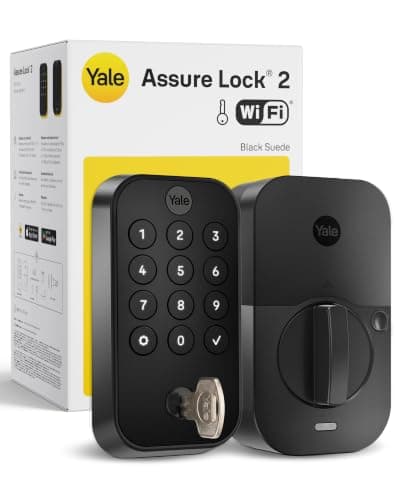
Best overall smart lock
Yale Assure Lock 2 (Wi-Fi, keyed)
The modular one. Yale sells the same lock body in keyed and key-free, touchscreen and keypad, with the radio as a swappable module — so you buy the connectivity you want instead of the connectivity that shipped.
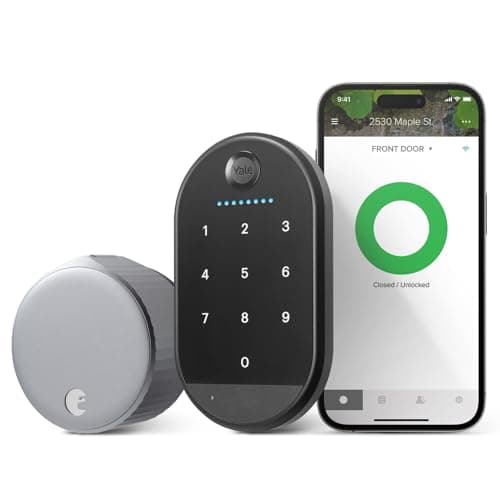
Best for renters
August Wi-Fi Smart Lock (with Yale Keypad)
The retrofit that started the category. It clamps onto the inside of your existing deadbolt and turns the thumbturn — the outside of the door does not change at all, which is why it is the default answer for renters. The listing we link is the bundle, so the Yale Keypad that gives it code entry is in the same box.
- ProductNo image
Best no-drill retrofit
SwitchBot Lock Ultra Touch Combo (with Hub Mini)
The credible way to make a rented door smart without drilling a hole. It mounts over the existing thumbturn, keeps your key, and this bundle puts the fingerprint keypad and the hub in the same box — so codes and remote access both work the day it arrives.
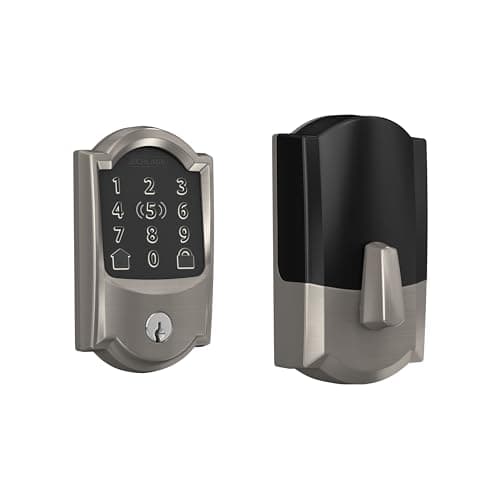
Best build quality
Schlage Encode Plus Wi-Fi Deadbolt
The one with the strongest published hardware pedigree. Schlage's deadbolt line is the reference point for BHMA Grade 1 in residential locks, and the Plus adds Apple Home Key so you tap a phone or watch instead of typing.
#ad · As an Amazon Associate we earn from qualifying purchases.
Questions
Frequently asked
How do I measure backset without taking the lock off?
My door has a 1-1/2 in bore. Can I still fit a smart lock?
Will a smart lock fit a 2 in thick door?
Does a smart lock need a different strike plate?
What if my measurements are all standard but the lock still jams?
Keep reading
Related
- Best smart deadboltsFull replacements for a standard 2-1/8 in bore.
- Best no-drilling smart locks for rentersThe retrofits that ignore four of the five measurements.
- How to install a smart lockIncluding the strike alignment step everyone skips.
- Yale Assure Lock 2 reviewThe modular lock, and what its published fit range covers.
- Best smart locks for sliding glass doorsThe door that fails every measurement on this page, ranked on mortise case instead.
Receipts
Sources
- Builders Hardware Manufacturers Association (BHMA) — standards for locks and door hardware
- American National Standards Institute (ANSI)
- Yale Home — product support and installation manuals
- Schlage — support center, installation instructions and thick-door kits
- Kwikset — support and installation documentation
- August — retrofit lock compatibility and install guides
- SwitchBot — Lock Ultra documentation and mounting requirements
We do not run a testing lab and we do not pretend to. Specifications come from the manufacturer's own published documents and from published standards; prices come from the live Amazon API. Where a figure is not published, the page says “not published” rather than guessing. Read the full method.