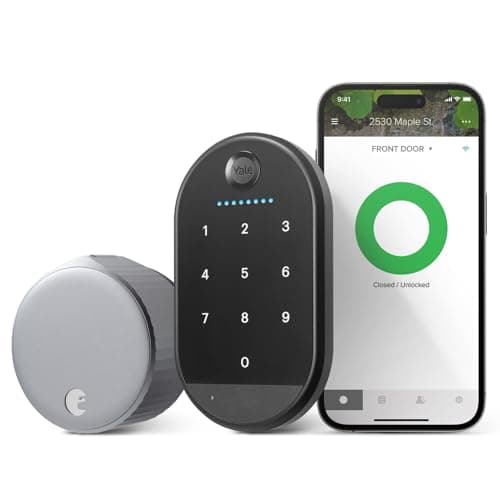
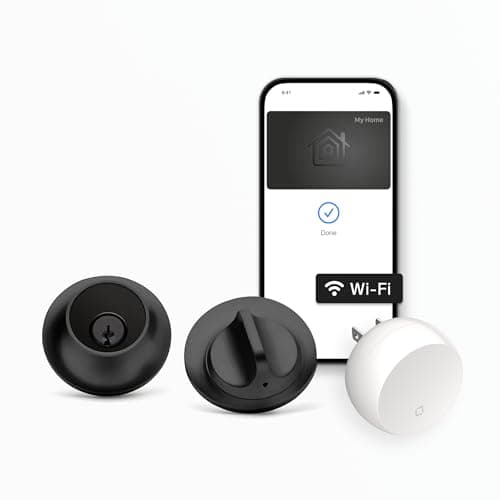
Both of these were designed so nobody can tell your door got smart. Neither adds a keypad, an escutcheon, or a bank of buttons to the front of the house. The difference is how far the disappearing act goes: the Level Lock+ replaces the deadbolt entirely and buries the motor, radio and battery inside the bore of the door, so it is invisible from both sides; the August keeps your existing deadbolt in place and clamps a unit onto the interior thumbturn, so it is invisible from outside but plainly there on the inside. One is a full deadbolt swap, the other is a reversible retrofit, and almost everything else follows from that.
Level Lock+ vs August Wi-Fi Smart Lock: the short answer
Buy the Level Lock+ if you want a lock that is genuinely invisible inside and out, you live in the Apple ecosystem and want to tap an iPhone or Apple Watch to open, and you own the door or are free to change the deadbolt itself. Buy the August Wi-Fi Smart Lock if you rent, or you want to keep your current deadbolt and key completely untouched, and you value the most mature app and the best auto-unlock in the retrofit class. Both keep your exterior hardware and your physical key working, and neither has a keypad — so on either lock, anyone without a phone falls back to that key. The August's renter case is set out in full on our no-drill renter roundup.
The decision rule in one line: if the lock must vanish on the inside too and you carry an iPhone, Level. If you rent, or you refuse to touch the deadbolt you already own and just want it to open from your phone, August.
Head to head: what actually separates them
Both hide from the street and both keep your keyway, so the columns below are the places they diverge — how deep the install goes, where the hardware is visible, whether an Apple credential is on offer, and what you feed for power.
Compiled from manufacturer specifications, August 2026.| Model | What it replaces | Where it is visible | Apple Home Key | Power | Renter-reversible |
|---|
| Level Lock+ | The deadbolt itself — the mechanism sits in the door bore | Nowhere — invisible inside and out, keeps your trim and key | Yes | 1x CR2 lithium | More involved — the deadbolt is swapped |
|---|
| August Wi-Fi Smart Lock | Nothing — keeps your deadbolt, clamps on the interior thumbturn | Outside is unchanged; a chunky unit sits on the inside | No | 2x CR123A lithium | Yes — interior-only, reverses in minutes |
|---|
How invisible each one really is
This is the axis both locks are sold on, and they do not mean the same thing by it. The Level Lock+ puts the entire mechanism — motor, radio and cell — inside the bore of the door, replacing only the bolt assembly while reusing your existing exterior trim and keyway. Stand on either side and it reads as an ordinary deadbolt, because visually it is one. There is no keypad, no escutcheon, and nothing on the interior to announce that the door is connected. On a period door or a front elevation you do not want to spoil, that is the strongest argument any smart lock makes, and it is why the Level anchors our Apple Home Key lock roundup on looks as much as on the tap-to-open credential.
The August is invisible only from the outside. It leaves the exterior cylinder, the trim and your key exactly as they were — nothing on the street changes — but the way it achieves that is by mounting a unit over the interior thumbturn and turning it for you. That interior unit is chunky by August's own description, and on a narrow door edge or behind a storm door it can foul. So if “invisible” to you means the hallway side as well as the porch side, only the Level qualifies. If it means “the front of my house looks untouched and my landlord never notices,” the August does that just as well and does it reversibly.
What the Level Lock+ is genuinely better at
Total invisibility. Covered above, and it is the whole reason the Level exists. Nothing else in this pair, and very little in the wider category, hides the interior hardware as well.
Apple Home Key.The August has no answer to this. With Home Key, an iPhone or Apple Watch held near the lock opens it, the credential lives in the Wallet rather than a manufacturer app, and it still works from a phone that has dropped into low-power reserve — the exact situation where a dead-battery phone would otherwise leave you reaching for the key. In an Apple household the tap becomes the way everyone actually opens the door.
It keeps your trim and your key. Because the electronics replace only the bolt assembly, the existing exterior hardware and the mechanical key both carry over. You are not re-keying the house or changing the look of the door to gain the smarts.
What the August is genuinely better at
Renting.This is the August's home ground. Nothing is drilled, the deadbolt you do not own is left completely intact, and the whole thing installs with a screwdriver in minutes and reverses just as fast on move-out. A renter can add it, take it to the next place, and hand the original door back untouched — which is precisely what the Level's deadbolt swap makes harder. The full retrofit picture is in the August Wi-Fi Smart Lock review.
The mature app and auto-unlock.August largely defined the retrofit category and it shows in the software. Auto-unlock — the lock sensing your phone returning and opening the door before you reach for it — is the feature owners report still using a year later, and August's implementation is the one others are measured against.
Nothing to swap on the door. Because it clamps onto the existing thumbturn, there is no bolt assembly to replace and no chance of getting the mechanical fit wrong. If your deadbolt already throws smoothly, the August inherits a working lock rather than becoming one.
Batteries: one CR2 against two CR123A
The power stories differ because the form factors differ. The Level runs on a single CR2 lithium cell — a small reservoir for a motor to draw from, and one of the honest costs of fitting everything inside the door. The August carries two CR123A lithium cells, a larger bank, though it is also driving your existing bolt rather than a purpose-built one. Neither is an AA lock, so both use cells you may not already keep in a drawer; buy a spare of the right chemistry when you buy the lock. Neither charges a subscription for any function, so the only recurring cost on either is the cell it eats, and the mechanics of why a connected lock drains faster are in how long smart lock batteries last.
The limitation both share: nothing on the door takes a code
It is worth stating loudly because it disqualifies both locks for a lot of buyers. Neither the Level nor the August has a keypad or a fingerprint reader on it. On the Level, entry without a phone means the physical key, full stop. The August bundle we link answers the problem one step removed: it includes the Yale Keypad, a separate pad on the wall beside the door, so a dog walker with an Android phone or a child without a smartphone gets a code — but it is a second device with its own cells, and it takes codes rather than fingerprints. If a pad on the door itself is what you want, this pair is the wrong shape and a keypad model is the right one — the alternatives sit on our renter roundup and the wider hub. Do not let a clean install talk you out of a way in you will genuinely need.
Where each one costs you
On running cost they are close: a lithium cell each, no plan on either, no gated features. The up-front picture is where they part. The Level Lock+ sits among the most expensive locks in the category, and you are paying for the engineering that makes it disappear and for Home Key. Outside the Apple ecosystem a slice of that premium buys a credential you can never use. The August lands lower, in the mid tier, and its cost is mostly the app and the built-in Wi-Fi radio rather than a re-engineered bolt. Read them as what they are — a premium invisible deadbolt against a mid-priced reversible retrofit — and the choice stops being about which is “better” and starts being about which problem is yours.
The decision rule
There is no winner here because the two locks answer different questions. Find the sentences below that describe you.
Buy the Level Lock+ if…
- You want the lock invisible on the inside as well as the outside — no keypad, no escutcheon, nothing on the hallway side.
- Your household runs on iPhones and Apple Watches, and a tap-to-open credential in the Wallet is the feature you actually want.
- You own the door, or are otherwise free to replace the deadbolt itself rather than just clamp onto it.
- You accept that there is no keypad, so everyone without a phone opens it with the physical key.
Buy the August Wi-Fi Smart Lock if…
- You rent, or you refuse to alter the deadbolt you already own — the August keeps it intact and reverses in minutes.
- You want remote access and the most refined app and auto-unlock in the retrofit class, with the Wi-Fi built in and no bridge.
- You are not in the Apple ecosystem, so Home Key is a feature you would pay for and never touch.
- A chunky interior unit is fine on your door — you do not need the inside to disappear.
What decides the price
On the Level side the premium is the in-door engineering plus Home Key. Strip Home Key out and it still costs more than most locks purely to fit inside the bore; add an Android phone and you are paying for a credential you cannot use. On the August side the number is mostly the mature app and the built-in radio, and it keeps your existing bolt rather than shipping a new one. Compare them as system prices for the job you have — an invisible full swap against a reversible retrofit — not as two versions of the same product, because they are not.
The mistake buyers make
The common error is buying the Level for a household that needs code entry. It is a phone-or-key lock with no keypad, so if a family member, a dog walker, or a cleaner needs to get in without your phone, you are handing out physical keys again — which is the exact convenience most people buy a smart lock to escape. Decide first whether anyone needs a code; if they do, the August and the wall-mounted Yale Keypad in its bundle is the side of this pair that answers it. The second mistake is renters choosing the Level for its looks and then discovering the deadbolt swap is more than the tenancy allows — on a rented door the August is almost always the correct shape.
How we compared these
Products we claim to have tested: zero. Everything above is compiled from each manufacturer's published specifications and support documentation, which is the only method we use and the only one we claim. You can read the retrofit in depth in the August Wi-Fi Smart Lock review, step back up to the smart locks hub, or see the rest of the head-to-heads at comparisons. Our rubric and sources are published in full on the methodology page.