HUB 06 · Guides
Is a Video Doorbell Worth It?
It is worth it for parcels, for answering the door from elsewhere, and for a record of who called. It is not worth it for three specific households.
We earn a commission if you buy through our links. It does not change the price you pay, and it does not decide our picks — our selection criteria are published in full. How this works.
Is a video doorbell worth it?
Worth it if you receive parcels regularly, are often out when people call, or want a record of who came to the door. Not worth it if you have no doorbell wiring, no parcel problem, and a household that will mute the notifications inside a week. That last case is more common than the category admits.
Video doorbells are the most-bought product in home security and the one most likely to end up ignored. Both facts have the same cause: the value is entirely dependent on your household's pattern of use, and almost nothing published about them engages with that. So this page starts with the case against, because if one of the three disqualifiers below applies to you, everything after it is irrelevant.
The case for not buying one
You have no doorbell wiring, and you do not want another battery
A wired doorbell needs an existing transformer supplying low-voltage AC, and it needs that transformer to be adequate for the model you are buying — the install manual states the required voltage and VA range, and an old transformer sized for a mechanical chime is sometimes marginal for a camera. If the house has no doorbell circuit at all, wiring one is electrical work.
The alternative is a battery doorbell, and battery doorbells are a commitment. You take it off the wall to charge it, on a schedule that varies with how busy your street is and how cold it gets, and while it is charging your doorbell is a hole in the wall. Some people never mind this. Others resent it by the second charge. Know which you are before you buy, because it is the most common reason a video doorbell ends up in a drawer.
You have no parcel problem
Delivery evidence is the strongest single argument for these devices, and if you work from home, have a porch, use a locker, or simply receive few parcels, that argument does not apply to you. What remains — seeing who is at the door — is largely covered by a peephole and a chime for a lot less money.
Your household will mute it
This is the failure mode nobody writes about. A doorbell that alerts on every passing pedestrian trains people to ignore it, and once notifications are muted the device is a recorder rather than an alert system. Motion sensitivity tuning and detection zones help, and radar-plus-infrared detection on the better models helps more, but if the honest answer is “we will turn the alerts off in a week,” you are buying a camera that happens to have a button. That may still be worth it. It is a different purchase.
One more disqualifier: the storage model. Several of the best-supported doorbells record nothing you can watch later without an active subscription. That is stated plainly in the Ring Battery Doorbell Plus record on this site — without a plan it is a live-view intercom that notifies you and keeps nothing. If you bought a doorbell to review footage afterwards, check the storage model before the resolution.
What a video doorbell genuinely changes
Parcel evidence
You get a timestamped record of the delivery, which is the difference between a dispute with a retailer and a two-minute resolution. This is the use case that survives the novelty period, and it is why the shape of the camera's view matters more than its resolution. A standard doorbell camera aimed at head height cannot see a box on the step. The fixes are a second downward-facing lens, as on the eufy E340, or a tall aspect ratio — 1:1 or a 180 degree vertical field — as on the Tapo and Reolink units. Any of those three beats a higher-resolution camera pointed at the wrong place.
Answering the door when you are not there
Two-way audio means a courier can be told where to leave something, and a caller gets an answer. This is genuinely useful and it is also the function most dependent on your internet connection and on notification latency, which is where cheap doorbells actually fall down. A doorbell that alerts you forty seconds late has not answered the door; the person has gone.
A record of who called
A log of visits, with images, that you can look back through. For most households this is low-grade useful most of the time and occasionally very useful indeed. Its value depends entirely on retention, which depends on the storage model, which brings us back to local storage versus cloud.
The door being answered at all
An underrated one. A household that does not answer the door to strangers can still see and speak to whoever is there without opening it, which changes the interaction for deliveries, contractors and canvassers. This is a convenience argument rather than a safety one, and we would rather make it that way.
What it does not change
- It is not a lock. A doorbell records; it does not secure anything. If what you want is not to carry keys or to let someone in remotely, that is a smart lock, and the two purchases solve genuinely different problems.
- It covers one approach. The front door. Side gates, back doors and ground-floor windows are unaffected, and those are where the coverage gaps in most houses actually are. Contact sensors are the cheap answer, and are covered in our sensor roundup.
- It does not stop parcel theft. It documents it. Those are different outcomes and it is worth being clear which one you are buying.
- It does not summon anyone. A self-monitored device alerts you and stops there. If you want a professional response, that is a monitored alarm and a different category of product.
Making it survive the first month
Most doorbells that end up ignored were never configured, and the configuration takes about twenty minutes. It is worth doing on day one rather than after you have already stopped reading the alerts.
Set detection zones before anything else.Almost every model lets you mask out the parts of the frame you do not care about: the sidewalk, the road, the neighbor's path. A doorbell watching a public footpath in a town center will alert hundreds of times a day and there is no sensitivity setting that fixes that — only a zone does.
Separate the two kinds of alert. A button press and a motion event are different in importance and should be different in urgency. Most apps allow the ring to be a high-priority notification while motion is silent or batched. Households that do this keep their doorbells; households that leave everything at default do not.
Prefer models with better detection hardware if your street is busy. Combined radar and infrared detection, as on eufy's dual-sensor doorbells, produces materially fewer false triggers than infrared alone, and person, vehicle and package classification narrows it further. On a quiet cul-de-sac none of this matters. On a through road it decides whether the product works for you.
Then check it once. A week in, look at what it actually recorded. If the log is full of passing cars, the zones are wrong. If it is full of nothing, the sensitivity is too low and you will miss the delivery you bought it for.
The practical checks before you buy
| Check | Why it matters | What to do about it |
|---|---|---|
| Existing transformer | Wired doorbells need adequate low-voltage AC. An old transformer may be under-specified for a camera. | Read the required voltage and VA in the manual. If there is no circuit, choose a battery model. |
| Chime | Battery models often cannot drive an existing mechanical chime, so the doorbell only rings on a phone. | Buy a model with a plug-in chime in the box, or accept app-only alerts. |
| Field of view shape | A head-height camera cannot see a parcel on the step. | Choose a second downward lens or a 1:1 / tall aspect ratio. |
| Storage model | Some doorbells save nothing without an active plan. | Confirm local card or base storage if you want subscription-free playback. |
| Wi-Fi at the door | The front door is often the furthest point from the router, through a wall. | Check signal at the mounting spot before ordering. 2.4 GHz only on most models. |
| Mounting angle | Doors set back in a porch or beside a wall give a view of brickwork. | Check whether an angled wedge mount is included or available. |
| Tenancy and shared entrances | Rented and shared-entrance properties may restrict fixings and camera placement. | Confirm before drilling. Also check what your local rules say about recording audio and public space. |
So who should buy one
Buy one if parcels arrive regularly and go missing or get left in odd places, if you are frequently out during delivery hours, or if you want to speak to callers without opening the door. Choose on storage model first, field-of-view shape second, and resolution last.
Buy the wired version if you have a transformer. It removes the charging cycle, usually enables continuous standby recording, and drives a real chime. The Reolink Video Doorbell is the value pick here and includes a chime, with the caveat stated in its record: it is wired only, so check for a transformer before ordering rather than after.
Buy a battery or dual-mode version if you have no wiring. The Tapo doorbell runs either way and includes a chime, which makes it the least likely to be blocked by your house.
Buy the dual-camera versionif parcels are the entire reason. The eufy E340's second downward lens does the job a wide single lens only approximates.
Skip it if you have no wiring and no appetite for charging, no parcel problem, or a household that will mute the alerts. In that case a good mechanical chime and a wide-angle peephole solve the actual problem for a fraction of the cost, and we would rather tell you that than rank seven doorbells at you.
If you are buying, the ranked field is in our best video doorbells roundup, with the subscription-free subset in video doorbells without a subscription. Our methodology sets out how those judgments were compiled, and the rest of the explainers are on the guides hub.
The hardware
The hardware this guide is about
The products this guide refers to, with prices pulled live from Amazon and dated on every card. Full rankings live in the roundups linked above.
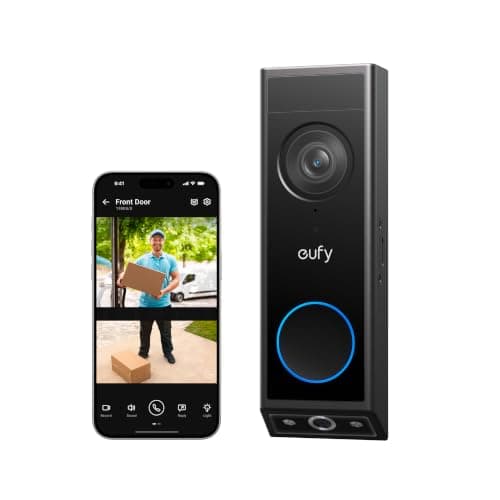
Best video doorbell
eufy Video Doorbell E340 (dual camera)
Two cameras — one on the visitor, one pointed down at the doorstep — so you see the parcel as well as the person. Records locally, wired or battery, no plan.
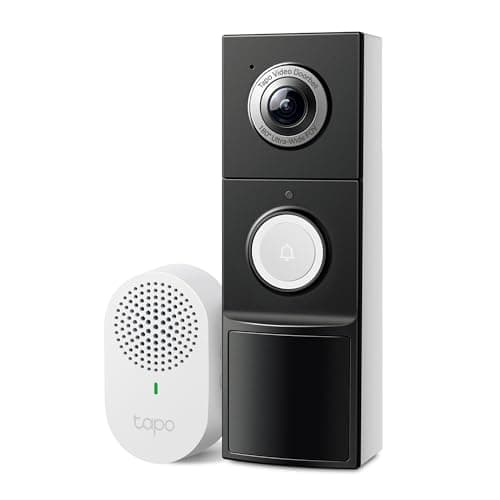
Best flexible install
TP-Link Tapo 2K+ Video Doorbell with Chime
Wired or battery, 180-degree field of view, chime included and a card slot — the most flexible install in this group and the one least likely to be blocked by your wiring.
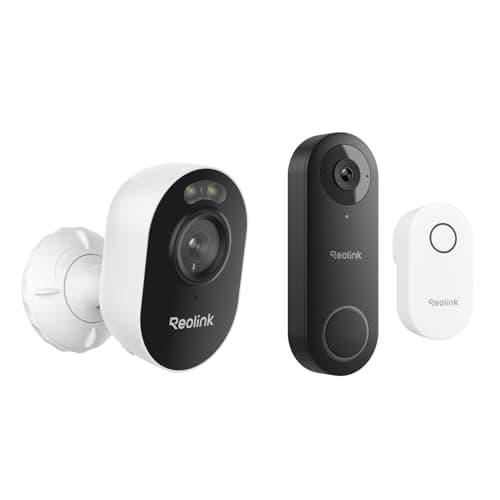
Best value doorbell
Reolink Video Doorbell WiFi (with chime)
2K, wired, local storage, chime in the box, and a head-to-toe aspect ratio that shows the parcel without a second lens. Reolink's usual trade: less polish, no bill.
#ad · As an Amazon Associate we earn from qualifying purchases.
Questions
Frequently asked
Do video doorbells need existing doorbell wiring?
Will a video doorbell ring my existing chime?
Can a video doorbell record without a subscription?
Do video doorbells work without wifi?
Is a video doorbell better than a security camera above the door?
Keep reading
Related
- Security camera vs doorbell cameraWhich device answers your actual question, if you can only buy one.
- Do video doorbells need a subscription?Which doorbells record for free and which keep nothing without a plan.
- Best video doorbellsThe ranked field, with the storage model on every pick.
- Video doorbells without a subscriptionThe ones that record to your own storage.
- Local storage vs cloudThe storage decision underneath every doorbell purchase.
- Ring vs eufyThe two doorbell philosophies, compared directly.
Receipts
Sources
- eufy — Video Doorbell E340 documentation and installation guide
- Reolink — video doorbell wiring and transformer requirements
- Reolink support — doorbell installation documentation
- TP-Link Tapo — video doorbell installation and chime documentation
- Ring support — doorbell power requirements and plan terms
- Aqara — video doorbell and HomeKit Secure Video documentation
We do not run a testing lab and we do not pretend to. Specifications come from the manufacturer's own published documents and from published standards; prices come from the live Amazon API. Where a figure is not published, the page says “not published” rather than guessing. Read the full method.