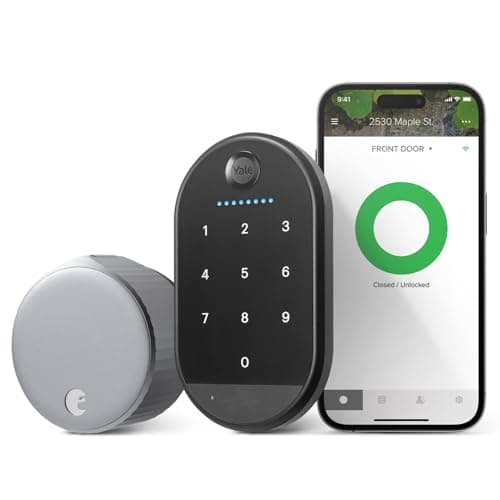
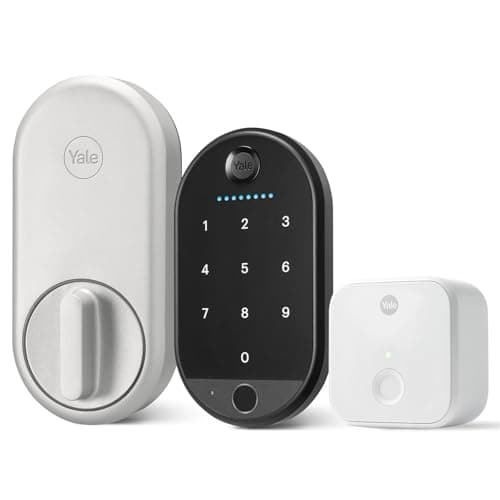
This is a stranger comparison than it looks, because these are not rivals in the usual sense. August was bought by ASSA ABLOY, which also owns Yale, so the Approach is Yale's own second attempt at the product August invented: a motor that clamps over the inside of a deadbolt you already own and turns the thumbturn for you. The exterior of the door does not change. Your key still works. That is the whole proposition, and it is why this shape of lock is the default answer for renters — the ranking of the full field is in our no-drilling roundup.
Because the mechanical half is effectively the same bet, the comparison comes down to the two things the boxes differ on, and both of them are easy to miss on a product page.
Difference one: where the Wi-Fi lives
The August has Wi-Fi in the lock body. You mount it, you join it to the network, and that is the end of the installation. The Yale Approach does not: its remote access runs through the Yale Connect Wi-Fi bridge, a small plug-in unit that is included in the box but which needs a free socket close enough to the door to hold a Bluetooth link to the lock.
That is one more thing to site, one more thing on your power bill, and one more thing that is unplugged by a cleaner and quietly takes your notifications with it. In a hallway with a spare socket it is a non-issue. In a studio flat where the door opens onto a wall with no outlet on it, it decides the purchase. Check the wall before you order either lock, because nothing else on this page is as hard to work around.
Worth being precise about what the radio actually does on a retrofit lock: it carries remote access and notifications, nothing more. Codes are verified by the lock's own processor against codes stored inside it, so the pad and the key keep working with the broadband down and the bridge dark — the mechanism is in our guide to whether a smart lock needs Wi-Fi.
Difference two: what the bundled pad can read
Neither lock body has a keypad on it. Both are a motor on the inside of the door, so code entry comes from a second device stuck or screwed to the frame outside. Both bundles we link include that second device, and this is where they genuinely diverge:
- The Yale Approach bundle ships Yale's biometric keypad. It reads a fingerprint as well as a code.
- The August bundle ships the plain Yale Keypad. It reads codes only. Nothing on an August lock reads a fingerprint, which is stated plainly in its own entry.
If a print on the door is the reason you are buying a smart lock, that single line ends the comparison. It is also the most common returned-lock story in this category: the buyer assumed “keypad” and “biometric keypad” were the same accessory because the lock bodies are near-identical.
Both pads are their own battery schedule. A retrofit lock with code entry is two powered devices, not one: the motor inside the door and the pad outside it, each on its own cells. That is the hidden running cost of this whole category, and it is why a full deadbolt replacement with the keypad built into one body is less fuss if the door is actually yours to drill. The arithmetic is in our lock battery guide.
Difference three: the cells themselves
The August takes two CR123A lithium cells. The Approach takes four AA. CR123As last well and are not expensive, but they are a camera-shop battery rather than a supermarket one, and the day the lock asks for them matters more than the price. AAs you already have in a drawer. Neither lock is heroic here, because a motor turning a bolt is the heaviest duty cycle in the smart-lock category.
Compiled from manufacturer documentation and the live Amazon listings for the bundles we link. Prices on the cards above are pulled live and dated October 18, 2026.| | Yale Approach (bundle) | August Wi-Fi (bundle) |
|---|
| Fits a door you cannot drill | Yes — interior retrofit | Yes — interior retrofit |
|---|
| Wi-Fi location | Plug-in Yale Connect bridge (in the box) | Inside the lock body |
|---|
| Needs a free wall socket | Yes | No |
|---|
| Pad included in this bundle | Biometric keypad — fingerprint and code | Yale Keypad — code only |
|---|
| Fingerprint entry possible | Yes | No, on any configuration |
|---|
| Lock cells | 4x AA | 2x CR123A |
|---|
| Second battery schedule (the pad) | Yes | Yes — 4x AAA |
|---|
| Existing key keeps working | Yes | Yes |
|---|
| Subscription for remote unlock or codes | None | None |
|---|
What neither of them fixes
A retrofit drives the deadbolt you already have, which means it inherits every mechanical problem that deadbolt has. If the bolt needs a shoulder against the door to throw, a motor will jam on it, drain its cells reporting the failure, and eventually strip something. Both locks say this in their own documentation and both of our registry entries say it as a disqualifier. Fix the strike alignment first — it is usually a screw and a file — or accept that the door needs a new deadbolt rather than a motor.
Neither changes the exterior, which is the point for a renter and a limitation for an owner. You do not get a better cylinder, a published hardware grade or a thicker bolt; you get remote control of the lock you were given. If the door is yours to modify, a full replacement is the better buy and our main roundup ranks that field. The design decision itself — retrofit or replace — is laid out in our retrofit versus replacement guide.
The third option, and when it wins
The SwitchBot Lock Ultra Touch Combo (with Hub Mini) is on this page because it answers both complaints at once and introduces a different one. Its bundled pad reads fingerprints like the Yale's, and its power is a rechargeable pack you top up over USB-C rather than a steady diet of disposables. The catch is that the lock itself is Bluetooth: remote access, Matter and voice all run through the Hub Mini in the box, so you are back to a second powered box on a socket — the exact thing the August avoids.
So the honest three-way summary is that you can have fingerprint entry, or you can have a single self-contained device, but no retrofit bundle in this comparison gives you both. SwitchBot against August is a different argument with a different answer, and we made it separately in August vs SwitchBot.
The decision rule
- Is there a free socket within a few metres of the door? If no, buy the August. The Approach's remote access depends on a bridge being plugged in near the lock, and there is no version of the Approach that puts the Wi-Fi inside the lock body.
- Do you want a fingerprint on the door? If yes, buy the Yale Approach bundle, or the SwitchBot. August does not read prints and never has.
- Does your deadbolt turn with one finger? If it does not, buy neither until it does. Both locks fail the same way on a stiff bolt.
- Are you going to take it with you? Both reverse completely, which is the whole reason to pay retrofit prices. If you own the door and are staying, a full deadbolt replacement is a better lock for the money.
- Do you need codes at all? If everyone entering has a phone, skip both pads, run the lock on Bluetooth auto-unlock, and lose the second battery schedule entirely. Guest access without a pad is covered in our guest code guide.
What you are not paying for
Neither brand charges a subscription for app unlock, remote access, codes or alerts, which is worth saying because it is not true across home security generally — the five-year arithmetic for the brands that do charge is in our subscription cost comparison. What you are paying for on both of these is the bundle: the lock alone is cheaper and useless for code entry, and buying the pad separately later costs more than buying it in the box. Check that the listing you are looking at is the bundle before you compare prices between them.
If you are renting, read the lease first
A retrofit is reversible, which is not the same as permitted, and a pad screwed to the frame is a small hole in someone else's woodwork. What is normally allowed, what to ask for in writing, and how to leave the door exactly as you found it is in our guide to installing a smart lock in an apartment.