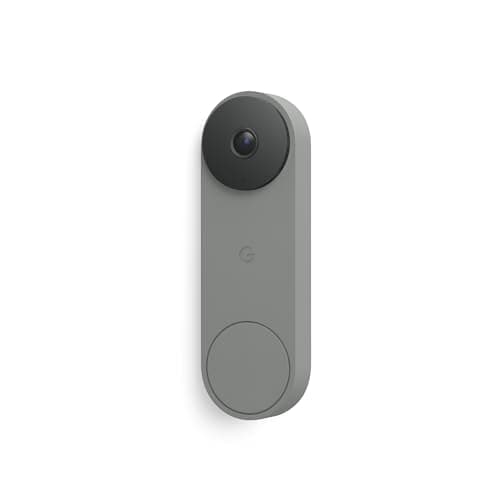
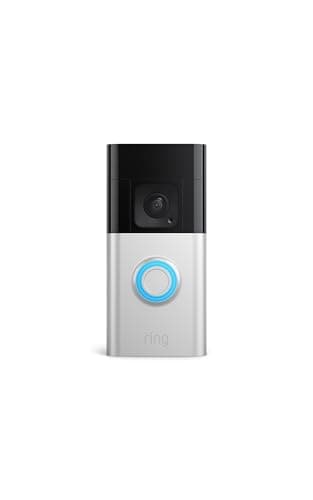
These two get compared on picture quality, which is the least useful axis available. Two things actually decide it. The first is whether your door has doorbell wiring, because Google's current-generation Nest doorbell is wired-only and Ring's is battery. The second is what each one keeps when you do not pay: Ring keeps nothing at all, and Nest keeps a rolling three-hour window. Neither writes a clip to hardware you own, at any price.
Ring vs Nest doorbell: the short answer
Buy the Google Nest Doorbell (Wired, 3rd Gen)if your door already has a doorbell transformer inside Google's specification, your house runs on Google Home, and you want the better picture and a free window of history to fall back on. Buy the Ring Battery Doorbell Plus if there is no doorbell wiring at the door, your house runs on Alexa, and you have accepted that recorded video is a subscription.
And buy neither if the reason you are reading this is that you do not want a monthly bill. That is not a dodge, it is the honest reading of both spec sheets, and it is worked through at the bottom of this page.
Head to head
Compiled from manufacturer specifications and vendor plan documentation, September 2026.| | Ring Battery Doorbell Plus | Nest Doorbell (Wired, 3rd Gen) |
|---|
| Power | Rechargeable battery; can be hardwired | Wired only — 16-24VAC, 10-40VA, 50/60Hz |
|---|
| Sensor and view | HD+ head-to-toe; Retinal 2K on Ring's current generation | 2048 x 2048 square, 166 degree field of view |
|---|
| Recorded video with no plan | None | Rolling three-hour event history |
|---|
| Local storage | None at any price | None at any price |
|---|
| Plan needed for real history | Ring Home | Google Home Premium (formerly Nest Aware) |
|---|
| Ecosystem | Alexa; largest accessory range in the category | Google Home; Gemini features on the newest model |
|---|
The wiring question comes first, and it is not close
Google specifies the 3rd-generation Nest doorbell for a 16-24VAC, 10-40VA, 50/60Hz transformer, and it draws its power from the doorbell wiring. There is no battery variant of the current generation in stock as we write this — the older Nest Doorbell (Battery) returned no availability at all when we checked the retailer. So if your door has no wiring, or has wiring fed by a transformer outside that window, the Nest is not a worse option here. It is not an option.
Ring's Battery Doorbell Plus has the opposite property: it runs on a rechargeable pack and will hardwire if you have the wiring, so it fits both houses. That flexibility is worth more than any imaging spec to a reader in an apartment, a rental, or a house where the transformer died years ago and nobody replaced it.
Two things are worth checking before you decide you are wired. A doorbell that chimes today proves a transformer exists but not what it is rated at; the VA rating is stamped on the transformer itself, usually near the panel, in the basement, or in the attic above the hallway. And a house can have wiring at the door with a transformer too weak for a video doorbell — that is the most common failed install in this whole category. The full walk-through is in our wired doorbell rankings, and if the answer turns out to be “no usable wiring,” the battery field is where to shop instead.
What each one keeps when you do not pay
This is the axis this site exists to cover, and it is the one place the two brands genuinely differ rather than trading blows.
Ring keeps nothing. Without a Ring Home plan the doorbell is a live-view intercom: it notifies you, you can look and talk, and when you close the app there is no clip. Nothing is retained that you can go back to. That is a coherent product for a household that wants to answer the door from a phone, and it is a poor one for anyone who bought a doorbell to find out what happened at two in the afternoon.
Nest keeps a little.Google publishes a rolling three-hour window of event history at no cost, alongside live view and its detection alerts. Three hours is not security coverage, but it is the difference between checking who rang while you were in a meeting and having no record at all. It overwrites itself continuously, and Google has changed the length of this window before, so check the current figure on their own page rather than trusting any article — including this one.
Neither one stores anything locally.There is no card slot, no base station, no drive, no option to buy your way to local storage on either product. Both are cloud-first by design. If the clip has to survive the camera being removed from the wall, or has to exist without a company's servers in the path, neither of these is the product — and no amount of subscription changes that.
What a plan buys is retention length and cloud-side detection, in both cases per household rather than per device. We deliberately do not print plan prices here, because they change and a stale number is worse than none; the structure of both, and the arithmetic over five years, is in what the subscriptions actually cost.
Picture, and why it is the third question
Against the Ring doorbell ranked here, the Nest wins on specification. It uses a 2048 x 2048 square sensor at a 166 degree field of view, with 2K HDR, a dedicated night-vision HDR mode and 6x digital zoom. A square frame suits a doorbell better than a widescreen one, because the thing you want to see runs vertically: a face at the top, a parcel at the bottom. Ring solves the same problem with its head-to-toe HD+ format, which achieves the same tall framing at a lower resolution. That gap has since closed. Ring has replaced this doorbell with the Battery Doorbell 2K Plus, which keeps the head-to-toe shape and shoots Retinal 2K, so on the current generation the two are level on resolution and the picture stops being a reason to pick either one.
Treat this as a tiebreak rather than a decider. Both resolve a face at doorstep distance in daylight, which is the job. Resolution starts mattering when you want a plate at the curb or a face across a wide porch, and at that point you are asking a doorbell to do a security camera's job — which is a different purchase, covered in security camera versus doorbell camera.
Ecosystem, honestly weighted
Ring is Amazon's and Nest is Google's, and each works best inside its own house. If you own Echo displays, a Ring doorbell will announce and show the visitor on them with no configuration. If you own Nest displays and Google speakers, the Nest does the same. Buying across the line works but is the less pleasant version of both.
The asymmetry worth knowing is accessories. Ring has by a wide margin the larger ecosystem of chimes, mounts, wedges, corner kits and solar panels, much of it third-party. That sounds trivial until your door faces the wrong way and you need a 45-degree wedge, or the household cannot hear the phone upstairs and wants a plug-in chime. Nest's range is narrower.
Neither publishes an RTSP or ONVIF interface, so neither drops into Home Assistant, Frigate or Blue Iris as a stream. If self-hosting is the plan, that rules both out at the first hurdle, and the Home Assistant camera rankings are the right list instead.
The chime is a real difference, and it follows from the power
Everything above about wiring has a second consequence that buyers meet on day one: what actually makes a noise inside the house.
A wired doorbell sits on the circuit that was installed to run your mechanical bell, so it can drive that bell — the thing already screwed to the hallway wall, audible upstairs, in the shower, with the television on. Google publishes a chime compatibility list for the Nest doorbell, so check yours against it rather than assuming, but the arrangement is the normal one.
A battery doorbell is not on that circuit and cannot ring that bell. The Ring Battery Doorbell Plus ships with no chime unit in the box; a Ring Chime is a separate accessory, and without one the doorbell rings phones. That is fine for a household that carries phones everywhere and quietly terrible for a household that does not — and it is the single most common complaint about battery doorbells generally, not a Ring-specific fault. Budget for the chime accessory when you compare the two, because one of these prices includes a way to hear the door and the other does not.
Living with each one
Two practical differences that do not show up on a spec sheet and do show up in month three.
The Ring needs taking down.A battery doorbell is a device you unclip, carry inside, charge, and remount, on a cadence set by how much traffic your door gets. A busy front door in a cold month is a very different interval from a quiet one in June, and the manufacturer's stated figure assumes the quiet version. Cold makes it worse: lithium cells lose usable capacity as temperature drops, so the winter interval is always the short one. If the doorbell is mounted somewhere awkward — high, behind a storm door, on a porch you need a stepladder to reach — count that chore honestly before choosing battery.
The Nest does not, and that is most of the point of a wired doorbell. It draws from the transformer continuously, so there is nothing to recharge and nothing to remount. Google rates it for operation down to -20C / -4F, which is a colder specification than most doorbells publish at all. The trade is that the install is a wiring job rather than a bracket job, and if the transformer turns out to be underpowered you are calling an electrician rather than returning a camera.
None of this is a reason to pick one over the other on its own. It is the part of the decision that gets skipped, and then gets discovered.
The decision rule
Buy the Nest Doorbell (Wired, 3rd Gen) if you have confirmed doorbell wiring on a 16-24VAC, 10-40VA transformer, your house runs on Google Home, and you want the better sensor plus a free three-hour history to fall back on.
Buy the Ring Battery Doorbell Plusif the door has no usable wiring, or you rent, or your house runs on Alexa — and you have decided a subscription is acceptable, because without one it records nothing.
Buy neither if you want recorded video with no monthly bill. Both are cloud-first with no local storage at any price, and there are doorbells that record to a card or a base station you own.
The case for buying neither
It would be easy to end this page with a winner, and dishonest. Measured on the thing this site measures — whether the hardware keeps working, and keeps your footage, without a company in the path — both of these score badly, and they score badly in the same way. The Nest is the better product of the two and it is still a cloud-first doorbell with a three-hour free memory.
The alternative is not a compromise. Doorbells that record to a microSD card or to a base station you own will play back weeks of history with no account and no plan, and several of them cost less than either product on this page. That field is ranked in video doorbells without a subscription, and the broader case sits in the main doorbell rankings. The five-year cost difference between renting retention and owning it is the whole argument, and it is bigger than the price gap between these two.
If you have read this far and still want a big-brand doorbell with a big-brand app, that is a legitimate choice and the decision rule above sorts it. Just make it knowing what you are buying: an excellent intercom, a good camera, and a recording arrangement you rent. The rest of the head-to-heads are at the comparisons hub, and the rubric behind every score on this page is published at how we pick.