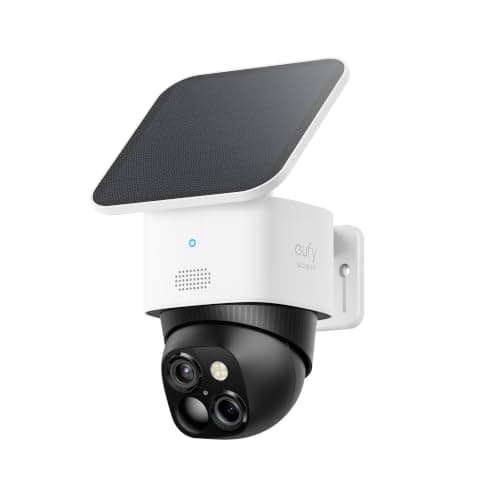
The eufy SoloCam S340 is our pick for the best outdoor camera you never pay a subscription for. An integrated solar panel keeps a built-in battery topped up, two lenses pan and tilt to follow what moves, and everything records to storage inside your own house with no plan for the core functions. It heads our best outdoor security cameras on exactly that combination. The one condition it puts on you is real sun.
What it is
The SoloCam S340 is a self-contained, wire-free outdoor camera with three unusual things bundled into one housing: an integrated solar panel on top, a pan-and-tilt head that turns a full 360 degrees, and two lenses — a wide 3K camera for context and a telephoto for a zoomed-in detail view of the same scene. It stores footage locally, on the camera itself or on a paired eufy HomeBase, and it does its whole job — record, alert, live view, play back — without a monthly fee. That last point is the entire reason it exists in a market where most cameras this capable expect a card number.
Solar plus battery: install-once, if the sun cooperates
The mechanism is simple and it is the heart of the camera. A rechargeable battery runs the camera; the solar panel trickles it back up during daylight. In a spot with adequate direct sun, the two balance out and you never recharge it — the ladder trip every few months that a plain battery camera demands simply does not happen. That is the promise, and in good sun it holds.
The condition is the honest limitation, and it is the whole of the skip line: the solar panel only works with real sun exposure. A north-facing wall under a deep eave, a spot in permanent shade, a porch overhang — put it there and the panel cannot keep pace with the draw, and you have bought an expensive battery camera that you now have to climb up and recharge on a schedule. The panel is the value. If the mounting spot gets no direct sun, this is the wrong camera, and one of the mains or PoE picks is the right one.
The running cost, stated plainly: solar, and no subscription for local recording, live view or notifications. Over five years that is a materially different number from a cloud camera with a monthly plan, and the reasoning is the same one that runs through best security cameras without a subscription.
Two cameras, and the pan-tilt tracking
The dual-lens arrangement is not a gimmick. The wide 3K lens gives you the context — the whole scene, who is where — while the telephoto pulls in a detail view of the same moment, so you are not choosing between a broad picture and a usable close-up. Married to the 360-degree pan-and-tilt head, the camera can follow a subject across the scene rather than watching them walk out of a fixed frame, keeping them in view as they move.
The honest counterweight is the ecosystem. This is a eufy device, and it lives inside eufy's world: the tracking, the dual-lens handling and the local storage all assume you are using eufy's app and, for expanded storage, eufy's HomeBase. There is no open RTSP or ONVIF path here the way there is on the wired cameras we rank, so if your plan was to feed this into Home Assistant, Frigate or a third-party recorder, it is the wrong camera and the open options are on best wireless security cameras and the PoE page beneath it. Buy the SoloCam for what it is — a polished, self-contained eufy camera — not for what a component camera does.
Where the footage goes: on the camera, or a HomeBase
Storage is the reason this camera earns its award, so it is worth being precise about it. The SoloCam S340 records to local storage on the camera itself, and it can also pair to a eufy HomeBase for expanded, centralized storage across your eufy cameras. Either way the footage stays in your house, and either way the core recording needs no subscription. eufy does sell an optional cloud tier, but the point of this camera is that you do not need it.
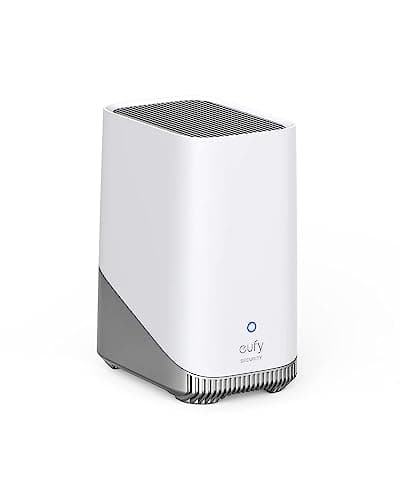
If you are building more than one eufy camera into a system, the box that makes the no-subscription claim scale is the eufy HomeBase 3 — up to a large expandable drive and on-device face recognition, so retention becomes a drive-size decision rather than a plan tier, and the AI runs in your house rather than a cloud. The honest trade of any local-storage system is stated here too: a single box holding all your footage in your house is also a single thing that can be taken, and a stolen camera takes its onboard clips with it. That is a genuine trade against a cloud that keeps an off-site copy, and it is the crux of Ring vs eufy— the cleanest statement of the cloud-subscription-versus-local-storage choice this camera sits on one side of. The general version of the argument is in local storage vs cloud security cameras.
What you give up on battery power
One thing, and it matters enough to say clearly: there is no continuous, always-on recording. A solar-battery camera sleeps between events to preserve charge, wakes when its sensor fires, and records the event. That means a short wake-up moment and no rolling pre-roll buffer of the seconds before the motion — the timeline is a series of clips, not an unbroken record. For the overwhelming majority of outdoor uses that is exactly what you want and the charge it saves is the reason the solar model works at all. But if you need a literal 24/7 continuous record with nothing missed between events, no battery camera does it, including this one; that is a wired camera, which in practice means the PoE options on best PoE security cameras.
Mounting and placement
Two placement rules decide whether this camera is a pleasure or a chore. First, mount it where the panel gets direct sun for a meaningful part of the day — south-facing and clear of overhangs is ideal, and the difference between “never recharge it” and “climb up monthly” is entirely down to this. Second, mount it high enough to be out of easy reach and angled so the pan-and-tilt head has room to sweep the scene you care about. Because the panel and the camera share a housing, the best sun angle and the best view sometimes pull in different directions; walk the spot at the time of day that matters before you drill. The general principles — height, angle, overlap, avoiding the neighbor's window — are in where to place security cameras.
Who should skip it
Anyone whose mounting spot gets no direct sun. This is the disqualifier. Under a deep porch, on a shaded north elevation, or anywhere the panel stays in shadow, you lose the entire value proposition and inherit a recharge chore. A mains or PoE camera is the right answer for a sunless location.
Anyone who wants footage off-site by default. Everything the SoloCam records lives in your house. That is the feature for most buyers and a liability for a few: if a camera being taken must not take its footage with it, a cloud-first system keeps an off-site copy, and the trade is laid out in Ring vs eufy.
Anyone who wants an open, recorder-agnostic camera. There is no RTSP or ONVIF path to a third-party NVR here. If your build is Home Assistant or Frigate, this is the wrong camera; the open picks are on best wireless security cameras and best PoE security cameras. And anyone who needs a genuine 24/7 continuous record, as above, wants a wired camera rather than any solar one.
How this review was put together
Products we claim to have tested: zero. We have not put this camera on a wall and we will not imply otherwise. What this review is built from is eufy's published product and support documentation for the SoloCam S340 and the HomeBase, the stated solar and storage behavior, and the running-cost arithmetic that follows from “no subscription for core recording.” Every one of those is a source you can open yourself, and they are listed below. Our scoring rubric and the weightings behind the metric scores on this page are published in full at methodology, so you can disagree with our conclusion using the same public material. The rest of the category is on the cameras hub.
The alternatives worth comparing
eufy HomeBase 3 — if you are building a system, not buying one camera
The SoloCam records perfectly well on its own, but if you are putting several eufy cameras around a property, the HomeBase 3 is what makes the no-subscription claim scale. It holds a large expandable drive and runs face recognition on the device, so both the footage and the processing stay in your house and retention becomes a hardware decision rather than a plan tier. Its limit is the flip side of its strength: it serves eufy cameras and nothing else, so it is not a general-purpose NVR, and the whole store sitting in one box is one box to protect. Buy it when you own more than one eufy camera; skip it if the SoloCam is the only eufy device you plan to own.
Reolink Argus PT Ultra — if you want the same idea with an open card slot
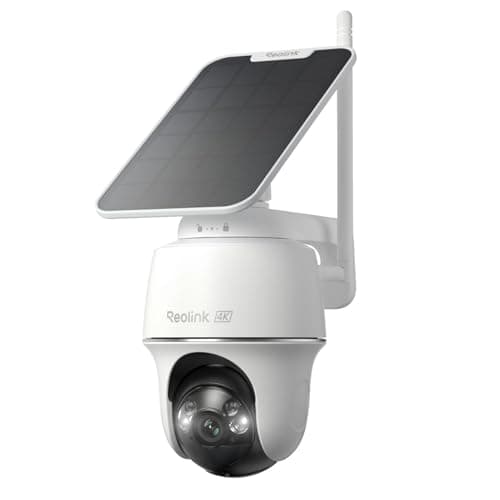
The closest cross-shop: another 4K-class solar pan-and-tilt camera that records with no account, but to a plain microSD card, and with Reolink's published RTSP and ONVIF support that makes it usable in Home Assistant or Blue Iris. It is the pick when the deciding factor is an open, recorder-agnostic storage path rather than eufy's polished app and HomeBase ecosystem. The app is less refined than eufy's, and like every solar camera it records events rather than a continuous stream. Where the two brands sit against each other across the range is at eufy vs Reolink.
Where the SoloCam sits between them
The HomeBase is an addition to the SoloCam, not a rival: buy it when the system grows. The Reolink is the genuine alternative, and the choice between them is the choice between eufy's closed-but-polished ecosystem and Reolink's open-but-rougher one. For a buyer who wants a single, self-contained, subscription-free outdoor camera that installs once and looks after itself in good sun, the SoloCam S340 is the one we would fit, which is why it heads best outdoor security cameras and earns the subscription-free award here.