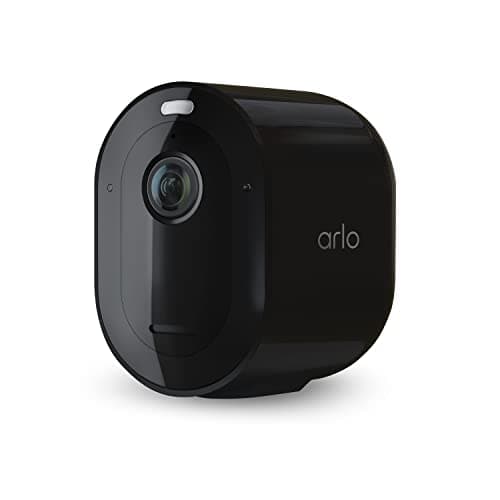
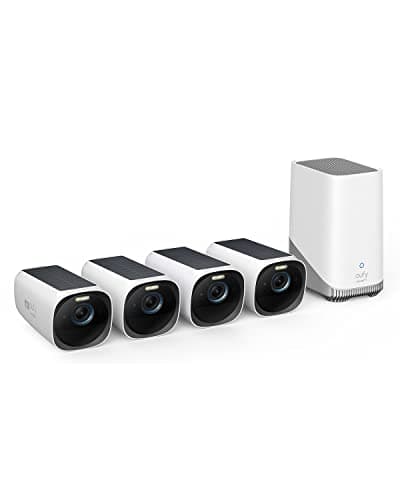
The eufyCam 3 (S330) and the Arlo Pro 5S sit on opposite sides of the one decision that outlives every other spec in a security camera: where the recording lives, and whether you keep paying to watch it. The eufyCam 3 records 4K to a HomeBase 3 that comes in the box and asks for no plan at all. The Arlo Pro 5S is a genuinely sharp 2K HDR camera whose recorded video — and much of what makes it worth owning — sits behind an Arlo Secure subscription. Settle that one line first and the rest of this page is detail.
One honest note on what you are actually buying, because these two are not sold the same way. The eufyCam 3 (S330) is a whole-property kit: four solar-charged 4K cameras plus the HomeBase 3, bought once. The Arlo Pro 5S is usually bought as a single camera or a small bundle. So the up-front outlay is not like-for-like on camera count — and we do not print prices here in any case. What is like-for-like, and what this comparison is about, is the storage model each brand builds around: local and included on one side, cloud and metered on the other. That difference is the one that follows you for years.
eufyCam 3 vs Arlo Pro 5S, compared
The columns below are the ones that separate these two. There is no price row, because the shelf number moves and a live layer renders it; there is a plan row, because that is the number that never stops.
Compiled from manufacturer specifications, August 2026.| Model | Resolution | Where recordings live | Plan needed for recorded video? | Power | Sold as |
|---|
| eufyCam 3 (S330) | 4K | Local — HomeBase 3 in the box, expandable with a drive | No | Solar-charged battery | Four-camera kit with the HomeBase |
|---|
| Arlo Pro 5S | 2K HDR | Cloud by default; local needs a separate Arlo base station | Yes — Arlo Secure | Rechargeable battery | Single camera or small bundle |
|---|
The decision rule. Buy the eufyCam 3 (S330)if you want the footage to live in your house, you are covering a whole property in one purchase, and you refuse to pay a monthly fee to watch your own recordings — 4K, solar, nothing gated behind a plan. Buy the Arlo Pro 5Sif you want the sharpest single camera of this pair and you are genuinely willing to keep an Arlo Secure plan for as long as you own it, because without that plan the camera keeps no recorded video. If the monthly fee is the dealbreaker, the answer is eufy, not Arlo — the whole no-plan field is ranked at best local-storage security cameras.
Storage is the whole argument
Everything else on this page is downstream of one thing. The eufyCam 3 writes its footage to the HomeBase 3 that ships in the box, and that base takes a large drive, so how much history you keep is a hardware decision rather than a plan tier. You buy the retention once. The Arlo Pro 5S sends its recordings to Arlo's cloud, and reaching them — playing back a clip, saving an event, using the smarter detection — requires an active Arlo Secure subscription. Arlo does sell a base station that adds local storage, but it is a separate purchase and a shrinking part of the line, so it is not the default experience most buyers get. For the mechanism behind that split, and why it decides the long-run cost more than any spec, see local storage versus cloud security cameras.
The trade-off runs both ways, and the eufy side has a real one we will not skip. Because the eufyCam 3 keeps everything on the HomeBase in your house, the recordings are only as safe as the base. If someone walks off with the base, the footage goes with it, and eufy's optional cloud backup is the answer to that, at extra cost. A cloud-first camera like the Arlo puts the clip off-site the instant it is captured, which is a genuine advantage of the model — it is just an advantage you rent rather than own.
Resolution: 4K local against 2K HDR cloud
On raw resolution the eufyCam 3 is ahead: it captures 4K, where the Arlo Pro 5S captures 2K with HDR. More pixels is more detail to zoom into after the fact, which is the number that matters when you are trying to read a plate or a face at the edge of a wide scene. The Arlo answers with image processing rather than pixel count: 2K HDR handles high-contrast scenes — a bright doorway against a dark porch — with a real spotlight, color night vision and up to 12x zoom, plus dual-band Wi-Fi that dodges the 2.4GHz congestion that makes cheaper cameras stutter. If you judge a camera on the sharpness of a single well-lit frame, the eufy leads; if you judge it on holding detail across an ugly mixed-light scene, the Arlo's HDR closes much of that gap. Neither is a weak imager. The difference that lasts is still where the frame is stored, not how sharp it is.
The shape of the five-year cost
Do not compare these on the shelf price. Compare them on the hardware plus five years of whatever keeps each one working. The eufyCam 3 is a larger up-front number — four cameras and a base — and then close to nothing: solar charging means no battery swaps, and recording, playback and notifications carry no fee. The Arlo Pro 5S is a smaller up-front number for one camera and then sixty months of Arlo Secure to make it do the job you bought it for, and Arlo's plan pricing is, by the manufacturers' own published history, among the most volatile in the category — it has moved upward more than once. We keep that arithmetic as a maintained table rather than printing a figure that would be stale within a quarter; the current shape of it is at subscription costs compared. The short version: the eufy front-loads the cost and stops, the Arlo spreads it and does not.
Ecosystem, power and the app
Arlo wins the software and the integrations. Its app is more polished, its detection is smarter, and its works-with list is broader — check Arlo's current compatibility page for the exact voice-assistant and platform support, because that list changes. eufy centers on its own app and the HomeBase, which is deliberately more self-contained; the strength there is that the system does not lean on someone else's cloud to function. On power the two are close in spirit: both run on rechargeable batteries, but every eufyCam 3 camera charges from an integrated solar panel, so in a spot that catches daylight it is effectively maintenance-free, while the Arlo is a recharge-when-it-runs-down camera unless you add a solar accessory. Neither records continuously, because neither is mains-wired; both capture event clips, which is the honest limit of any battery camera.
How we compiled this
Products we claim to have tested: zero. We have not mounted either of these on a wall, and we will not pretend to a lab we do not have. What we do instead is read each manufacturer's published specification, support documentation and plan terms — especially the quiet lines about what a subscription gates and what a base station stores — work out the running cost, and cite it. Both cameras here are ranked on their own hubs too; this page only exists to put the storage question side by side. The rest of the head-to-heads live on the comparisons hub, and the full scoring rubric is at methodology.
How to choose between them
Start with the subscription question, not the camera
The fastest way to pick is to answer one thing before you look at either spec sheet: are you willing to pay a monthly fee, forever, to watch your own footage? If the answer is a firm no, this comparison is already over — the eufyCam 3 records with no plan and the Arlo Pro 5S does not, and no amount of Arlo's better image or app changes that. If you are genuinely fine with a recurring plan, then the Arlo's software polish and processing become real reasons to prefer it, and the decision reopens.
Then count the cameras you actually need
These are sold for different scopes. If you need to cover several approaches to a detached property in one buy, the eufyCam 3 kit is built for exactly that and the per-camera cost works in its favor. If you need one camera on one spot — a single side gate, a back door — buying a four-camera eufy kit to use one of them is poor value, and a single Arlo (or a single-camera pick from another brand) is the saner shape. Match the pack size to the number of walls you are watching.
The mistake buyers make
The common error is buying the Arlo on the strength of its hardware review and only later discovering that the recorded video they assumed came with the camera is a separate, ongoing bill — and that the plan price has a habit of rising. It is a good camera; it is just a rental relationship, and it should be bought as one, with eyes open. The mirror mistake on the eufy side is ignoring the single-point-of-failure risk: all your footage is on one base in one house, so if off-site copies matter to you, plan for eufy's optional cloud backup rather than assuming local means bulletproof.