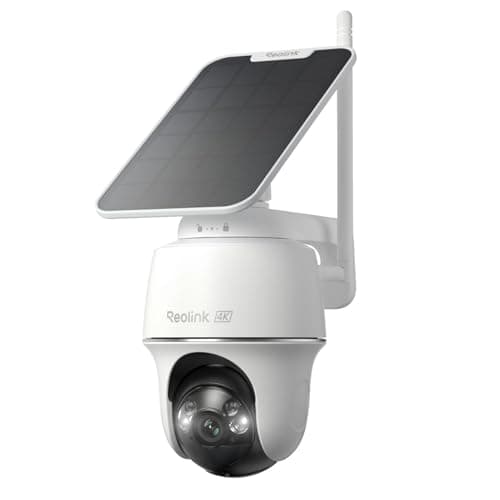
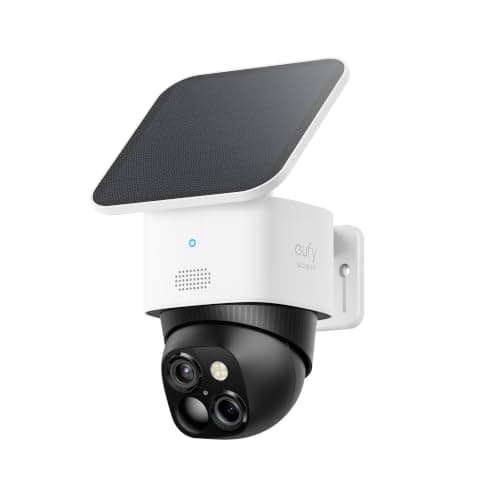
Most brand-versus-brand pages in this hub are decided by the subscription, because usually one of the two cameras stops recording the day you stop paying. That tiebreaker is not available here. Both of these record to storage in the device with no plan at any tier, so the comparison has to be made on the things that actually differ: the storage medium, the optics, and whether anything other than the maker's own app can reach the stream.
The head-to-head
Compiled from manufacturer specifications, October 2026. Prices for both cameras are live on this page from the Amazon API and are stamped as of October 5, 2026. | eufy SoloCam S340 | Reolink Argus PT Ultra |
|---|
| Sensor | 3K, two lenses (wide + telephoto) | 4K, single lens |
|---|
| Movement | 360° pan with tilt | Pan and tilt |
|---|
| Power | Integrated solar panel | Solar panel |
|---|
| Storage medium | Onboard, inside the camera | microSD card you supply |
|---|
| Open stream | Not published | RTSP and ONVIF published across much of the range |
|---|
| Plan needed to record | No | No |
|---|
| Continuous recording | No — events only | No — events only |
|---|
Where the footage is written
This is the first real difference and it cuts both ways. The eufy writes to storage built into the camera: nothing to buy, nothing to format, nothing to forget, and no slot for water to find. The Reolink writes to a microSD card you choose, which means you decide the capacity, you can pull the card and read it in a laptop, and you can replace it when it wears out — flash cards in a camera that records every event do eventually wear out.
If you want the simplest possible arrangement, sealed onboard storage is genuinely simpler. If you want the footage to be a thing you physically hold, the card wins. Both share the same honest weakness, which neither maker advertises: local storage means a stolen camera takes its recordings with it. That trade-off is the whole subject of our local storage versus cloud guide.
Two lenses against more pixels
The eufy spends its money on a second camera. One lens gives you the wide context and the other gives you a zoomed view of the same scene, which on a drive or a garden path is more useful than it sounds: you get the shape of what happened and a closer look at the part that matters, without having to crop a recording afterwards.
The Reolink spends its money on resolution instead: a single 4K sensor rather than two smaller ones. On a wide scene that is more total detail, and the pan and tilt lets you aim the whole sensor at what you care about. Neither has optical zoom, so neither reaches the way a motorized lens does — if distance is the problem rather than coverage, both are the wrong camera and our driveway camera rankings explain why.
The openness difference, which outlasts both cameras
Reolink publishes RTSP and ONVIF support across much of its range. In practice that means the Argus can be added to Home Assistant, Frigate or Blue Iris and recorded by software you run, independently of Reolink's app and independently of whether Reolink still exists in five years. eufy does not publish an equivalent interface for the S340, so the camera is usable through eufy's app and what eufy chooses to integrate with.
For most buyers that is an abstraction. For anyone who already runs a local camera server it is the entire decision, and it is the reason the Argus is the pick in our Home Assistant camera roundup. It is also worth weighing against brand history in general: eufy's past disclosures about cloud thumbnail handling are a fair thing to read before buying the brand, and a camera you can record with your own software is less dependent on any vendor's future decisions.
What they have in common, and it matters more than the differences
Both are solar, and solar only works with real direct sun at the mounting point. A north-facing wall under a deep eave will not keep either of them charged, and you will have bought an expensive battery camera you now have to climb up to recharge. Check the sun on the actual spot across a day before you buy either.
Both are also event-driven, because every battery camera is. Neither records continuously, so a car that was already parked when the camera went to sleep may not appear in any clip, and a slow approach at the edge of a detection zone may not wake it in time. That is a property of the power design, not a flaw in either model, and it is set out in do security cameras record all the time. If continuous capture is the requirement, both of these are the wrong purchase and the answer is a wired camera — in practice PoE.
The decision rule
There is no universal winner here, so here is the rule rather than a verdict.
- Buy the eufy SoloCam S340 ifyou want the best image on the page and the second zoomed lens, you are happy in one maker's app, and you would rather have storage that needs no decisions than storage you can hold.
- Buy the Reolink Argus PT Ultra if you want the footage on a card you supply and can remove, or you run Home Assistant, Frigate or Blue Iris and want the camera recorded by your own software on your own terms.
- Buy neither if the mounting spot gets no direct sun, or you need continuous 24/7 recording. Both fail on the first for the same reason, and both fail on the second because every battery camera does.
If you are buying two
Buying one of each is a more sensible answer than it looks. The eufy goes where you want the detail and the second lens — the approach to the front door, the drive — and the Reolink goes where you want the recording in your own hands, or where your camera server can reach it. They do not have to be the same brand, and nothing about either requires a matching system or a base station.
What decides the price
Lens count against sensor resolution, and panel size. Neither camera carries a subscription for recording, playback or notifications, so the purchase price is close to the whole cost of ownership — which is unusual in this category and is exactly the comparison made in our subscription cost table. Both appear in our solar camera roundup, and the wider brand question is in eufy versus Reolink.
How we picked
Products we claim to have tested: 0
Everyone in this category says they tested a dozen locks on their own front door. We have not tested any, and we say so. Here is what we do instead: read the manufacturer's manual and spec sheet, record the published protocol, power and storage figures, check the published standard where one exists, compute what the device costs to keep running, and cite all of it so you can check the work. Prices come live from Amazon's API and disappear rather than go stale.
The scores above are judgments from that documented research — not bench measurements. The full rubric, including what disqualifies a product, is published in full.