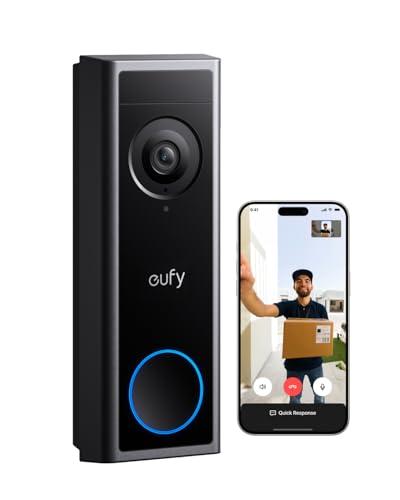
The best video doorbell under $100 for most houses is the eufy Video Doorbell C31: a card you own, no monthly fee for recording, and a battery option so an unwired door is not disqualified. Everything below is the reasoning, including the two cases where a different doorbell on this page is the better buy.
Under $100 is where the video doorbell market gets interesting, because it is where the business model stops hiding. Above $150 the hardware is good enough that brands compete on features. Below $100 there is not enough margin in the box, so the money has to come from somewhere else — and in this category it comes from storage. Two doorbells on this page give you a card slot and walk away. One gives you a card slot only if you add the house wiring. One needs a second box you already own a worse version of. And one has no local storage path at all, at any price, forever.
That is the whole ranking. Not resolution, which is within a hair across four of the five. Not field of view, which varies by about thirty degrees and matters less than where you mount it. Where the clip gets written, and what it costs per month to keep it there.
About the ceiling. Every doorbell on this page came in under $100 on Amazon when the page was written, verified through the Amazon API rather than from a retailer listing. The cards above pull today's live price and are stamped November 12, 2026. Prices move, and two of these are close enough to the line that a restock can push one over it — read the card, not the headline, before you buy.
The best video doorbells under $100, compared
The columns below are the five facts that decide this purchase. The two that get skipped in most cheap-doorbell lists are the last two: whether a chime is in the box, and whether the doorbell can work at all without a second device.
Compiled from eufy, TP-Link Tapo, Wyze, Blink and Ring product and support documentation, November 2026. Prices on the cards above are pulled live and dated November 12, 2026; no price appears in this table.| Model | Local storage | Plan needed to save video | Power | Chime in box | Second device required |
|---|
| eufy Video Doorbell C31 | microSD to 128GB (not included) | No | 6,500mAh pack or 16-24V AC | No | No |
|---|
| Tapo D210 with Chime | microSD to 512GB (not included) | No | Battery only | Yes | No |
|---|
| Wyze Wired Doorbell v2 | microSD to 256GB, 24/7 continuous | No, for local | Existing wiring only | No | No |
|---|
| Blink Battery Doorbell 2K+ | Not on the included Sync Module Core | Yes, unless you add a Sync Module 2 or XR | 3x AA lithium | No | Yes — a Sync Module, Core included |
|---|
| Ring Wired Doorbell 2K | None at any price | Yes | 8-24V AC wiring or adapter | No, and no mechanical chime support | No |
|---|
The axis: does the price include storage, or rent it?
A video doorbell has one job that costs money to perform: keeping the thirty seconds of video from the moment you were not home. Live view is cheap — it is a stream between two devices and nobody has to store anything. Two-way talk is cheap. Recording is the expensive part, because somebody has to hold the file.
There are only two places to hold it. On a card or drive in your house, which costs you one payment and then nothing, or in a manufacturer's cloud, which costs a monthly fee for as long as you want the footage. Every price difference in this category traces back to which of those two the brand has decided you will use. A doorbell sold cheap by a company with a storage plan is a loss leader for the plan. A doorbell sold cheap by a company selling you a card slot is just a cheap doorbell.
Run the arithmetic over the life of the hardware and the sticker price almost stops mattering. A doorbell that needs a plan is paying rent the whole time it is on the wall, and the plan does not get cheaper as the hardware ages. We keep the shape of that calculation in our subscription cost comparison, and the practical version of the question — what you actually lose by refusing the plan — in do video doorbells need a subscription.
The five doorbells, ranked
1. eufy Video Doorbell C31 — the one that owes nobody anything
eufy builds its whole security line around not charging you monthly, and the C31 is the cheapest expression of that. Its specification page lists 2K at 2048 by 1536, a 160-degree view, IP65, an operating range of -4F to 122F, and a microSD card of up to 128GB that eufy is explicit is not included. Recording to that card has no monthly fee. If you later want more than a card holds, a HomeBase 3 takes a 2.5-inch SATA drive up to 16TB — that is an upgrade path rather than a requirement, and it is the one the rest of this page does not have.
The power story is what puts it first rather than second. A removable 6,500mAh pack, or existing 16-24V AC doorbell wiring if the door has it. A rented house with no transformer is not excluded, and because the pack is quick-release, charging does not mean taking the camera off the wall for the evening.
What it does not do: packages. eufy lists person and motion detection and states that package detection and face recognition are not supported. If a doorstep parcel is the whole reason you are shopping, the dual-camera E340 one tier up exists for that job and we rank it in our parcel-coverage doorbell rankings. There is also a wrinkle worth knowing before you order: eufy's own page gives the view as 4:3 in the spec table and as a 16:9 extended view in a feature callout. Treat the framing as approximate until it is mounted.
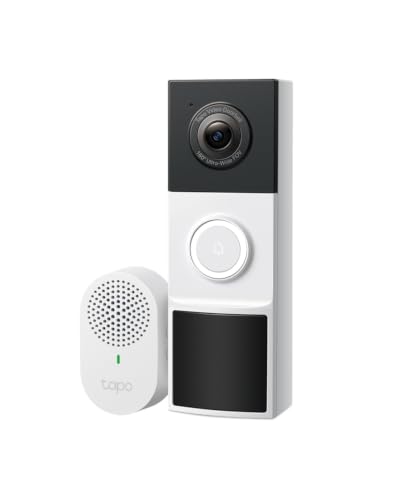
2. Tapo D210 with Chime — the one that arrives finished
The most common disappointment with a cheap battery doorbell is discovering it does not ring. It alerts your phone, and if your phone is face-down in another room, nobody answers the door. A chime is a separate purchase on most of this page. On the D210 it is in the box, which is why this is the kit we would hand to someone who does not want a project.
Tapo publishes 2K video, a 160-degree head-to-toe view, up to six months per charge, and microSD support up to 512GB — the largest card allowance here by a factor of four over the eufy. Tapo also states directly that local storage and smart AI detection require no subscription, with Tapo Care as an optional cloud layer. That is the same posture eufy takes, from a brand whose cheap cameras we already rank well in our budget camera roundup.
The honest limits: Tapo lists person detection on this model and reserves vehicle and package detection for its dearer D225 and D260. It is battery-only, so a wired door gains nothing here. And Tapo's product page publishes neither a weather rating nor a battery capacity for the D210, which is a gap — two numbers a careful buyer would like are simply not stated, and we are not going to invent them.
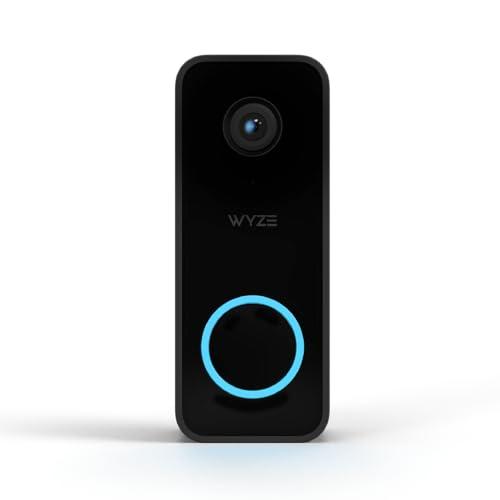
3. Wyze Wired Doorbell v2 — the only continuous recorder at this price
Everything else on this page records events. Something moves, the camera wakes, you get a clip, and the time between clips does not exist. The Wyze Wired v2 records continuously to a microSD card of up to 256GB, which means you can scrub a timeline rather than hope the trigger fired. Wyze documents that as 24/7 local recording with no plan required, and at this price nothing else offers it.
The cost of that capability is the power cable. Continuous recording is only possible on mains power, so the product name itself says existing doorbell wiring is required — there is no battery mode to fall back on. If your door has a working transformer, this is arguably the most capable doorbell on the page. If it does not, it is not a candidate at all, and our connectivity and power guide for doorbells covers how to tell which you have before you order.
Two further caveats. Without a card you get short press-triggered clips and nothing else, so the card is not optional in practice. And Wyze has publicly disclosed security incidents involving camera feeds; that history belongs in the decision about where in the house you point any Wyze product, and we say the same thing on the budget camera page where Wyze also ranks well on price.
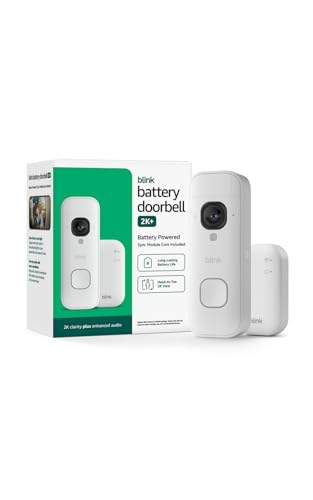
4. Blink Battery Doorbell 2K+ — two years of battery, one missing box
Blink's battery claim is not marketing fluff and it is not close: three AA lithium cells, up to two years at default settings, in a doorbell rated IP65 across -5F to 113F. That is the widest temperature window published by any maker on this page and several times the runtime of any rechargeable here. For a cold climate, a gate at the end of a drive, or a second door nobody uses, that is a genuine advantage.
Then there is the storage problem, and it is specific rather than vague. The doorbell requires a Sync Module to function at all. The kit includes the Sync Module Core, and Blink's own support pages state that the Core supports neither Local Storage nor Clip Backup — and that it is not sold separately. So plan-free recording on this doorbell means buying a Sync Module 2 or XR as well, which takes a USB drive or a microSD card up to 256GB. We worked the same arithmetic through in our Blink Outdoor 4 review, where the kit has exactly this gap. Add it up and the cheapest sticker on the page stops being the cheapest system.
It is also 1920p in Blink's own wording rather than 2K, with a 140-degree horizontal view — the narrowest here. Buy it for the battery and the cold, and budget for the module.
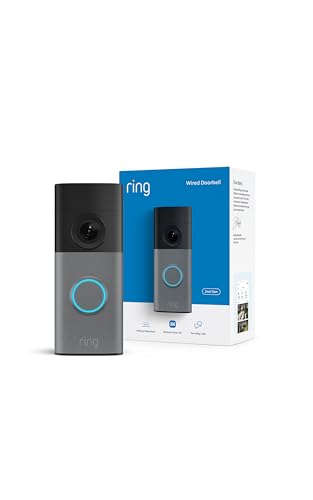
5. Ring Wired Doorbell 2K — the cheapest to buy, the dearest to keep
We are ranking this last and still listing it, because it is the doorbell most people in this price band will actually be shown, and the reason not to buy it is a fact rather than an opinion. Ring publishes no card slot, no drive option and no local storage path for this doorbell at any price. Saved video history is a feature of an eligible Ring Home plan. With no plan you have a working intercom — live view and two-way talk — and no record of anything that happened while you were out.
The hardware is good. Retinal 2K with a wide-angle view and up to 6x enhanced zoom, the most mature app in the category, and the best mounting hardware in the group. There is also an install detail Ring states and buyers routinely miss: it does not support an existing mechanical chime, so the in-home chime has to be bypassed during installation and replaced with a Ring Chime or an Alexa speaker. Budget for that too.
If you are specifically trying to get off Ring's monthly fee rather than onto it, that is its own project and we have written it up separately in our guide to the Ring alternatives.
Which one to buy
Unwired door, or renting: the eufy C31 on battery, or the Tapo D210 if you want the chime included. Both record locally with no plan. Wired door and you want everything: the Wyze Wired v2, for the continuous timeline nothing else here offers. Cold climate or a door you rarely use: the Blink, with a Sync Module 2 added so the recordings are yours. You already pay for a Ring plan and like it: the Ring Wired Doorbell 2K is the cheapest way into hardware you will not resent, as long as the plan is a decision you have made rather than one you discover.
And one case where the answer is to spend more: if parcel theft is the actual problem, none of the five does package detection well, and the dual-camera tier above this ceiling does. That is a real reason to break the budget, and our main doorbell rankings cover the field without a price cap.
What this ranking is based on
Every specification on this page is quoted from the manufacturer's own product or support documentation, listed in the sources below. Every ASIN was checked for live availability and a live price through the Amazon API on the day this page was written, and any doorbell that returned no stock was left off — which is why the Aqara G4, a pick elsewhere on this site, is not here. Products we claim to have tested: zero. We do not run a test lab and we do not pretend to. What we do instead is read the specification sheets, the support articles and the plan terms, and publish the rubric at our methodology page so you can reproduce the ranking from the same public sources.
How to buy a video doorbell under $100
Check your wiring before you check anything else
Two of the five doorbells here are wired-only and one of those does not work at all without existing doorbell wiring. Before you compare resolutions, find out whether your door has a transformer and what it is rated. Ring specifies 8-24V AC at 40VA maximum; eufy wants 16-24V AC at 10-40VA for a wired install. A doorbell button that already chimes indoors means a transformer exists; a door with no button, or a battery-operated chime, usually means it does not. That single answer eliminates half this list in either direction.
Decide the storage question before the brand question
Ask what happens to a clip when nobody is home, and insist on an answer in two parts: where is it written, and what does it cost per month. If the answer is a card you buy once, the running cost is zero and you are done. If the answer is a cloud plan, multiply the monthly fee by sixty and compare that number to the sticker price. In this price band the plan almost always wins, which is precisely why the hardware is cheap.
Budget for the two things that are never in the box
A microSD card, on every single doorbell here that takes one. None of the five includes it. And a chime, on all of them except the Tapo — a battery doorbell with no indoor chime notifies your phone and nothing else, and on the Ring you also have to bypass the chime you already own. Add those to the price before you compare, because they are the difference between a doorbell and a doorbell that works the way you imagined.
What actually decides the price down here
Not the sensor. The four 2K-class cameras on this page are close enough that mounting height and lighting matter more than the spec. What decides the price is power design — a 6,500mAh rechargeable pack costs more to build than a battery tray, and continuous recording needs mains power — and whether the brand expects to earn from you later. The cheapest units here are the ones with the clearest route to a recurring fee.
The mistake buyers make
Buying on the sticker and discovering the system. The Blink is the clean example: cheapest price on the page, and the module in the box is documented by Blink as unable to store anything locally, so the plan-free version of that doorbell costs the doorbell plus a module plus a drive. The Ring is the other shape of the same mistake — nothing missing from the box, and no local option will ever exist for it. Neither is a scam. Both are systems, and the price of a system is not the price of its first box.
What $100 does not buy, at all
Reliable package detection, as a feature you can trust rather than a checkbox. A second downward lens. 4K. Continuous recording on battery power — physics, not pricing. And a mechanical chime on the Ring. If any of those is non-negotiable, this is the wrong page and the uncapped rankings are the right one.