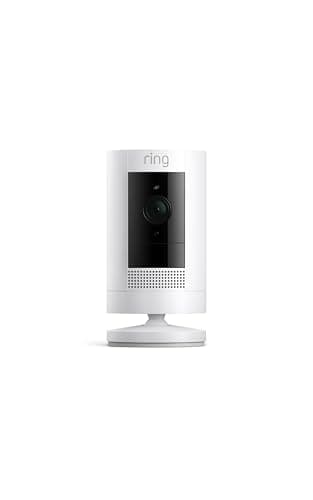
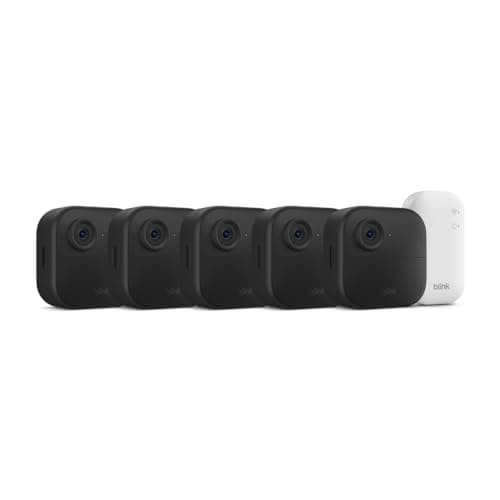
Ring and Blink are owned by the same company and sold beside each other, which encourages the assumption that Blink is simply the cheap Ring. It is not. The two brands answer the single most consequential question in a security camera — where does the recording go — in opposite ways, and that difference outlives every specification on either box.
The one difference that decides it
Blink's design allows a Sync Module with local storage, so clips can land on hardware sitting in your house and stay there without a monthly payment. Ring's cameras are cloud-first: without a plan you get live view and notifications, and recorded clips you can go back and watch are what the subscription buys. Neither company hides this, and neither arrangement is dishonest. But it means the two products cost very different amounts to own over five years, and the gap grows the longer you keep them and the more cameras you add.
If your reason for shopping is that you do not want a monthly bill, the comparison is effectively over at this paragraph, and Blink wins on the criterion you came with. If you are relaxed about a plan, the rest of the page is about whether Ring's ecosystem and app are worth what they cost, and often they are.
It is worth naming why the two brands are positioned this way, because it is not an accident of engineering. Blink is sold as inexpensive hardware you own; Ring is sold as the front end of a service, which is why its app, its accessory range and its support are all better resourced than Blink's and why its recorded video sits behind a plan. Both are coherent products. They are simply aimed at two different buyers, and the mistake is assuming the cheaper one is the same product with less of it.
Compiled from manufacturer specifications and published plan documentation, August 2026. Battery life varies with traffic, temperature and detection settings. | Blink Outdoor 4 | Ring Outdoor Cam |
|---|
| Recorded clips without a plan | Yes, via Sync Module local storage | No — live view and alerts only |
|---|
| Resolution | 1080p | HD |
|---|
| Power | AA cells, two-year published life | Battery or wired |
|---|
| Night vision | Infrared | Color night vision |
|---|
| Ecosystem depth | Basic app, Alexa | Deep Alexa integration, large accessory range |
|---|
| Best suited to | Cheap coverage with no recurring cost | A polished app and an ecosystem you will extend |
|---|
Where Blink is genuinely better
Two places, and both are structural rather than marginal. The first is running cost: a Sync Module is a one-off purchase that lets a set of cameras keep their clips, where the Ring equivalent is a payment that repeats for as long as you own the camera. Multiply that by three or four cameras and several years and it becomes the largest number in the whole decision — the arithmetic is worked through in our subscription cost comparison.
The second is battery life. Blink publishes a two-year figure on ordinary AA cells, which is an order of magnitude beyond what most rechargeable battery cameras manage, and it changes the ownership experience more than any image specification. A camera you service twice a decade is a camera you forget about; a camera you take down to charge every few months is a chore with a lens. For a shed, a side path or a second property, that alone can settle it.
Where Ring is genuinely better
The app and the ecosystem. Ring's app is the most polished in this category, its notifications and shared-user handling are better thought through than most, its Alexa integration goes deeper than a voice command, and the accessory range means a Ring house can grow into doorbells, sensors and an alarm system without leaving one interface. If several people in the household will use the camera, that coherence has real value.
Its cameras also do color night vision where the Blink is plain infrared, which is a meaningful difference in describing what you saw: clothing color and vehicle color survive the recording rather than becoming shades of gray. If the camera exists to tell you who was there rather than that somebody was, that matters. Ring's full position against the subscription-free field is in our Ring versus eufy comparison.
The decision rule. Buy Blink if you want recorded footage without a recurring bill, if you are covering outbuildings or low-stakes positions cheaply, or if changing batteries twice a decade instead of four times a year is worth more to you than image polish. Buy Ring if a monthly plan is acceptable, if the household will use the app daily, or if you intend to add a doorbell and an alarm and want one ecosystem doing all of it.
The Sync Module, in plain terms
Blink's local storage is not a card in the camera. It runs through a Sync Module: a small hub that sits indoors, talks to the cameras on its own radio, and holds a USB drive you supply. Clips land on that drive, and reviewing them is free. Understanding this arrangement matters because it explains both the appeal and the limits.
Check which Sync Module is in the box. There are two, and only one does this. Blink now ships the Sync Module Corewith its current Outdoor 4 kits, and Blink's own support documentation states that the Core does not support local storage or clip backup — there is no USB port on it. The module that takes a drive is the Sync Module 2, and on a current kit that is a separate purchase. Budget for it, or the plan-free arrangement below does not happen.
The appeal is that one module covers several cameras, so the local-storage cost is paid once for a system rather than per camera, and the footage is consolidated in one place rather than scattered across memory cards on ladders. The limits are that it stores clips rather than continuous video, because the cameras are battery devices that sleep between events; that the drive is in your house, so it can be taken along with everything else; and that some cloud-side features still sit behind a plan even when local storage is working. Read the current feature list rather than assuming local storage means every feature is free.
Ring has no equivalent for its cameras. Its local-storage story runs through the alarm side of the product line rather than the camera side, so for a Ring camera the recorded-clip question really does come down to whether you subscribe. That is the honest shape of the comparison, and it is why this page spends more time on storage than on sensors.
What each one is like to live with
Both are battery cameras that mount without an electrician, and both are genuinely easy to install — a bracket, a charge or a set of cells, and a few minutes in an app. The difference shows up over the following year rather than the first afternoon.
With Blink, the ongoing task is essentially nothing. AA cells with a published two-year life means the camera disappears into the wall and you stop thinking about it, which for an awkward mounting position is worth more than any specification. What you notice instead is the app: functional, plain, and clearly built to a budget. Alerts arrive, clips play, and little else happens.
With Ring, the ongoing task is a charge cycle on the battery models and the monthly payment, and what you get in return is the most complete consumer app in home security: sensible shared access for a household, notification handling that is genuinely better thought through than most, and an accessory range that means a Ring house grows without a second app appearing. If several people rely on the system daily, that coherence is not a luxury — it is the difference between a system everyone uses and a system one person maintains.
What neither of them is
Neither brand is the answer if you want continuous recording, high-resolution detail at distance, or footage on a drive you control at scale. Both are event-clip battery cameras aimed at convenience, and both stop well short of what a wired system does — that is a different purchase, covered in our camera systems roundup. If you want subscription-free recording and a serious image, the eufy and Reolink side of the market is where to look, and it is ranked in our no-subscription cameras roundup. Read both brands' plan pages before you commit either way; the storage model is the part of a camera you cannot change afterwards.