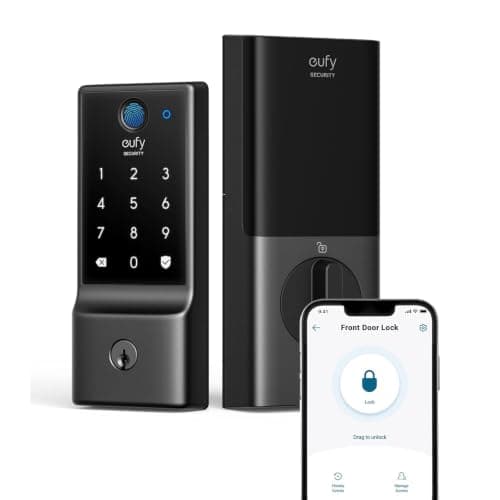
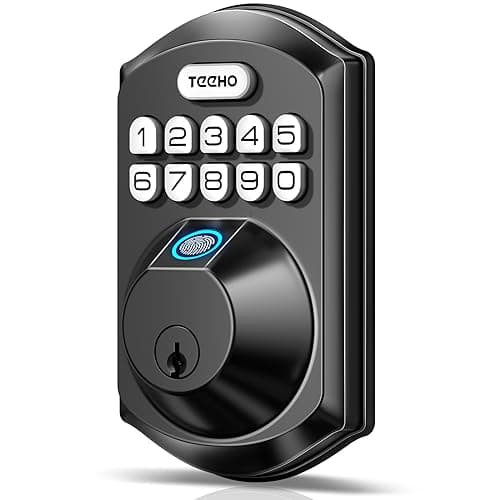
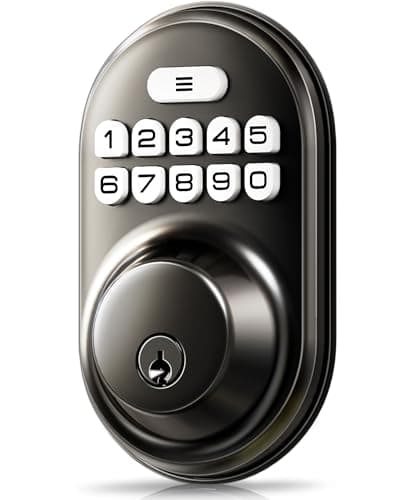
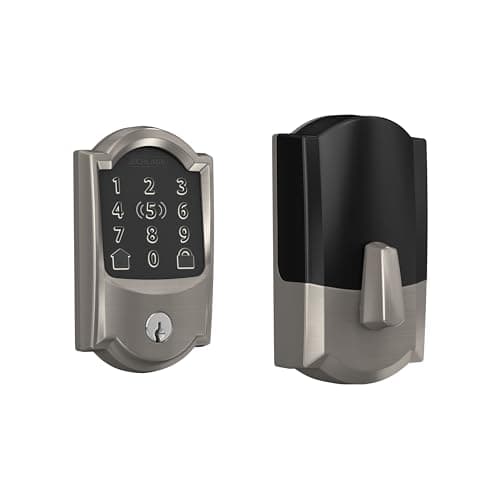
The lock most people should put on a garage entry door is the SwitchBot Lock Ultra Touch Combo (with Hub Mini)— because it is the only pick here that drives your existing deadbolt without drilling the door, and this is the one door in the house where drilling can be a code problem. The Schlage Encode Plus Wi-Fi Deadbolt leads the page on build quality if your slab is a plain solid-core door with no fire label on it.
What is different about a garage entry door
Four things, and the lock catalog knows about none of them.
It is regulated. Under the International Residential Code, section R302.5.1, the door between an attached garage and the dwelling must be a solid wood door, a solid or honeycomb-core steel door at least 1-3/8 in thick, or a 20-minute fire-rated door. It must also be self-latching and fitted with a self-closing or automatic-closing device. No other interior door in a house carries that requirement.
It is often unconditioned. An attached garage is not heated or cooled in most of the country. The door and whatever is bolted to it live through the full outdoor temperature swing, on the garage side at least, which is harder on alkaline cells and plastic keypads than a hallway is.
The Wi-Fi is usually poor. The garage is typically the furthest room from the router, often behind a masonry wall, with a large steel door in the way. A lock that depends on a solid 2.4GHz signal to do anything useful is a bad bet in that spot.
You come through it with your hands full.This is the grocery door, the bin door, the door you use fifteen times on a Saturday. A key is more annoying here than anywhere else in the house, which is exactly why people want a smart lock on it — and it is why fingerprint and keypad matter more than app features.
The code question, and why it decides the winner
The IRC gives three ways to satisfy R302.5.1, and only one of them creates a problem.
If your door is the 1-3/8 in solid wood or solid-core steeloption — which is what most builders fitted — then it is an ordinary slab as far as hardware is concerned. Bore it, fit a deadbolt, done. Most garage entry doors already have a deadbolt in them.
If your door is a listed 20-minute fire door, it is a different object. A listed fire door assembly is certified as a whole, and modifying it beyond what the manufacturer permits — cutting it, or drilling it for hardware it was not listed with — voids that listing. That is not a smart-lock-specific rule; it applies to any hardware. Look for a label on the hinge edge of the door. If there is one, the safe hardware change is one that uses the bore that is already there.
Check the hinge edge before you buy.A listed fire door carries a label with a rating on it. If yours has one, a retrofit that fits over the existing deadbolt's interior thumbturn changes nothing about the door and is the straightforward answer. If you are not sure what you are looking at, ask your local building department — they answer this question routinely and it costs nothing.
There is a second consequence of R302.5.1 that works in your favor. Because the door has to be self-closing, it actually closes — which means auto-lock on a garage entry door behaves far better than it does on a front door that people leave standing open. The classic auto-lock failure, where the bolt throws into fresh air because the door was ajar, is much rarer here. That is a genuine argument for turning the feature on at this particular door, provided the strike is aligned.
The five picks, side by side
Compiled from manufacturer specifications and the IRC, September 2026.| Model | Drills the door? | Works with no garage Wi-Fi | Hands-full entry | Power |
|---|
| Schlage Encode Plus | Yes — full deadbolt replacement | Keypad and Home Key work locally | Touchscreen keypad, Apple Home Key | 4x AA |
|---|
| SwitchBot Lock Ultra | No — interior retrofit only | Bluetooth to the included hub | Bundled fingerprint keypad or phone | Rechargeable pack |
|---|
| eufy Smart Lock C220 | Yes — full deadbolt replacement | Fingerprint and code work locally | Fingerprint | 4x AA |
|---|
| TEEHO TE002 | Yes — full deadbolt replacement | Entirely — no radio at all | Fingerprint | 4x AA |
|---|
| Veise Keypad Deadbolt | Yes — full deadbolt replacement | Entirely — no radio at all | Keypad code | 4x AA |
|---|
No radio is a legitimate answer here
Two of these locks have no wireless connectivity at all, and on this specific door that is closer to a feature than a compromise. A garage entry door is an interior door. You are not checking it from the office; you are walking through it. What you want is for the code and the fingerprint to work every single time, in February, with cold hands, carrying two bags — and a lock with no radio has nothing to drop off a network, no firmware update to fail, and no account to be locked out of.
The trade is real and worth naming: no radio means no log, no remote unlock for a delivery, and no notification that the door was opened at 2am. If any of those matter to you, buy a connected lock and accept that you may need a mesh node in the garage to make it reliable. If none of them do, the money is better spent on the strike.
If you do want the door reported rather than just locked, the cheaper and more reliable path is a contact sensor on the frame rather than a better lock. A lock tells you the bolt moved; only a sensor tells you the door is shut, and on a self-closing door that distinction is exactly what you want confirmed. The options are in the best door and window sensors.
This is the door codes get handed out on
Worth planning for, because the garage entry door is where access sprawl actually happens in a house. The front door gets a code for the family and maybe a house sitter. The garage entry door gets one for the person who mows, the person who walks the dog, a contractor who was in for a week in 2024, and a neighbor who was watching the place that time. The garage is where people are already being let in, so it is where the codes accumulate.
Two habits stop that becoming the thing that actually undoes a good lock. First, one code per person, never a shared one — it costs nothing at setup and it is the difference between removing one person and changing the code for everybody. Second, put a recurring reminder somewhere you will see it, twice a year, to read the code list and delete anything you cannot immediately name. A live code belonging to a contractor who finished a job last spring is a far more realistic problem than anything in the radio.
This is also the argument for choosing a lock that keeps a log, if you were on the fence about connectivity. A no-radio deadbolt is excellent at opening reliably and cannot tell you that code four was used at eleven on Tuesday. If several people have codes to this door, that record is worth the connected lock and the mesh node it may need.
Batteries in an unheated garage
Alkaline cells lose usable capacity as temperature drops, which is why a lock rated for a year in a hallway can want new cells before spring on a garage door in a cold climate. Nothing here is unusual about the locks — it is chemistry, and it applies equally to the four-AA deadbolts and to any coin cell you put on that door.
Two practical consequences. First, lithium AA cells hold up considerably better in the cold than alkaline, so on a garage door they are worth the premium even where a manufacturer recommends alkaline for a heated interior. Check what your specific lock permits before switching — some explicitly ask for alkaline. Second, find the emergency power path before you need it: a 9V contact on the exterior escutcheon, a USB-C port, or a physical key, and confirm you can reach it from the garage side. The full battery arithmetic is worked through in how long smart lock batteries last.
Fit it properly, because this door moves constantly
The garage entry door gets cycled more than any other door in the house, and it has a closer pulling it shut every time. Both of those punish a misaligned strike. If the bolt has ever needed a shoulder to throw, fix the alignment before you fit a motor to it — a motorized bolt has far less leverage than your wrist did, and a lock that stalls on a tight strike reports locked while sitting half-thrown.
The step-by-step for both a full replacement and a retrofit, including the strike diagnosis, is in how to install a smart lock. And if the deadbolt you already have is smooth, the retrofit route deserves a serious look on this door for the code reason above — the trade-offs between the two designs are in retrofit against full replacement. The wider lock field is at the smart locks hub, and the scoring rubric is at how we pick.
How to choose a lock for a garage entry door
1. Look at the hinge edge
Label or no label. A listed 20-minute fire door should not be drilled for hardware it was not listed with, which points you at a retrofit that uses the existing bore. A plain 1-3/8 in solid-core slab has no such restriction and takes any deadbolt on this page.
2. Check the signal at the door
Stand at the garage entry door and look at your phone. If 2.4GHz coverage is weak there, either fix it with a mesh node or buy a lock that does not need it. Do not buy a Wi-Fi lock and hope the garage is better than it looks.
3. Decide whether you need the door reported
If you genuinely want a log and remote access, that is a connected lock plus decent coverage. If you want the door to open without a key and lock itself behind you, a lock with no radio does that more reliably and for less money.
4. Pick the reader for hands-full entry
Fingerprint is the best answer at this door and a keypad is the reliable fallback. Cold, wet or dry hands make capacitive readers less consistent, and a garage in January supplies all three — so every fingerprint lock here needs a code you have actually memorized.
What decides the price
Three things, in this order. The first is the radio: Wi-Fi built into the lock costs more than Bluetooth, and both cost more than nothing, which is why the two no-radio deadbolts here are the cheapest by a wide margin. The second is the reader — a fingerprint sensor or a capacitive touchscreen is a real bill of materials cost over a membrane keypad. The third is the door hardware itself: cycle-tested bolt mechanisms, published grades and better finishes are where the premium at the top of this page goes.
What does not scale with price is suitability for this particular door. The most expensive lock here is not the one this page recommends, because on a garage entry door the thing that matters most is whether you have to modify the slab.
The mistake buyers make
They treat it as an interior door with no rules. It is the one interior door in a house with a code section written specifically about it, and if yours is a listed fire door, drilling it is a compliance problem rather than a preference. Two minutes at the hinge edge settles it.
They defeat the closer. Propping the garage entry door open, or removing the self-closing device because it is annoying, undoes the reason the code asks for it. It also breaks the thing that makes auto-lock work well on this door. If the closer slams, adjust it; do not remove it.
They buy for the app and use the keypad. Almost everyone who fits a smart lock on a garage entry door ends up entering a code or pressing a finger to it, every time, for years. The remote features get used in the first fortnight and then rarely. Buy the reader you will actually touch, not the feature list you will read once.
This door is the last of four garage weaknesses rather than the only one, and the other three are cheaper to fix. How to secure a garage door covers the emergency release, the service door and the opener, in the order that matters.