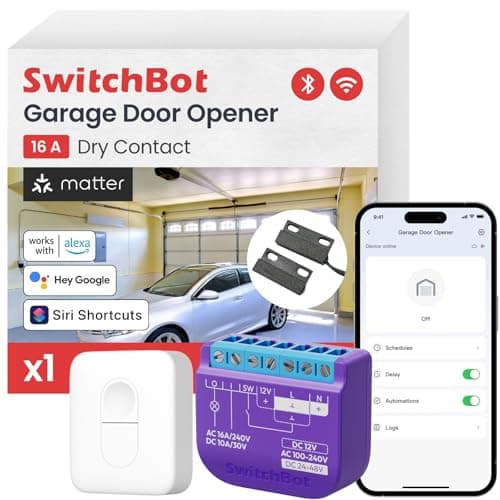
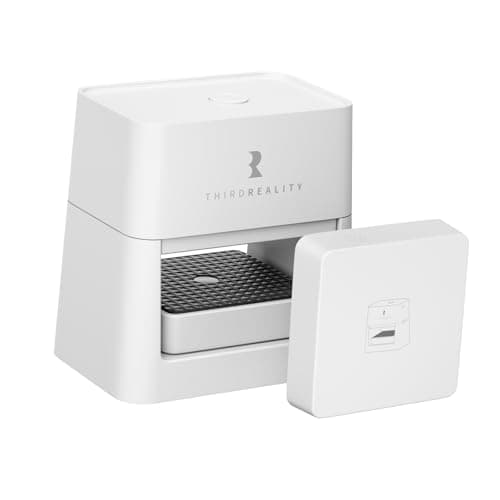
The best smart garage door opener is the THIRDREALITY Smart Garage Door Opener (Matter)— it is the only pick here that is both Matter certified and ships a real door-position sensor, so the door joins your smart home as a standard device and actually knows whether it is open. If your opener is not on its list, the SwitchBot Smart Garage Door Opener (with remote) covers more models than anything else here.
What a smart garage door opener actually is
Search results for this category mix two completely different products. One is a new garage door opener: a motor, a rail and a lifting mechanism that replaces the unit bolted to your ceiling, and costs several hundred dollars to buy and a day to install. The other — and it is what almost everyone is actually shopping for — is a small retrofit controller that leaves the existing motor exactly where it is and gives it a radio. Every product on this page is the second kind.
That distinction matters because it collapses the specification sheet. A retrofit controller does not change how fast the door moves, how quietly it runs, or how much weight it lifts. Your existing opener still does all of that. What the controller changes is a much shorter list: how it triggers the door, whether it can tell you the door's position, which apps and ecosystems can see it, and whether any of that keeps working when the internet does not. Four questions, and the marketing on the box answers roughly one of them.
So the ranking on this page is not about build quality, and it is not about which app looks nicest. It is about who the door answers to once the controller is installed — because in this category, more than in any other we cover, that has turned out to be something the manufacturer can change after you have bought the thing.
The five controllers, side by side
Compiled from manufacturer product pages and support documentation, September 2026.| Model | How it drives the door | Door-position sensor | Ecosystem | Works with the internet down |
|---|
| THIRDREALITY Smart Garage Door Opener | Existing remote / key interface | Tilt sensor included, pre-paired | Matter over Wi-Fi — Apple Home, Google, Alexa, SmartThings, Home Assistant, Homey | Yes, via a local Matter controller |
|---|
| SwitchBot Smart Garage Door Opener | Two wires to the opener terminals | Not described in the listing | Matter over Wi-Fi, plus Bluetooth, IFTTT, SmartThings | Yes, over Bluetooth at close range |
|---|
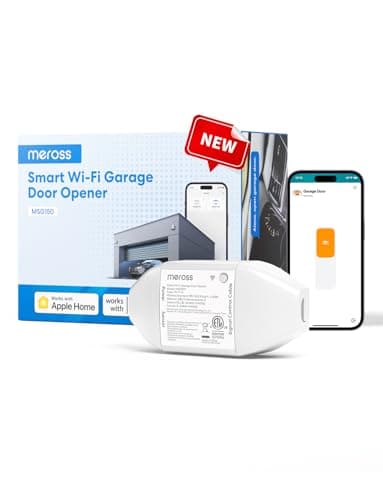
| meross MSG150HK | Wires to the opener, no separate sensor run | Built into the unit; mechanism not published | Apple HomeKit, Alexa, Google, SmartThings, CarPlay | HomeKit local control only; meross app needs the cloud |
|---|
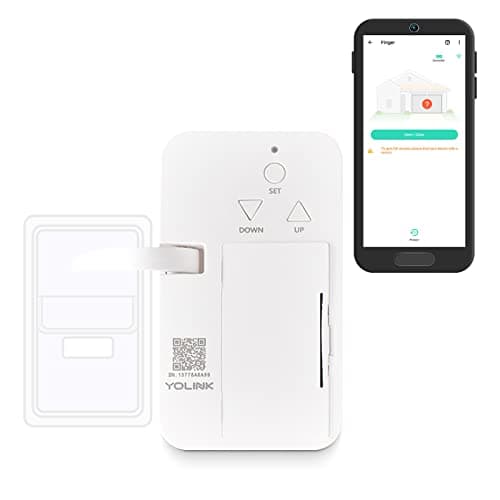
| YoLink Finger | Motorized finger presses the wall button | No — sold separately or as a kit | YoLink app, Alexa, IFTTT. LoRa to a YoLink hub | Local hub scenes only; app control needs the cloud |
|---|
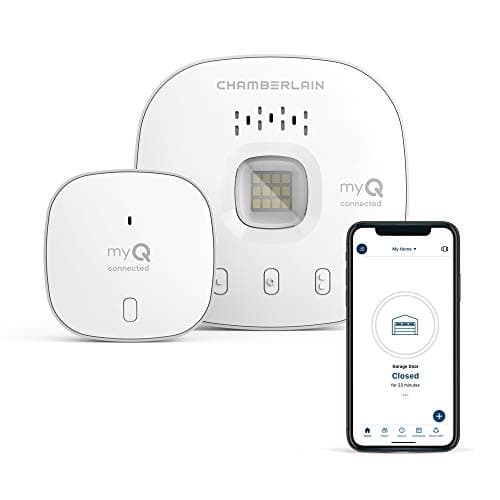
| Chamberlain myQ Smart Garage Control | Wires to the opener | Door sensor included | myQ app. No HomeKit, no Google Home, no Home Assistant | No |
|---|
Who does the door answer to?
This is the question that decides the ranking, and it is not a hypothetical. Over three years the largest company in this category systematically removed every route into its product that it did not own. Chamberlain discontinued the myQ HomeKit bridge in 2022. It dropped Google Assistant support in mid-2023. Then, in November 2023, it blocked the third-party API access that Home Assistant and Homebridge had used for years, describing that usage as unauthorized. Home Assistant removed the myQ integration from the platform entirely the following month and published a post explaining why.
None of that made the hardware worse. The myQ hub in someone's garage in October 2023 was physically identical in December. What changed was that automations people had built around it — close the garage when the front door locks, warn me if it is still open at midnight — simply stopped existing, and there was no version of the product they could have bought to prevent it. That is the specific risk this page ranks against.
Matter is the structural answer, not a feature bullet.A Matter-certified controller is not integrated with Apple Home or Home Assistant by a partnership that can lapse; it speaks a standard those platforms already implement, and the commissioning happens on your network rather than through the vendor's account system. If you have never had a reason to care about Matter before, this is the category where it pays for itself. Our plain-English explanation of Matter and Thread covers what the certification does and does not promise.
The catch is real and worth stating plainly: Matter needs a controller in the house. A HomePod, an Apple TV, a Nest hub, a recent Echo, a SmartThings hub or a Home Assistant install. Without one, a Matter device has nothing to join, and the box will not tell you that in those words. If you do not already own one, which smart home hub to buy for security works through the options before you spend anything on the garage.
The safety rule that comes before any of this
Every residential garage door opener sold in the United States since January 1, 1993 has been required to include a secondary entrapment protection system. That requirement came out of the Consumer Product Safety Improvement Act of 1990; UL published the standard, UL 325, that defines what the protection has to do, and in practice nearly every opener satisfies it with photoelectric eyes — the two small sensors mounted no more than six inches off the floor on either side of the opening. Break the beam while the door is closing and the door stops and reverses.
Do not close a garage door you cannot see. The photo eyes are a backstop for something crossing the opening during travel, not a license to close a door remotely on the assumption that nothing is under it. Every controller here can close the door from an app, and the responsible way to use that is with a camera on the opening or after a long, obvious warning. Openers made before 1993 may have no photo eyes at all, and a retrofit controller does not add them.
This is also the practical argument for an auto-close timer rather than a manual remote close: a timer with a delay and a beeper is a predictable, repeatable behavior that the people in the house learn, where a door that shuts because someone tapped a phone somewhere else is not. The meross unit builds the timer in; on Matter controllers you can build the same rule in whichever platform you use.
Wi-Fi is often the wrong radio for a garage
Four of the five controllers here run on 2.4GHz Wi-Fi, and the garage is one of the worst places in a house to ask that of a small radio. It is usually the furthest room from the router, frequently on the far side of a masonry wall, and the door itself is a large sheet of steel or aluminum that moves. Marginal coverage in a garage is the single most common reason these products get returned, and it is not a manufacturing fault — it is a site survey nobody did.
Check the signal at the ceiling by the opener with a phone before you buy, not after. If it is weak, a mesh node or an access point in the garage fixes it and is worth doing anyway. If the garage is detached, or at the end of a driveway, or a barn, Wi-Fi is usually the wrong tool entirely and the YoLink route is the honest answer: LoRa is sub-GHz, YoLink states a quarter-mile range, and it reaches a hub sitting comfortably indoors. The same reasoning drives our no-hub door sensor rankingsin reverse — there, avoiding a hub is the goal; here, a long-range hub is the thing that makes the installation possible at all.
Knowing the door is open is a separate question from opening it
It is easy to miss that these are two functions, and that some products only sell one. Triggering the door is trivial: close a contact across the opener's terminals, or press the wall button, and it moves. Knowing the door's position requires a device that watches the door — a tilt sensor on the panel, or a contact sensor at the threshold — and that part is what tells you the garage has been open since four in the afternoon.
The second function is the one most owners actually use daily, and it is unevenly supplied. THIRDREALITY and Chamberlain both put a real position sensor in the box. meross builds status detection into the unit but does not publish how it works. SwitchBot does not describe a position sensor in its listing at all. YoLink sells the Finger as a pure actuator and the garage door sensor as a separate product. If you buy a controller without a sensor, budget for one: a tilt or contact sensor is cheap, and the same hardware pattern is ranked in the best door and window sensors, where a single unit on the garage's side door often turns out to matter more than the big door itself.
That side door deserves a sentence of its own. The door between an attached garage and the house is, in most homes, a hollow-core interior door with a builder-grade knob on it, protecting the room where the tools and the ladder are. It is the cheapest meaningful upgrade in this whole discussion, and our comparison of smart locks against plain deadbolts covers what actually needs replacing there.
That door has one more wrinkle worth knowing before you shop for it: it is the only interior door in a house with a building code section written specifically about it, and if yours carries a fire label, drilling it for new hardware is a compliance question rather than a preference. Smart locks for garage entry doors works through what that means and which lock the constraint points at.
What none of these will do
A retrofit controller will not make an old opener quieter, stronger or safer. It will not add photo eyes to an opener that never had them. It will not give you a rolling-code upgrade. And on a one-piece tilt-up door, a roller door or a side-hinged pair, a tilt sensor calibrated for a sectional panel will report the wrong thing — THIRDREALITY scopes its product to sectional doors specifically, and it is worth confirming your door type before ordering anything in this category.
If the opener itself is genuinely at the end of its life, a controller is money spent on the wrong part, and a new opener with the smart radio already inside is the better purchase. That trade-off is the same one we work through for locks in retrofit against full replacement, and the logic transfers cleanly. The full sensor lineup that surrounds a garage build starts at the sensors hub, and the rubric behind every score on this page is published at how we pick.
How to choose a smart garage door opener
Four questions, in this order. Answering them honestly eliminates most of the category before you look at a single price.
1. What controller do you already run?
If the household is on Apple Home, the meross HomeKit unit and the Matter-certified THIRDREALITY both work, and the Matter route is the more durable of the two. If it is Home Assistant, SmartThings or Homey, Matter is effectively the only sane answer — and the myQ is disqualified outright, because the integration those platforms used no longer exists. If there is no controller in the house at all, a Matter device has nothing to join and you are choosing between a vendor app and buying a hub.
2. What kind of door is it?
Sectional flip-up doors — the paneled type that curves up into the ceiling — are the overwhelming majority in American garages and are what these products are designed for. One-piece tilt-up doors, roller shutters and side-hinged doors are a different geometry, and tilt sensors calibrated for a sectional panel misreport on them. Check the door before you check the opener.
3. Is there usable Wi-Fi at the opener?
Stand under the opener with a phone and look at the bars. If the answer is marginal, fix the network or buy the LoRa option; do not buy a 2.4GHz controller and hope. A detached garage is almost always a LoRa job.
4. Does a door sensor come with it?
If not, add the cost of one to the price you are comparing. Otherwise you are comparing a complete product against an incomplete one and calling the incomplete one cheaper.
What actually decides the price
The spread across this page runs from the low thirties to the high sixties, and almost none of that gap buys better hardware. Three things move the number. The first is what is in the box: a controller with a pre-paired position sensor costs more than a bare actuator, and should. The second is certification — Matter certification and Apple HomeKit qualification both cost the manufacturer money and both show up in the retail price, which is why the HomeKit variant of a meross opener sits above the plain one. The third is the radio: a LoRa product carries the cost of an entire proprietary network behind it, and the hub it needs is a separate purchase that does not appear on the product's own price tag.
What does not move the price much is app quality, and it is worth being clear that the most polished app on this page belongs to the product ranked last. Polish is not the same as ownership.
The mistake buyers make
They buy the brand that made the opener.It is an entirely reasonable instinct — the opener says Chamberlain or LiftMaster on it, so the Chamberlain controller must be the safe choice. On compatibility, that instinct is correct. On everything else it is backwards, because a first-party controller is precisely the one with the strongest commercial reason to keep your door inside its own app, and the documented history of doing so. A third-party controller has to be interoperable to sell at all.
They treat this as a one-time purchase.It is not the money that recurs, it is the dependency. Everything on this page opens the door for free today; the question is what has to keep existing for that to be true in three years — a company, a server, an API, a partnership. Matter is the only answer on this page that does not depend on a company's continued goodwill, which is exactly the reasoning we apply to cameras and locks in what the subscriptions actually cost.
They skip the sensor and then wonder why it is useless.A controller with no position sensing gives you a button on a phone, which you already had on the visor of your car. The thing people genuinely value — a notification that the door has been open for an hour, or an automation that closes it at midnight — requires the door's state, and that requires a sensor. Buy the sensor.