A doorbell camera and a security camera look like the same device in two shapes. They are not. A doorbell answers one question — who is standing at my door right now — with a tall, close, well-lit view and a two-way conversation. A security camera answers a broader and vaguer one — what happened in this space — across a wider area at greater distance. Buy the one that matches the question you actually have.
What each one is designed to see
A doorbell is mounted at roughly chest height, a step or two from its subject, and framed tall so it captures a face and the parcel on the ground beneath it. That geometry is fixed by the position, and it is why doorbells are unusually good at identification and unusually bad at coverage: a doorbell knows exactly who pressed the button and almost nothing about what happened at the side gate.
A security camera is mounted high, aimed down a path or across a yard, and framed wide. It sees the approach, the driveway, the movement across the garden — everything the doorbell misses — but its subject is farther away and smaller in frame, so identification is harder and depends far more on lens choice and light. The two devices are complements, not competitors, and a house with one of each covers far more than a house with two of either.
Typical characteristics of each device class, compiled from manufacturer specifications, August 2026. Individual models vary. | Doorbell camera | Security camera |
|---|
| Question it answers | Who is at the door | What happened in this space |
|---|
| Framing | Tall and close, head to toe | Wide and distant |
|---|
| Position | Fixed at the door | Anywhere you can power and mount it |
|---|
| Two-way talk | Central to the product | Present, rarely used |
|---|
| Power | Transformer wiring or battery | Mains, PoE, battery or solar |
|---|
| Typical failure | Sees nothing away from the door | Records a person too small to identify |
|---|
Buy the doorbell first if your problem is deliveries
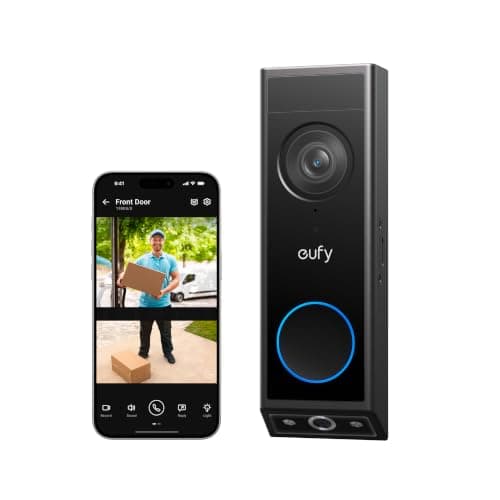
The most common reason people shop for a camera at all is parcels: knowing one arrived, seeing where it was left, and being able to speak to a courier who is about to leave it somewhere useless. A doorbell does all three better than any camera, because it is at the exact spot where the event happens and it has a speaker aimed at the person causing it. The eufy Video Doorbell E340 is the pick here for the reason most relevant to this site: it keeps its footage locally with no plan and pairs a doorstep-facing second camera with the main lens, so the parcel on the floor is in frame as well as the person. The full field is in our doorbell roundup.
A doorbell also solves the install problem in a way cameras often do not. If there is existing doorbell wiring, power is already at the position; if not, battery doorbells with plug-in chimes handle it. Compare that with a camera, which needs a power decision and a mounting decision at every position you want covered.
Buy the camera first if your problem is a space
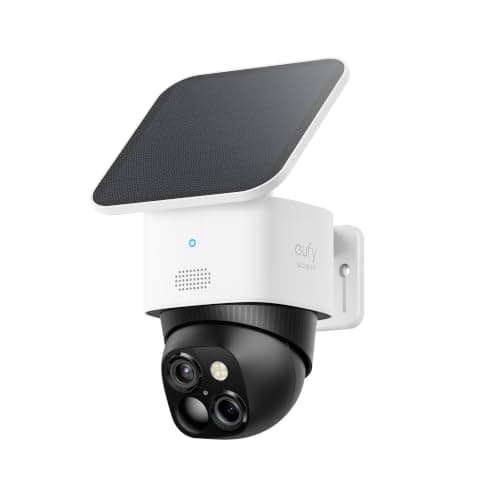
A driveway, a side return, a back garden, a garage, a shed: none of these has a door people knock on, and a doorbell cannot help with any of them. If what worries you is the part of the property nobody approaches from the front, a camera is the only device that covers it. The eufy SoloCam S340 is here as a representative: solar powered so it needs no cabling, panning 360 degrees so one unit can watch more than one approach, and storing locally with no plan. The wider field is in our outdoor cameras roundup.
Cameras also give you something a doorbell structurally cannot: choice of position. You can put a camera where the light is, where the approach narrows, or where a face is unavoidable — the reasoning in our placement guide. A doorbell is stuck at the door, at door height, looking at door-height things.
The decision rule. Buy a doorbellfirst if your problems are deliveries, visitors and knowing who came to the front of the house — that is most people, most of the time. Buy a camera first if the thing you want covered is a space rather than an entrance: a driveway, a garden, a side path, an outbuilding. If you can buy both, buy the doorbell first anyway, because it will be the one you actually use every week.
They fail in different ways, too
The two device classes generate different kinds of useless footage, and knowing which annoyance you are signing up for is part of the choice.
A doorbell's characteristic failure is over-alerting. It sits at head height beside a path people use for reasons that have nothing to do with you — a shared drive, a sidewalk, a neighbor's gate — and its motion detection is aimed straight down that path. Untuned, it will tell you about every passer-by until you stop reading the notifications, which is the worst outcome of all. The fix is detection zones and person-only detection, and every doorbell worth buying has both.
A camera's characteristic failure is under-identifying. It is mounted high and far, so the person in frame is small, and it is looking at a scene whose lighting it does not control. You get a recording of somebody, which is not the same as a recording of who. The fix is not resolution but geometry: put a camera at a choke point where anyone must pass close and roughly face-on, and accept that the wide overview camera is for context rather than identification.
Notice that the two fixes pull in opposite directions. A doorbell needs its attention narrowed; a camera needs its subject brought closer. That is the clearest practical sign they are not the same device in two shapes.
Power and install: another real difference
A doorbell has a fixed position and therefore a fixed power question. If the house has existing doorbell wiring, there is a low-voltage supply already at the spot, and a wired doorbell will never need charging — the arrangement covered in our wired doorbell roundup. If there is no wiring, a battery doorbell with a plug-in chime handles it, at the cost of recharging on a cadence set by how busy your doorstep is.
A camera has a free position and therefore a harder power question, which is the trade-off examined in how to choose a security camera. Mains and PoE cameras can record continuously but need a cable to wherever you want them; battery and solar cameras go anywhere but record events only. That freedom is exactly why a camera can cover the side return a doorbell will never see, and exactly why it takes more planning to install.
The overlap, and where it misleads
Some devices blur the line. Doorbells with unusually wide lenses market themselves as covering the porch as well as the visitor; cameras mounted beside a door market themselves as doorbell replacements. Treat both claims carefully. A wide doorbell still cannot see around the corner of the house, and a camera beside the door still has no button and no chime, which matters more than it sounds — a visitor who cannot announce themselves is a visitor you will miss.
The one genuine overlap is a camera pointed at the front door in a house that already has a working doorbell people press. That is a reasonable setup, and it is cheaper than a video doorbell in some cases. What it gives up is the two-way conversation at the moment of delivery, which is the single feature most people say they bought a doorbell for. Whether that trade is worth it is worked through in our guide on whether a video doorbell is worth it.