HUB 06 · Guides
Do Security Cameras Work Without Wi-Fi? Yes, If They Store Footage Locally
Wired PoE cameras with a local recorder and cameras with an onboard microSD card keep recording through an internet outage. What stops is remote viewing, not recording.
We earn a commission if you buy through our links. It does not change the price you pay, and it does not decide our picks — our selection criteria are published in full. How this works.
Do security cameras work without Wi-Fi?
Yes — the ones that store footage locally do. A wired PoE camera feeding a local recorder, or any camera writing to an onboard microSD card, keeps recording through an internet outage without missing a frame. What you lose offline is remote viewing on your phone and cloud alerts, not the recording itself. Cameras that record only to the cloud record nothing.
Separate two things that get muddled.“Working” means two different jobs: recording (capturing footage to storage) and remote access (watching it live from somewhere else). Local-storage cameras keep doing the first with the internet down. Only the second needs a working connection out to the world.
What actually stops when the internet drops
Picture a camera on your home network with the broadband line cut. Inside the house, the local network is usually still alive — your router keeps switching packets between devices even with no path to the internet. So a camera and a recorder on that network can still talk to each other, and a phone on the same Wi-Fi can often still pull up a local camera. What breaks is the round trip out to a vendor's servers and back: push notifications, cloud-based person detection, off-site backup, and viewing from a phone on cellular data somewhere else. A camera built to lean on those services stops being useful the instant the line drops. A camera built to record locally does not notice.
This is the same recording-location decision covered in depth in our local-storage versus cloud comparison; here the question is narrower and more practical: with no internet, does the footage still get written down? For local cameras the answer is yes, and that is the whole point of buying one.
PoE cameras and an NVR: the setup that never blinks
The most robust offline setup is a set of Power-over-Ethernet cameras wired back to a network video recorder. One Ethernet cable per camera carries both power and data, so there is no Wi-Fi in the path at all and nothing to charge. The cameras write continuous footage to a drive in the recorder, which sits in your house. A complete kit like the Reolink PoE NVR system ships as four 4K cameras, an eight-channel recorder and a 2TB drive; with the broadband unplugged it records twenty-four hours a day exactly as it does online, because the internet was never part of the recording loop. Individual PoE cameras such as the Reolink RLC-811A do the same, recording to a card in the camera or to a shared NVR.
The cost of that reliability is the cabling. A PoE system means running Cat6 to each camera position and feeding it from a PoE switch or the recorder's built-in ports, which for most homes is the actual project. What you buy for the effort is a system with no monthly fee, no cloud dependency and no battery, whose weak points are physical — power to the recorder and the cables themselves — rather than a broadband line you do not control.
RTSP and ONVIF: why wired cameras are portable
The reason serious local setups gravitate to PoE is that most of these cameras publish an open RTSP stream and speak the ONVIF standard. In plain terms, that means the camera will hand its video to recording software that is not the manufacturer's app — a third-party NVR, or a self-hosted system like Frigate or Blue Iris on a machine in your house. The footage lives entirely on hardware you own, and if the manufacturer ever shuts down a service or changes its terms, the camera keeps working because nothing it does depends on that service. A camera with no open stream is only ever as available as its maker's cloud.
Power is the real offline weak point, not the internet
If a local system has a vulnerability, it is not the broadband line — it is mains power. The internet going down does not stop a PoE system recording, but the electricity going down does, because the recorder and the PoE switch both run on it. That is worth designing around: a small uninterruptible power supply sized for the recorder and switch keeps a PoE system writing footage through the kind of brief outage that also, not coincidentally, sometimes takes the broadband with it. It is the single cheapest upgrade to an already-local setup, and it closes the one gap that “works without Wi-Fi” does not by itself cover.
Local microSD: offline recording without wiring the house
If pulling cable is not happening, a wireless camera with a microSD card is the middle path. The camera still connects to Wi-Fi for setup and for sending you alerts, but the recording is written to a card in the camera itself, so an internet outage does not stop it capturing events. Battery-and-solar cameras like the eufyCam 3 kit record to an included local base, and mains cameras like the Wyze Cam v4 record to a card slotted into the camera. Both keep writing footage with the broadband down.
One practical detail decides how much offline history you actually keep: card capacity and how the camera handles a full card. Local recording loops — once the card fills, the oldest footage is overwritten — so a bigger card buys more retention, and an event-only camera stretches a card much further than a continuous one because it is not writing when nothing moves. Check the largest card size a camera supports before buying, because that number, not a cloud plan, is your retention limit once the internet is gone.
Two honest limits apply. First, most battery cameras record eventsrather than a continuous stream — they wake on motion, capture the clip and sleep — so “works offline” means it still catches events, not that it films twenty-four hours the way a wired camera does. Second, local storage that lives in the camera is stolen with the camera; a recorder in a cupboard or a base station indoors is the safer home for the footage. The subscription-free, local-first options are ranked in our best local-storage cameras roundup, which is the right place to start if avoiding a cloud dependency is the goal.
The cameras that record nothing offline
Cloud-only cameras are the opposite design, and it is worth naming plainly. Some popular doorbells and cameras — Ring's lineup is the clearest example — keep no local copy by default: the recorded clips live in the vendor's cloud, and on most of that hardware the recording itself is gated behind a subscription. With the internet down, such a camera can often still show a live view to a phone on the same local Wi-Fi, but it is not writing an event history you can retrieve later, because the history was only ever going to the cloud. If continuity through an outage matters, that is the model to avoid; the deeper cost comparison is in our PoE versus Wi-Fi guide. And if a camera has to record continuously through anything, only a wired camera does that — no battery camera records around the clock, offline or on.
Telling the two designs apart before you buy is simple: read the storage line on the spec sheet, not the resolution line. Words like microSD, local storage, NVR or base stationmean the camera keeps its own copy and will record offline; a listing that mentions only cloud video, or that quotes a monthly plan as the way to save recordings, is telling you the footage lives somewhere you do not control. Some cameras do both — recording locally and optionally mirroring a copy to a cloud — and those are the most resilient of all, because the local copy survives the outage while the off-site copy survives a stolen camera.
How to choose for offline reliability
Match the storage design to how much you care about the internet being down, and to whether you can run cable.
If you want it to never depend on the internet
Buy PoE and a local recorder. This is the only setup that records continuously with the broadband unplugged, keeps every frame on a drive you own, and has no monthly fee. Accept the cabling as the price of that independence. A complete NVR kit is the least decision-heavy version; individual PoE cameras like the RLC-811A suit a house that will grow the system over time. Everything about this design's reliability comes from the wire, which is also its one hard requirement.
If you cannot run cable
Buy a wireless camera with a local card or base and treat cloud features as a bonus, not the foundation. The recording survives an outage; the alerts may not. A solar camera with onboard storage or a small kit with a local base gives you offline-safe event recording without drilling through walls, at the cost of not filming continuously. Confirm the model records to local storage as its default rather than only to a plan.
The mistake buyers make
They assume “security camera” means “records no matter what” and discover after an incident that a cloud-only camera captured nothing during the outage, or that the useful clips were behind a lapsed subscription. Read the storage line on the box before the resolution line. A camera that keeps footage locally is doing the job you think you bought; a camera that only records to the cloud is renting you access to your own driveway. Start from the local-storage roundup or the PoE cameras roundup, and check how the picks are graded in our methodology, or work through the rest of our guides for the storage and network questions that follow.
If this question is the whole reason you are shopping — no broadband at the property, or a decision that the cameras will not go on the network — the shortlist of cameras that record and play back with nothing online is ranked in the best security cameras without Wi-Fi. If the problem is power rather than signal, the four ways to get electricity to an outdoor camera are ranked in how to power an outdoor security camera.
The hardware
The hardware this guide is about
The products this guide refers to, with prices pulled live from Amazon and dated on every card. Full rankings live in the roundups linked above.
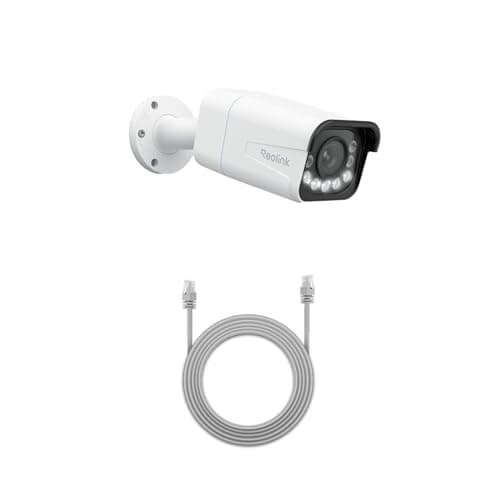
Best wired camera
Reolink RLC-811A (4K PoE, 5x zoom)
One cable for power and data, 4K with a real 5x optical zoom, and continuous recording to a card or an NVR. This is the camera for someone who wants a serious install rather than a convenient one.
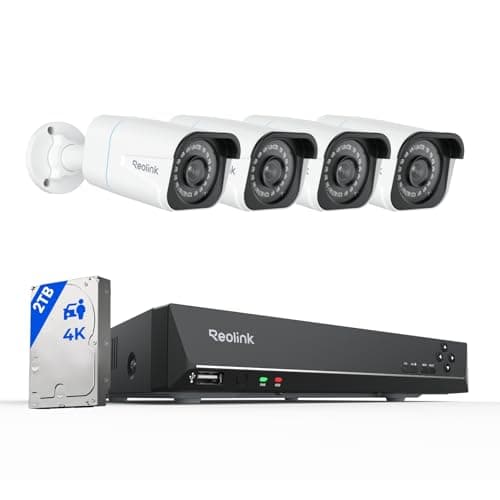
Best complete local system
Reolink 8CH 4K PoE System with NVR + 2TB
Four 4K PoE cameras, an eight-channel recorder and a 2TB drive in one box. Continuous recording, nothing in anybody's cloud, and no monthly anything — the endgame of subscription-free.
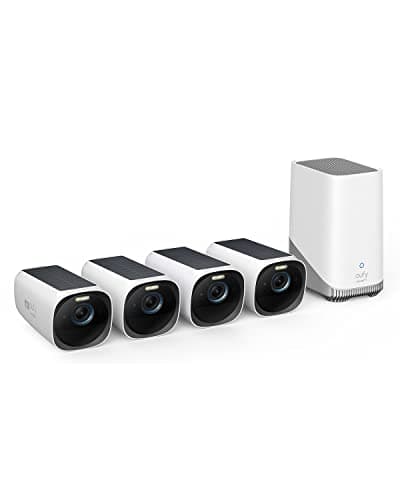
Best subscription-free camera system
eufyCam 3 (S330) 4-camera kit
Four 4K solar cameras and a HomeBase with expandable local storage. This is a whole-property system that never sends you a bill, which is close to unique at this capability level. It is also the previous generation: eufy's flagship is now the eufyCam S3 Pro, and the S330 is what you buy when you want four cameras rather than the newest two.
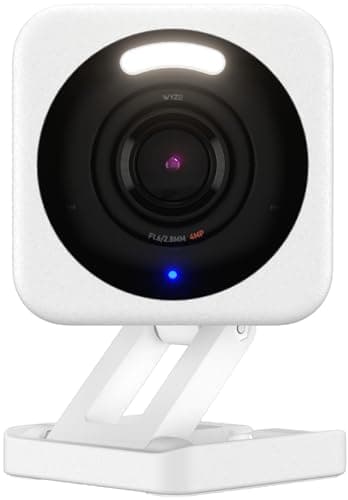
Best cheap camera
Wyze Cam v4 (2.5K)
The cheapest competent camera sold. 2.5K, indoor or outdoor, records to a card without a plan — with a brand history you should read before you put nine of them in your house.
#ad · As an Amazon Associate we earn from qualifying purchases.
Questions
Frequently asked
Will a security camera record if the internet goes down?
Do I need Wi-Fi for a PoE security camera?
Can I view my cameras without an internet connection?
Which cameras keep recording without a subscription and without Wi-Fi?
Does a camera with a microSD card still work if my Wi-Fi drops?
Keep reading
Related
- Best PoE security camerasWired cameras that record continuously with no internet in the loop.
- Best local-storage security camerasCameras that keep footage on hardware you own, no plan.
- Local storage vs cloud camerasThe recording-location decision in full.
- PoE vs Wi-Fi camerasThe cabling-versus-convenience trade, with running costs.
Receipts
Sources
- Reolink — PoE camera, NVR and RTSP documentation
- eufy — local-storage camera and base station specifications
- Wyze — Cam v4 local microSD recording documentation
- ONVIF — open standard for IP camera interoperability
- Ring — support documentation on cloud recording and video plans
- Amcrest — PoE camera and NVR reference documentation
We do not run a testing lab and we do not pretend to. Specifications come from the manufacturer's own published documents and from published standards; prices come from the live Amazon API. Where a figure is not published, the page says “not published” rather than guessing. Read the full method.