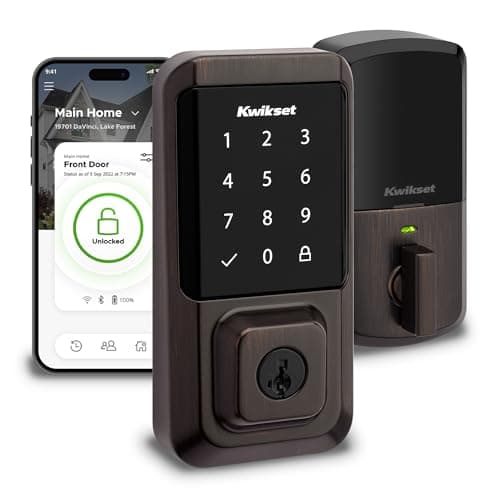
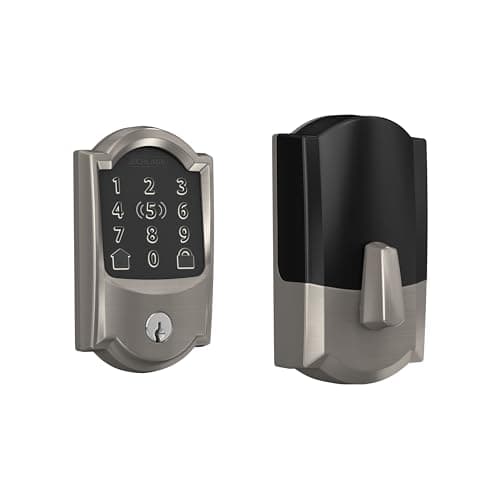
These two have more in common than most head-to-heads. Both are full touchscreen deadbolts, both put the Wi-Fi radio inside the lock so there is no separate bridge to power and lose, and both run on four AA cells with no subscription for any function. What separates them is what each brand chose to lead with: Schlage leads on published build strength and Apple Home Key, Kwikset on a lower price and a cylinder you can re-key yourself in under a minute. Decide which of those you actually value and the lock chooses itself.
Schlage Encode Plus vs Kwikset Halo: the short answer
Buy the Schlage Encode Plus if you want the strongest published hardware pedigree in residential locks — its deadbolt line is the reference point most people mean by BHMA Grade 1 — and you live in the Apple ecosystem, so Home Key's phone-or-watch tap is a feature you will use. Buy the Kwikset Halo if you want built-in Wi-Fi at a lower price and you value SmartKey, which lets you re-key the physical cylinder yourself without a locksmith when a set of keys goes missing. Both are ranked on our best smart deadbolts roundup, at different points for different priorities.
The decision rule in one line: if you carry an iPhone and want the strongest published build reputation, Schlage. If you want a touchscreen Wi-Fi deadbolt for less and the ability to re-key the cylinder yourself, Kwikset.
Head to head: the specs that actually decide it
Both share the shape — touchscreen keypad, built-in Wi-Fi, four AA cells, a real keyway, no plan — so the columns below are the places they genuinely diverge: the build credential each brand publishes, the Apple credential, and the party trick on the cylinder.
Compiled from manufacturer specifications, August 2026.| Model | Connectivity | Apple Home Key | Published BHMA build credential | Cylinder | Power |
|---|
| Schlage Encode Plus | Built-in Wi-Fi + Bluetooth, no bridge | Yes | Grade 1 published on its deadbolt line — the category reference | Standard keyed cylinder | 4x AA |
|---|
| Kwikset Halo | Built-in Wi-Fi, no bridge | No | BHMA grade published on the Halo line | SmartKey — re-key it yourself in under a minute | 4x AA |
|---|
What the Schlage Encode Plus is genuinely better at
Published pedigree.Schlage's deadbolt line is the reference point most people cite for a residential Grade 1 lock, and the part that matters is that Schlage actually publishes the certification. When the bolt strength and cycle life are printed and traceable, you can weigh them; when they are not, you are trusting a photo of a metal box. Kwikset also publishes a grade for the Halo line, which puts it ahead of the many brands that publish nothing — but Schlage's is the stronger, better-established credential, and it is why the Encode line sits where it does on our smart deadbolt roundup. Whether that strength is decisive for you is part of the wider question of whether smart locks are safe.
Apple Home Key.This is the feature Kwikset does not answer. With Home Key, an iPhone or Apple Watch held near the lock opens it, the credential lives in the Wallet rather than a manufacturer app, and it still works from a phone that has entered low-power reserve — the case where a dead-battery phone would otherwise leave you typing a code. In an Apple household the tap becomes the way everyone opens the door and the keypad becomes the backup. The rest of the Home Key field is on our Apple Home Key lock roundup.
Built-in Wi-Fi with nothing extra to lose.The Encode Plus talks to your network directly — no bridge to find an outlet for and troubleshoot when remote access silently stops. Kwikset matches this; both are bridge-free, which is a genuine shared strength worth crediting rather than a Schlage exclusive.
What the Kwikset Halo is genuinely better at
SmartKey re-keying.This is the Halo's standout, and it is a real one. The cylinder can be re-keyed by hand in under a minute with the tool in the box, so when a set of keys goes astray — a mover, a former tenant, a lost keyring — you reset the key that opens the door without paying a locksmith or replacing the lock. On a rental turnover or a busy household that hands out keys, that is a genuinely useful property Schlage does not offer.
Price. The Halo delivers a touchscreen deadbolt with built-in Wi-Fi and no bridge for less than the Encode Plus, largely because it does without Home Key and the top-tier Grade 1 pedigree. For an Android household, dropping Home Key costs you nothing you could have used, which makes the Halo the more rational spend for a large share of buyers.
A published grade at a lower tier price.Plenty of budget-leaning locks publish no build credential at all. Kwikset publishes a BHMA grade for the Halo line, so you are not trading the ability to verify the build away entirely to save money — you are trading down from the category's strongest published grade, not from a grade to nothing.
The one honest caveat on the Halo: the SmartKey cylinder
The same feature that makes re-keying easy has a documented trade-off, and it needs stating plainly rather than buried. SmartKey cylinders have been the subject of published bypass research, so the sensible way to read the physical key on the Halo is as a convenience — the thing you re-key when keys go missing — not as the layer doing your security work. That does not make the Halo a bad lock; a determined attacker at a residential door is a different threat model from the everyday one these locks are bought for. But if pick and bypass resistance on the cylinder is a real requirement for you, read that research first and weigh it against the convenience of self-re-keying. The broader version of this argument — where the actual risks in a smart lock sit — is in are smart locks safe, and it is a fairer framing than either brand's marketing gives you.
What they share, and the trait that bites both
Both put Wi-Fi inside a battery-powered lock, and a built-in radio holding a network connection is the heaviest draw a smart lock takes on — heavier than a Bluetooth or Thread design. So neither of these will match the battery life of a Bluetooth-only lock, and both will want fresh AAs more often than a bridge-based Bluetooth model. It is a fair price for the convenience of no separate bridge, but it is a price. The mechanism, and how to plan for it, is in how long smart lock batteries last. Both also keep a real mechanical keyway as the phone-free fallback, so a flat battery or a dead phone never strands you on either.
Where each one costs you
On running cost the two are identical: four AA cells each, no subscription for codes, app control, or notifications on either. Neither brand gates a core lock function behind a plan, so the recurring number is batteries and nothing else. Up front they part. The Encode Plus sits at the premium end of the category, and a real slice of that premium is Home Key plus the Grade 1 pedigree; the Halo lands lower precisely because it leaves both of those out. Read them as what they are — a premium pedigree lock with an Apple credential against a lower-priced Wi-Fi deadbolt with a self-re-keyable cylinder — and the gap stops being a quality gap and becomes a features-you-will-use gap.
The decision rule
There is no winner here because the two locks lead on different things. Pick the sentences that describe you.
Buy the Schlage Encode Plus if…
- You want the strongest published build reputation in residential locks, with the BHMA grade printed rather than implied.
- Your household runs on iPhones and Apple Watches, so Home Key's Wallet tap — working even on a phone in low-power reserve — is a feature you will use daily.
- You want a standard keyed cylinder rather than a re-keyable one, and you treat the key as a backup, not the security layer.
- You will pay a premium for pedigree plus Home Key.
Buy the Kwikset Halo if…
- You want a touchscreen Wi-Fi deadbolt with no bridge for less than the Encode Plus asks.
- You value SmartKey — re-keying the cylinder yourself in under a minute when keys go missing, without a locksmith.
- You are on Android, so Home Key is a feature you would pay for and never touch.
- You treat the physical key as convenience, not your security layer, having read the published research on SmartKey cylinders.
What decides the price
On the Schlage side the premium is pedigree plus Home Key. Strip Home Key out and you are close to the standard Encode; the difference is precisely the Apple credential, which is why an Android household is overpaying by definition. On the Kwikset side the lower sticker buys you the same bridge-free Wi-Fi and touchscreen while dropping Home Key and the top-tier Grade 1 credential, and adds SmartKey in their place. Compare them as the total of build credential plus the features you will actually use, not the box price — for an Apple household that leans on tap-to-open the Schlage earns its premium, and for an Android buyer who re-keys often the Halo wins on the same logic.
The mistake buyers make
The frequent error is treating these as the same lock at two prices and buying on the sticker alone. They are not the same lock. Buying the Encode Plus without an iPhone means paying for Home Key and getting nothing back; buying the Halo and then leaning on the SmartKey cylinder as your security layer ignores the documented bypass research and misreads what that feature is for. Decide the two questions that actually separate them — are you in the Apple ecosystem, and do you value self-re-keying — and the lock follows. If you are still unsure a full deadbolt swap is right at all, the retrofit alternatives are one hub click away.
How we compared these
Products we claim to have tested: zero. Everything above is compiled from manufacturer specifications and published standards documentation — including the BHMA grading each brand publishes and the public research on SmartKey cylinders — which is the only method we use and the only one we claim. You can read the pedigree pick in depth in the Schlage Encode Plus review, step back up to the smart locks hub, or see the rest of the head-to-heads at comparisons. Our rubric and sources are published in full on the methodology page.