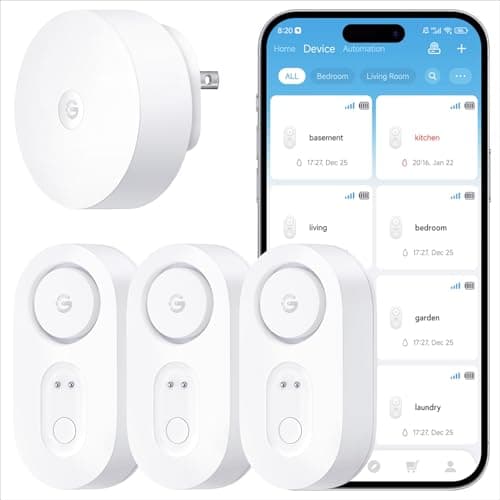
The GoveeLife Smart Water Leak Detector 1s is the pick, for one reason: Govee publishes SMS and email alerting alongside app push. A leak at 2am is precisely the notification a silenced phone swallows. But detection is not mitigation, and if nobody is home to act, only an automatic shutoff valve changes the outcome.
Detection is not mitigation
This is the argument of the whole page and the rest of the category will not make it.
A leak sensor is a notification device. It sits on the floor, it detects water bridging two contacts, and it tells you. That is genuinely valuable when you are home and asleep, because a burst supply line under a sink is a problem that scales with minutes. It is worth considerably less when you are away for a week, because the alert arrives, you read it four hundred miles from the stopcock, and the water keeps running for six days.
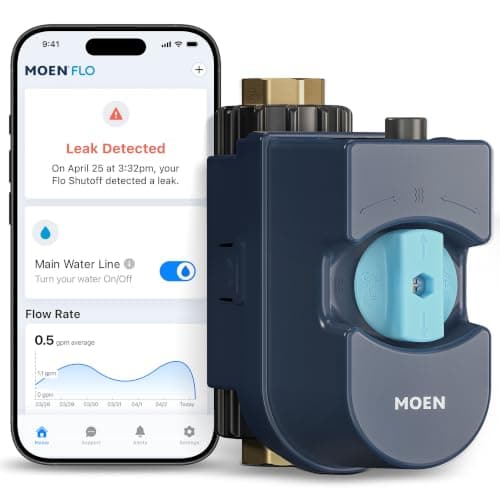
A shutoff valve is a mitigation device. It sits on the incoming main, it monitors flow, and it closes when the pattern says something is wrong. It costs several times what a sensor costs, usually needs a plumber, and it is the only product here that changes what happens rather than what you know.
The honest recommendation is both. Sensors at the failure points, a valve on the main. If the budget only stretches to one and the house is regularly occupied, buy sensors. If the house is empty for weeks at a time, or the main runs through a finished basement, the valve is the purchase that pays.
Which alerting paths does each one actually support?
This is the table that decides the purchase and nobody tabulates it. App push is universal and nearly useless on its own, because it is the notification type people mute. SMS and email escalate past a silenced phone. An onboard alarm wakes the house. Automatic shutoff is the only column that stops water.
Alerting paths compiled from manufacturer specifications and support documentation, July 2026. Where a manufacturer does not publish a capability we say so rather than guess.| Device | App push | SMS | Email | Onboard alarm | Automatic shutoff | Works offline? |
|---|
| GoveeLife Water Leak Detector 1s | Yes | Yes | Yes | Yes | No | Alarm yes; remote alerts need Govee's cloud |
|---|
| YoLink Water Leak Starter Kit | Yes | Yes | Yes | Varies by version; the silent variant has none | No valve in this kit | Yes, device-to-device triggers fire without the internet |
|---|
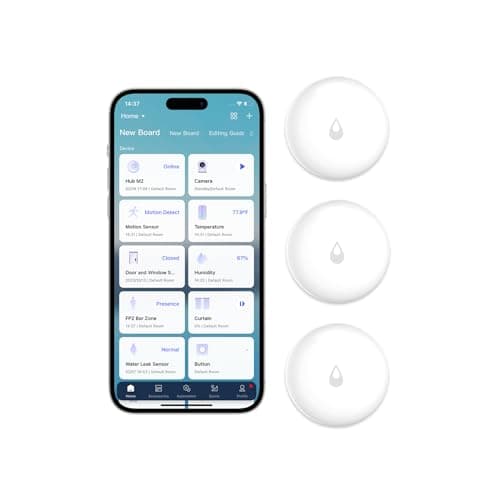
| Aqara Water Leak Sensor (3-pack) | Yes | No | No | No, the response runs on hub-connected devices | No | Yes, local Zigbee automations through the Aqara hub |
|---|
| SwitchBot Water Leak Detector | Yes | No | No | Yes, 100 dB adjustable | No | Alarm yes; remote alerts need SwitchBot's service |
|---|
| Eve Water Guard | Yes, through Apple Home | No | No | Yes, 100 dB | No | Yes, local HomeKit with an Apple home hub |
|---|
| Moen Flo Smart Water Shutoff | Yes | Not published | Not published | Not published | Yes, this is the point of it | Valve closure is local; alerting is not |
|---|
Why SMS is the column that matters
Consider the actual scenario. It is the middle of the night, or you are at work, and a supply line fails. App push notifications are the category of alert that people have trained themselves to ignore and that Do Not Disturb suppresses by default. SMS routes differently on most phones, and email persists so it is still there in the morning.
Govee publishes all three paths on this line and does not charge for them. YoLink publishes all three too. Aqara and SwitchBot are app push only out of the box, which is not a disqualification if the alarm is within earshot but is a real gap for a crawlspace sensor in an occupied-but-asleep house.
The picks, and who each one is for
Govee, first, for alerting breadth
SMS, email, app push and a loud onboard alarm, with a long published hub-to-sensor range that covers a basement or crawlspace from inside the house. It needs the Govee hub, so a single sensor is not a complete purchase, and the escalation depends on Govee's cloud service continuing to run. Both of those are stated plainly on the product card and neither changes the ranking, because no other sensor here matches the alerting coverage.
YoLink, second, for whole-house coverage
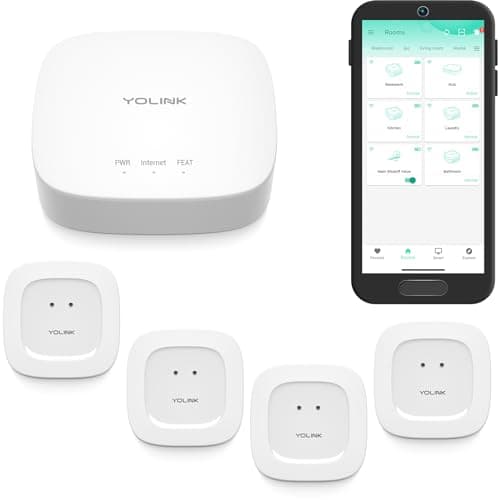
Four sensors and the hub in one box, on a long-range LoRa radio, with device-to-device triggers that fire even with the internet down. Four sensors is the right number because the failure points are the water heater, the washer, the dishwasher and the sink under the worst plumbing in the house, and covering one of those four is not a system. If you want a Home Assistant-native setup, note that YoLink's integration routes through their cloud.
Aqara, third, for a local-only house
Zigbee to an Aqara hub means the response, whatever you wire it to, runs on your own network with no cloud round trip. If you already have Aqara sensors on doors, this slots into the same estate and the same automations rather than adding a second app. Its gap is the alerting one: there is no SMS or email path unless you build the escalation yourself. The local-execution argument is the same one that decides the door sensor category, and it is set out in full in our Matter and Thread explainer.
SwitchBot, fourth, on price and volume
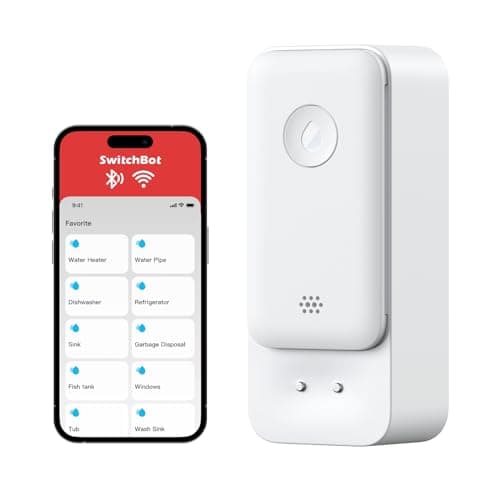
The cheapest working detector here, IP67-rated so it survives being submerged rather than merely splashed, with a 100 dB adjustable alarm. If the sensor sits within earshot of someone, an audible alarm is a better alert than any notification. Its remote path is ordinary and its expected service life is the shortest in the group.
Eve, fifth, when a spot sensor is the wrong shape
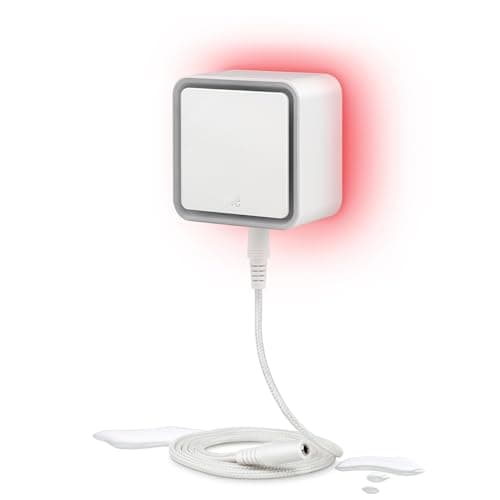
A puck detects water at a point. A 6.5-foot sensing cable detects it anywhere along a run, which is the correct geometry behind a washing machine or along the back wall of a utility room where the water will appear somewhere along a pipe rather than at a spot you guessed. It is the most expensive per detection point and it is built around Apple HomeKit, so on Android the proposition weakens considerably.
Moen Flo, last on the list and first on the argument
It ranks last because it is the most expensive item on this site, involves cutting into your incoming main, and is not something a renter can install. It is on the list because it is the only device here that stops water. Continuous flow monitoring also catches the slow leak that never reaches a floor sensor, which is the failure mode that quietly ruins a subfloor over eighteen months. Some insurers reduce premiums for automatic shutoff devices; ask yours before you buy, because that changes the arithmetic.
Where to put them
Sensor placement is not decorative. Water runs downhill and pools at the lowest point, so place the sensor on the floor at the low side of the appliance, not beside it at the same level, and not on a lip or a pedestal. The standard set, in priority order:
- Under or beside the water heater, which is the single most common catastrophic failure
- Behind the washing machine, at the supply hose connections
- Under the dishwasher, or as close to its base as the kickboard allows
- Under every sink with a shutoff valve or a waste trap
- Beside the sump pump, if you have one, because the pump failing is the event
- At the lowest point of a finished basement
That is six locations, which is why kits sold in fours are closer to right than singles. IP67 matters here: a device that will sit in a puddle should be rated for immersion, and the IP code is published by the IEC rather than invented by marketing departments.
How we picked
Compiled from manufacturer specifications, support documentation and published standards, with the alerting matrix built entirely from what each vendor documents. Where a capability is not published we say “not published” rather than assume it. The rubric is public, and if you are assembling a wider subscription-free setup, the sensors hub and the no-subscription section cover the rest.
Leak sensors are also the point at which most people commit to an ecosystem, because the hub you buy for them is the hub that will run your doors, your cameras and eventually your door lock. That makes it worth choosing deliberately rather than by whichever leak kit was cheapest: our Ring versus eufy comparison covers how two of the biggest ecosystems treat your device data and what each one charges for, and the smart lock hub covers the purchase that usually follows.
How to choose a water leak sensor
Start with how often the house is empty
This is the variable that decides everything. A house occupied most nights is well served by cheap sensors with loud alarms, because someone is there to turn off a valve. A house empty for a week at a time gets almost nothing from an alert nobody can act on, and the money is better spent on an automatic shutoff. A vacation property, or any property where the main is not accessible to the occupant, is the clearest case for a valve there is.
Then count the failure points, not the rooms
Water damage originates at connections: supply hoses, valves, traps, tank fittings and pump housings. Count those, not bathrooms. Most houses have five or six worth covering, which is why a four-sensor kit plus a couple of singles is usually the right buy, and why a single sensor bought to test the idea covers one sixth of the risk.
Check the escalation path before the specifications
Ask one question of any leak sensor: what happens if my phone is face down on Do Not Disturb? If the only answer is an app notification, the device has a real gap. Either the alarm has to be loud enough and close enough to wake somebody, or the alert has to escalate to SMS or email. Products that do neither are selling detection that arrives too late to be mitigation.
What decides the price
Four things. The radio, where long-range LoRa costs more than short-range Wi-Fi or Zigbee. The sensing geometry, where a cable costs more than a puck because it covers a line rather than a point. Ingress protection, where a genuine IP67 body costs more than a splash-proof one. And whether the device actuates anything, which is the step change: a valve on the main is a different class of product with plumbing labor attached.
The mistake buyers make
Buying one sensor and putting it under the kitchen sink. The kitchen sink is where you would notice a leak anyway, because you stand there. The water heater in the garage and the washer in the utility room are where a failure runs for hours unobserved, and those are the two placements that justify the purchase.
The second mistake is assuming a subscription is required for the alerting. It is not, for any device on this page. Moen offers optional monitoring and the valve's automatic shutoff does not depend on it. Where plans genuinely apply in home security, and what they add up to over several years, is laid out in our subscription cost breakdown. And if you are covering a whole property, the same hub that runs your leak sensors usually runs your door and window sensors too, which changes the cost per device considerably.