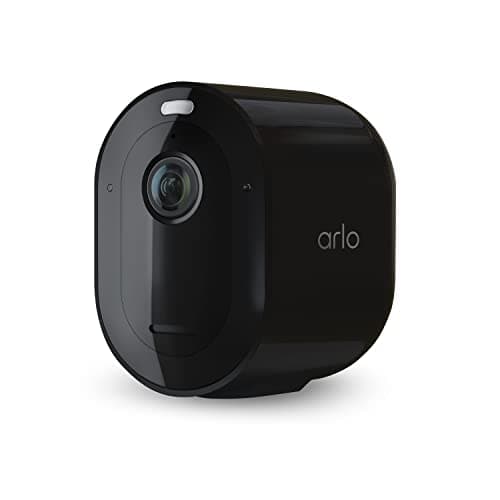
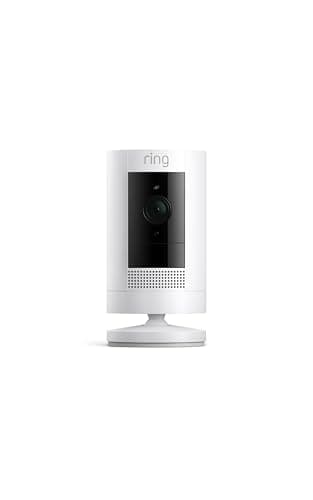
The Ring Stick Up Cam and the Arlo Pro 5S share the trait this site exists to flag: both lean on a cloud subscription for recorded video. Say it plainly up front — without a plan, neither one keeps a clip you can play back later. So this is not a local-versus-cloud comparison; it is a comparison of two cloud cameras, and the choice comes down to which ecosystem you live in and how much you care about the image. If avoiding a subscription is your actual goal, you are on the wrong page, and the last section says where to go instead.
With the plan taken as a given for both, the honest split is narrow and specific. Ring is the most polished app and the deepest Amazon and Alexa integration in the category, on HD hardware. Arlo is the sharper imager — 2K HDR, a real spotlight, 12x zoom, dual-band Wi-Fi — with a longer hardware feature list, also plan-gated. Pick the ecosystem first, the sensor second.
Ring Stick Up Cam vs Arlo Pro 5S, compared
The columns below are the ones that separate two cameras that agree on the thing that matters most — that recorded video needs a plan. Note the storage row: one of these has no local option at all, and the other only through a separate base station.
Compiled from manufacturer specifications, August 2026.| Model | Resolution | Where recordings live | Plan needed for recorded video? | Power options | Ecosystem strength |
|---|
| Ring Stick Up Cam | HD | Cloud only — no local storage option | Yes — Ring Home | Battery, plug-in or solar | Amazon and Alexa; best-in-class app |
|---|
| Arlo Pro 5S | 2K HDR | Cloud by default; local needs a separate Arlo base station | Yes — Arlo Secure | Rechargeable battery (solar accessory available) | Broad works-with list; strong app |
|---|
The decision rule. Buy the Ring Stick Up Camif you live in Alexa and want the most polished app and the most reliable notifications in the category, and you accept a Ring Home plan as a permanent line item — without it this camera records nothing you can play back. Buy the Arlo Pro 5S if you want a sharper 2K HDR image and a longer hardware feature list, and you are equally willing to keep an Arlo Secure plan. And if you are here hoping to avoid a subscription altogether, buy neither: this is the wrong pair for you, and eufy vs Arlo points you at the camera that records with no plan.
Both need a plan for recorded video — stated plainly
This is the line to internalize before comparing anything else. The Ring Stick Up Cam has no local storage option at all: without a Ring Home plan it gives you a live view and a notification and saves nothing to review afterward. The Arlo Pro 5S is nearly as blunt — recorded clips and the smarter detection require an active Arlo Secure plan, and while Arlo sells a base station that adds local storage, it is a separate purchase and not the default. So the practical reality is the same for both: buy the camera, keep paying, or the camera stops doing the one thing most people bought it for. That is not a knock on the hardware; it is the business model, and it should be bought with eyes open. The general case against assuming cloud-first is set out in local storage versus cloud security cameras.
Because the plan is a given for both, do not let it be a tiebreaker in either direction — compare the plan costshonestly instead. Arlo's pricing has moved upward more than once and is, by published history, among the more volatile in the category; Ring's plan is per-household now, which softens the blow for multi-camera homes but is still a bill that never stops. The maintained figures behind both live at subscription costs compared, which is the right place to weigh them because those numbers change.
Ecosystem is the real chooser
With image and plan roughly canceling out for a lot of buyers, ecosystem is what actually decides this. Ring's advantage is genuine and hard to overstate: its app, its notification reliability and its Alexa integration are the best in the category, and its accessory and mount ecosystem is enormous, so it slots into an Amazon household with almost no friction. If your home already runs on Alexa and Echo Shows, Ring is the path of least resistance and the live view will pop up on your smart displays without fuss. Arlo's integrations are broad too — check its current works-with page for exact platform support, since that list changes — but its center of gravity is its own app rather than any one voice assistant. If you are not committed to Alexa, that neutrality can be a point in Arlo's favor.
Resolution and power
On the sensor the Arlo is clearly ahead: 2K HDR against the Ring's HD, plus a real spotlight, color night vision, up to 12x zoom, and dual-band Wi-Fi that avoids the 2.4GHz congestion cheaper cameras suffer. If image quality is the deciding number and you are paying for a plan regardless, the Arlo is the better camera to attach that plan to. On power the two are close but Ring is the more flexible: the Stick Up Cam comes in battery, plug-in and solar variants of the same body, so you can wire it where there is power and run it on a cell where there is not. The Arlo Pro 5S is a rechargeable-battery camera with a solar accessory available. Neither records continuously — both are event-clip cameras in their battery forms — so if a 24/7 timeline is the requirement, neither is the tool.
If you do not want a plan, buy neither
We will be honest rather than sell you one of these anyway. If your firm rule is never to pay a subscription, both of these are the wrong buy: the Ring keeps nothing without a plan, and the Arlo is nearly as dependent. The camera you actually want records locally and asks for no fee — that is eufy's and Reolink's whole reason for being on this site. See the head-to-head that frames it at eufy vs Arlo, and the filtered field at best security cameras without a subscription. Ring and Arlo are excellent at what they are; they are simply not what a no-plan buyer is looking for.
How we compiled this
Products we claim to have tested: zero. We have not mounted either camera; we read each manufacturer's published specification, support documentation and plan terms — especially the lines about what a subscription gates — work out the running cost, and cite it. Both cameras sit on their own hubs; this page exists to put two cloud cameras side by side and to be straight about who should skip both. The rest of the head-to-heads are on the comparisons hub, and the scoring rubric is at methodology.
How to choose between them
Confirm you are actually a plan buyer
Before anything else, be honest about the subscription. Both of these cameras are built around a plan, and if that is a dealbreaker you should close this page and read the no-subscription camera field instead. If a monthly plan is genuinely fine with you — and for a lot of Alexa households it is — then the comparison is real and worth making carefully.
Pick the ecosystem, then the sensor
If your home runs on Alexa, Ring is the lower-friction choice and its app advantage is real. If you are ecosystem-neutral, or you weight image quality highest, the Arlo's 2K HDR and longer feature list make it the better camera to hang your plan on. The order matters: the ecosystem fit tends to affect daily satisfaction more than a resolution step does, so decide that first and let the sensor break the tie.
The mistake buyers make
Assuming either camera keeps footage without the plan. It does not — the Ring keeps nothing recorded, and the Arlo is nearly the same out of the box. People buy on the hardware review, skip the plan line, and are surprised when there is no clip to review after an event. Buy either of these knowing the plan is part of the product, compare the plan costs rather than pretending they are optional, and you will not be caught out. If that whole shape bothers you, it is the clearest possible sign you want a local-storage camera instead.