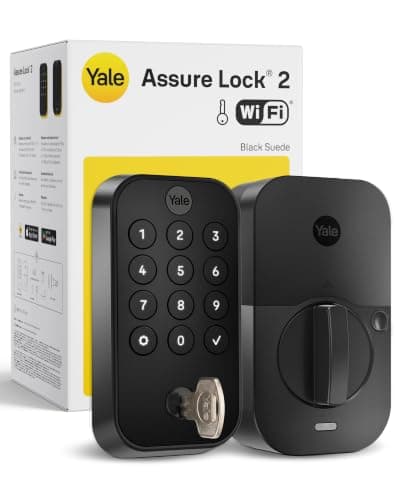
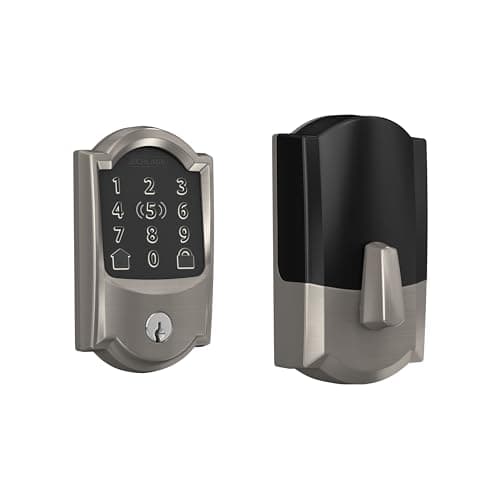
These two are not separated by whether they work. Both are full deadbolt replacements, both run codes and a physical key when the internet is down, and both carry the kind of build most budget locks only imitate. They are separated by one design decision: Schlage soldered its radio in and paired it with Apple Home Key, betting that the best connectivity available today is the connectivity you want for the life of the lock. Yale put its radio on a removable card, betting that a deadbolt outlives any one wireless standard and you should be able to swap the standard without swapping the door hardware. Almost everything below falls out of that single choice.
Schlage Encode Plus vs Yale Assure Lock 2: the short answer
Buy the Schlage Encode Plus if you live in the Apple ecosystem and you want the lock with the strongest published hardware reputation working at its best on day one — built-in Wi-Fi with no bridge, and a phone-or-watch tap to open. Buy the Yale Assure Lock 2 if you care less about Home Key and more about not being locked to whatever radio shipped in the box: Yale's module bay lets a Z-Wave or Matter card replace the Wi-Fi one later, which is how you keep a fifteen-year deadbolt from aging out of your smart home in three. Neither is the “better lock.” They answer different questions about the next ten years.
The decision rule in one line:if your phone is an iPhone and you want the best of what exists now, Schlage. If your priority is an upgrade path that outlasts the current standard, Yale. The build quality argument is real but secondary — both are good enough that it rarely decides the purchase on its own.
Head to head: the specs that actually decide it
The columns below are the ones that separate these two. You will not find a keyway row, because both ship with a real mechanical cylinder, and you will not find a price, because the shelf number moves and the live layer handles it. What you will find is the connectivity model, the Home Key line, and the one credential most of this category refuses to publish.
Compiled from manufacturer specifications, August 2026.| Model | Connectivity radio | Radio swappable? | Apple Home Key | Manufacturer-published BHMA grade | Power |
|---|
| Schlage Encode Plus | Built-in Wi-Fi + Bluetooth, no bridge | No — the radio is fixed | Yes | Grade 1 published on its deadbolt line | 4x AA |
|---|
| Yale Assure Lock 2 (Wi-Fi, keyed) | Bluetooth + a Wi-Fi module in a swap bay | Yes — Z-Wave or Matter modules available | No | Not published per SKU the same way | 4x AA |
|---|
What Schlage is genuinely better at
Published pedigree.Schlage's deadbolt line is the reference point most people mean when they say a residential lock is “Grade 1,” and the important part is that Schlage actually publishes the certification. Most smart-lock brands do not, which means most Grade claims in this category are marketing rather than a testable spec. When the bolt strength and cycle life are printed and traceable, you can weigh them; when they are not, you are trusting a photo of a metal box. That transparency is the whole reason our smart deadbolt roundup ranks Schlage where it does.
Apple Home Key.This is the feature Yale cannot answer at this price. With Home Key, an iPhone or Apple Watch held near the lock opens it, the credential lives in the Wallet rather than in a manufacturer app, and it still works from a phone that has entered low-power reserve — the case where a dead-battery phone would otherwise leave you typing a code. If most of the household is on iPhones, that tap becomes the way everyone actually opens the door, and the keypad turns into the backup.
Built-in Wi-Fi with nothing to lose. The Encode Plus talks to your network directly. There is no separate bridge to find an outlet for, keep powered, and troubleshoot when remote access silently stops. One fewer box on the shelf is one fewer point of failure, and it is the reason the Encode line reads as the low-friction option for someone who just wants remote lock and codes without assembling a system. If you are still deciding whether you need the radio on at all, our guide on whether a smart lock needs Wi-Fi lays out what actually stops working offline.
What Yale is genuinely better at
The swappable radio.This is the entire case for the Assure Lock 2, and it is a strong one. Yale ships the same lock body across keyed and key-free, touchscreen and push-button, with the network radio living on a card in a bay behind the interior escutcheon. You buy the Wi-Fi version today; if your home moves to a Z-Wave hub, or to a Matter fabric later, you pull one card and push in another. The mechanical deadbolt — the expensive, long-lived part — never changes. On a lock you expect to keep for a decade or more, that is a genuine hedge against the standards churn that has already stranded a generation of smart-home gear.
Future-proofing a fifteen-year deadbolt.The uncomfortable truth of this category is that the lock is durable and the radio is disposable. Wireless standards shift on a shorter clock than door hardware wears out, so a fixed-radio lock quietly ties the life of the whole unit to the life of one chip. Yale's module system decouples them. If you are the kind of buyer who wants to be on Matter eventually but is not ready to rebuild the house around it, the reasons are worth reading in our plain-English explainer on Matter for home security, which covers what the standard does and does not fix.
The keyed cylinder that stays useful.This SKU keeps a real keyway, which matters more than it sounds. If you ever hand a key to a contractor, a dog walker, or a family member who will not install an app, the physical cylinder is the fallback that needs no onboarding. Schlage keeps a keyway too, so this is parity rather than a Yale win — but it is a reminder that both of these are proper deadbolts first and gadgets second, which is not true of every lock on our main smart lock roundup.
The one axis this really turns on: fixed radio vs swappable module
Strip away the marketing and the choice is almost philosophical. Schlage's position is that the best available connectivity, integrated cleanly and paired with the Apple credential system, is worth committing to — and that a radio you cannot change is a fair trade for a radio you never have to think about. Yale's position is that no connectivity is “best” for long, and that the right move is to make the radio the cheap, replaceable part. Both are defensible. What they are not is the same bet.
The tell is your own time horizon. If you replace door hardware casually and would happily buy a new lock in five years to get the latest standard, the fixed radio costs you nothing and Home Key is pure upside. If the idea of throwing away a perfectly good deadbolt because its chip fell out of fashion bothers you, the module bay is worth the loss of Home Key. There is no version of this where one answer is correct for everyone, which is exactly why the pages that declare a “winner” here are not being straight with you. Our full reasoning on how to weigh these trade-offs is in how to choose a smart lock.
Where each one costs you
On running cost the two are near-identical: four AA cells each, no subscription for codes, app control, or notifications on either. Neither brand gates core lock functions behind a plan, so the recurring number is batteries and nothing else. If battery life is the axis you are anxious about, the mechanism — and why a Wi-Fi lock drains faster than a Bluetooth one — is covered in how long smart lock batteries last.
The up-front picture is where they part. The Encode Plus sits at the premium end of this category, and a real share of that premium is Home Key: outside the Apple ecosystem you are paying for a credential you can never use. The Assure Lock 2 lands lower, but the module you might swap in later is a separate purchase, so the “future-proof” path has a cost that shows up down the road rather than on the shelf. Read both as system prices, not sticker prices, and the gap narrows.
The decision rule
There is no winner here because the two locks answer different questions. Find the sentences below that describe you.
Buy the Schlage Encode Plus if…
- Your household runs on iPhones and Apple Watches, and a tap-to-open credential in the Wallet is the feature you actually want — it works even on a phone in low-power reserve.
- You want the strongest published build reputation in residential locks, with the BHMA grade printed rather than implied.
- You would rather have built-in Wi-Fi and no separate bridge to power and lose than a connectivity option you might change later.
- You are comfortable buying a new lock in a few years if standards move, so a fixed radio is not a downside for you.
Buy the Yale Assure Lock 2 if…
- You want a protocol-upgrade path — the module bay lets a Z-Wave or Matter card replace the Wi-Fi one without replacing the deadbolt.
- You are not in the Apple ecosystem, so Home Key is a feature you would pay for and never touch.
- You expect to keep this deadbolt for a decade or more and want the radio, not the whole lock, to be the disposable part.
- You value a lock family sold in matching keyed and key-free trims so the rest of the house can match.
What decides the price
On the Schlage side the premium is pedigree plus Home Key. Strip Home Key out and you are close to the standard Encode; the difference is precisely the Apple credential, which is why an Android household is overpaying by definition. On the Yale side the sticker is lower, but the “buy the connectivity you want” pitch only pays off if you actually buy a second module later — and that card is an additional cost. Compare them as the total of hardware plus the radio you will really run, not the box price.
The mistake buyers make
The common error is treating these as interchangeable premium deadbolts and choosing on looks. They are not interchangeable. Buying the Encode Plus without an iPhone means paying for Home Key and getting nothing back; buying the Assure Lock 2 for “future-proofing” and then never swapping the module means you paid for a bay you never opened and skipped Home Key for no reason. Decide the connectivity question first, and the lock chooses itself. If you are still unsure the lock will even fit your door, settle that before anything else with will a smart lock fit my door.
How we compared these
Everything above is compiled from manufacturer specifications and published standards documentation, which is the only method we use and the only one we claim. You can read a detailed take on each unit in the Schlage Encode Plus review and the Yale Assure Lock 2 review, or step back up to the smart locks hub. Our rubric and sources are published in full on the methodology page, and the rest of this hub is indexed at comparisons.